Saint Methodius of Constantinople
Born about 790 - June 14, 846 or 847
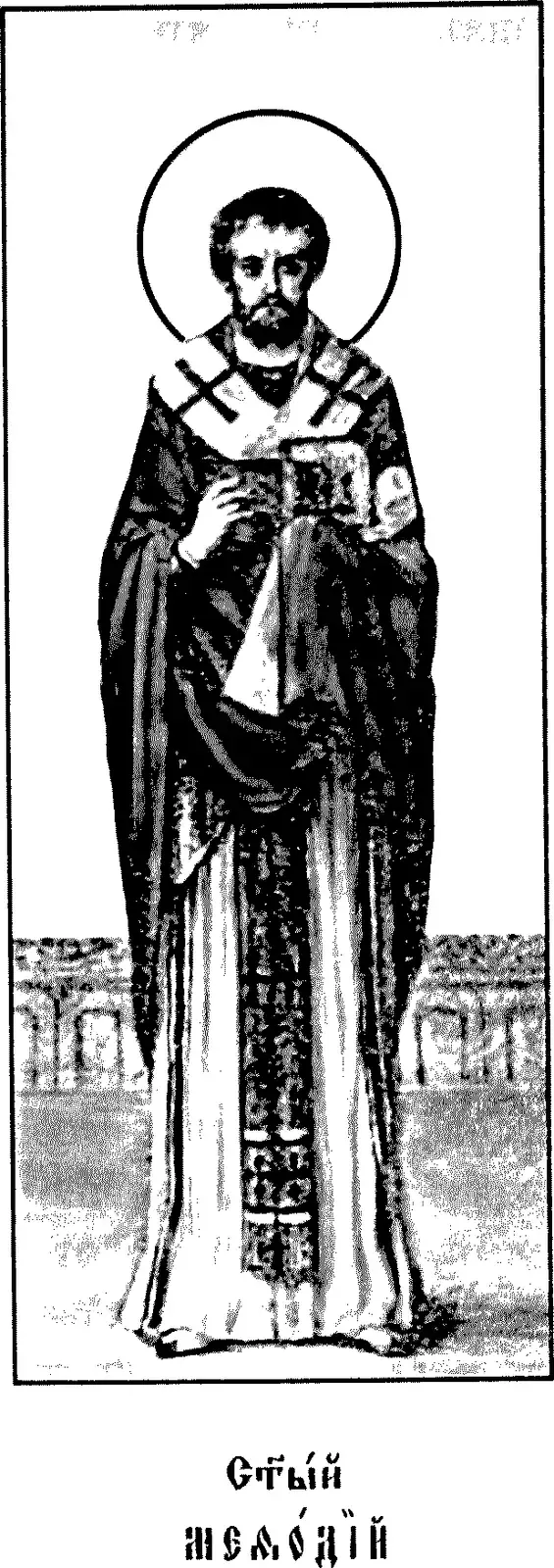
- Imprisoned
- Seven years under the Emperor Michael II; in a disused tomb on the island of Antigoni, says the Catholic Encyclopedia 12
- Patriarch
- Of Constantinople, 842-846 according to the Catholic Encyclopedia, 843-847 according to katolsk.no 12
Saint Methodius of Constantinople was a Sicilian monk who defended the veneration of icons through the last Iconoclast persecution of the Byzantine Empire, and spent seven years of it shut in an island prison. 12 When the Empress Theodora ended the persecution after her husband's death in 842, she made him patriarch, and under him the icons were carried back into the churches in the procession still kept as the Feast of Orthodoxy. 123 He died on June 14, the day of his feast. 15
From Syracuse to the monastery
He was born at Syracuse toward the end of the eighth century, the son of a rich family, says the 1910 Catholic Encyclopedia; the Norwegian bishops' saints database (katolsk.no) puts his birth at about 790 and adds that he was well educated in his home city. 12 Butler calls him "a Sicilian of high birth, and very learned." 3
He went to Constantinople as a young man hoping for a place at court. 12 A monk talked him out of it, and he entered a monastery instead; katolsk.no names it as Kenolakkos, in the city. 12 Butler and katolsk.no both say he later built a monastery of his own on the island of Chios, meaning to stay there, and that the Patriarch Nicephorus called him back to Constantinople to be at his side. 23
The second persecution
Under the Emperor Leo V the Armenian, the campaign against the veneration of images broke out a second time. 12 The monks were almost all on the side of the icons, Fortescue writes, and Methodius stood with his order and made himself conspicuous in opposing the government. 1 In 815 Nicephorus was deposed and banished for refusing the Iconoclast laws. 12
Methodius went to Rome. 123 The accounts disagree on why and when. 123 Fortescue dates the journey to 815 and says he was apparently sent by the deposed patriarch to report to the pope. 1 Butler says Nicephorus sent him in 817 as his apocrisiarius, his envoy at Rome. 3 katolsk.no says he was forced to flee, and went apparently with the task of reporting to Pope Paschal I. 2 The current Roman Martyrology remembers it in a phrase: as a monk, he went to Pope Paschal I in Rome to defend the veneration of sacred images. 5
Seven years in prison
Leo V was murdered in 820 and succeeded by Michael II. 12 Hoping for better from the new emperor, Fortescue says, Methodius returned to Constantinople carrying a letter in which the pope urged Michael to change course and restore Nicephorus. 1 katolsk.no dates the return to 821. 2 Butler says only that he came back on hearing of the death of Nicephorus. 3
The letter did not help him. 12 Fortescue says that as soon as he had delivered it and urged the emperor to act on it, he was scourged with seventy stripes, taken to the island of Antigoni in the Sea of Marmara and shut in a disused tomb, a building of some size, where he lived for seven years. 1 katolsk.no tells it differently: the emperor condemned him as a stirrer of rebellion, and he was kept seven years in a dungeon on the island of Saint Andrew with thieves, one of whom died and was left to rot in the cell with the others. 2
How he got out is told three ways. 123 Fortescue says Michael II eased the persecution and proclaimed an amnesty in 828, and that Methodius came back to the city almost worn out by his privations, though "his spirit was unbroken." 1 katolsk.no says he was set free in 829, after Theophilus had succeeded Michael, looking like a living skeleton, bald and deathly pale. 2 Butler has him released in 830 by Theodora, the new emperor's wife. 3
Under Theophilus
Theophilus brought what Fortescue calls "the last and fiercest persecution" of those who venerated images. 1 Methodius stood up to him to his face, and was scourged again and imprisoned under the palace. 12 Fortescue says he escaped that same night with the help of friends in the city, who hid him and bound up his wounds, and whose property the government confiscated for it. 1
katolsk.no records his answer when the emperor reproached him: if an image is worthless, why did Theophilus condemn the images of Christ while still allowing honor to be paid to images of himself, and having more of them made? 2 For that, it says, his jaw was broken. 2 Butler, who has him banished under Theophilus, says that because his jaw was broken in the persecution he wore a bandage under his chin to support it. 3 Fortescue ends the reign more quietly: the emperor tried argument where punishment had failed, Methodius to some extent persuaded him, and the persecution eased before the end. 1
Patriarch
Theophilus died in January 842, and his widow Theodora became regent for their small son, Michael III. 123 She had kept faith with the icons in secret, Fortescue says, and at once set the confessors free and brought the empire back to the decrees of the Second Council of Nicaea. 1 The Iconoclast patriarch, John VII, was deposed, and Methodius was put in his place. 123 Fortescue gives his years as patriarch as 842 to 846; katolsk.no gives 843 to 847. 12
A synod at Constantinople approved John's deposition and Methodius's succession; it made no new laws on images, Fortescue notes, but put the decrees of Nicaea back in force. 1 On February 19, 842, by Fortescue's date, the icons were brought back into the churches in solemn procession, and that day became the first Feast of Orthodoxy, kept on the first Sunday of Lent throughout the Byzantine Church ever since. 1 katolsk.no says the feast was first kept in 843, and that Methodius wrote the Synodikon, the declaration of the true faith read aloud on it. 2 Butler says simply that he instituted the feast. 3 On March 13, Methodius brought the relics of Nicephorus, who had died in exile, back to the city with great honor; they lay for a time in Hagia Sophia and were then buried in the Church of the Holy Apostles. 1
The peace was not a quiet one. 12 Fortescue says Methodius deposed the Iconoclast bishops throughout his patriarchate and seems to have acted severely, so that an opposition formed that nearly became a schism; he was even accused of rape, until the woman admitted that his enemies had paid her. 1 katolsk.no describes a painful quarrel with the monks of the Studion, once his firmest supporters, over his condemnation of some writings of Saint Theodore the Studite. 2 The Catholic Encyclopedia's article on Pope Leo IV adds that he suspended Gregory Asbestas, Bishop of Syracuse, for consecrating a bishop outside his own diocese. 4
His death and his writings
He died of dropsy on June 14, after about four years as patriarch, in 846 according to Butler and Fortescue and in 847 according to katolsk.no. 123 katolsk.no says he was buried in the Church of the Holy Apostles. 2 Both Butler and katolsk.no say his successor, Saint Ignatius, kept his feast every year. 23
He was reputed to have written a great deal, Fortescue says, but only a few sermons and letters survive, with an account of the martyrdom of Denis the Areopagite and two sermons on Saint Nicholas. 1 Butler lists penitential canons, sermons and an encomium of Dionysius. 3 katolsk.no calls him a diligent writer, above all of hymns, and names a life of Saint Theophanes the Chronicler among the little that is left. 2 Fortescue also reports an Orthodox legend that the prayers of Methodius and Theodora saved Theophilus from hell, told in the Synaxarion for the Feast of Orthodoxy. 1
What is Saint Methodius of Constantinople the patron saint of?
None of the sources consulted for this page names a patronage for him, and none is supplied here. 123 He is honored with three other patriarchs, Germanus, Tarasius and Nicephorus, as a defender of images; Fortescue quotes the acclamation sung for the four at the Feast of Orthodoxy, "true high priests of God and defenders and teachers of Orthodoxy." 12 katolsk.no says he is shown as a bishop with an omophorion and a book, as in the picture on this page. 2
Saint Methodius of Constantinople's feast day
Saint Methodius of Constantinople's feast day is June 14, the day he died. 12 The current Roman Martyrology, as the Italian bishops print it, commemorates him that day at Constantinople as a bishop who, while a monk, went to Pope Paschal I in Rome to defend the veneration of sacred images and, raised to the episcopate, solemnly celebrated the triumph of the true faith. 5 The 1897 English Martyrology has him on the same day: "At Constantinople, of St. Methodius, bishop." 6
The Eastern churches keep the same date. 13 Fortescue says the Byzantine Church celebrates him on June 14 together with the Prophet Elisha, and that the Syrian Catholics keep his feast on the same day; Butler says it was kept by both the Latin and the Greek churches. 13
Praying with Saint Methodius of Constantinople
Most of what is told of Methodius happened in a confined space: a monastery he chose, an island tomb or a dungeon he did not, a cell under a palace. 12 Seven years is the one figure every account agrees on. 12 The sources do not record what he prayed there, only that he came out still holding what he had gone in holding. 12
His argument with Theophilus, as katolsk.no tells it, was a plain one. 2 An emperor who was content to have his own image honored could not say that honoring an image of Christ was idolatry. 2 The question, as he put it, was about the image of Christ, and katolsk.no says he paid for putting it with his jaw. 2
Suffering did not make him gentle, as the sources tell it. 12 Fortescue thought he dealt severely with the bishops who had persecuted him, and katolsk.no records that the monks of the Studion, who had stood with him through the worst of it, turned against him. 12 The man who ended the persecution of the icons was the same man who spent his short patriarchate quarreling with old allies, and the sources keep both on the record. 12
Saint Methodius of Constantinople, pray for us.
Sources
- 1.Adrian Fortescue, "Methodius I," The Catholic Encyclopedia, vol. 9 (New York: Robert Appleton Company, 1910).
- 2."Den hellige Methodios I av Konstantinopel (Bekjenneren)," Den katolske kirke, the saints database of the Catholic Church in Norway, katolsk.no (in Norwegian).
- 3.Alban Butler, "St. Methodius, Confessor, Patriarch of Constantinople," June 14, in The Lives of the Fathers, Martyrs, and Other Principal Saints, Vol. VI (Derby: Richardson and Son, 1844), Internet Archive.
- 4.Horace K. Mann, "Pope St. Leo IV," The Catholic Encyclopedia, vol. 9 (New York: Robert Appleton Company, 1910).
- 5.Roman Martyrology, entry for June 14, "San Metodio, vescovo," Santo del giorno, Conferenza Episcopale Italiana (in Italian).
- 6.The Roman Martyrology, June 14 (Baltimore: John Murphy Company, 1897), Internet Archive.
Saints to turn to next
Others in this collection who are turned to for some of the same things.