Saint Meletius of Antioch
Born at Melitene; died at Constantinople, 381
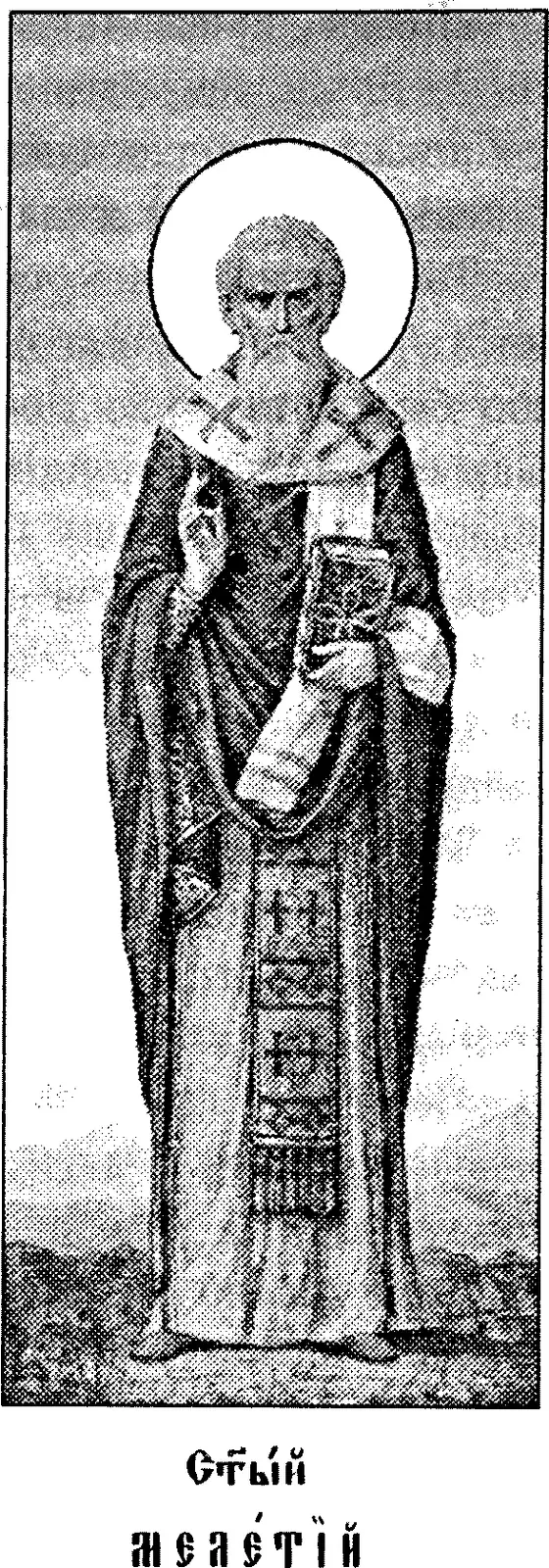
Saint Meletius was elected bishop of Antioch in 360 or 361 by a gathering in which the Arian party was strong, and both sides believed he was theirs. 12 Within a month he had preached the Nicene faith before the emperor, been banished, and left behind a sign the city never forgot: three fingers held up, two folded down. 13 He was exiled three times, outlasted the emperors who sent him away, and died in 381 at Constantinople while presiding over the Second Ecumenical Council. 125 His feast is February 12. 5
A gentle bishop for a divided city
Meletius was born at Melitene in Lesser Armenia, of one of the best families of the province, Butler says, and he chose fasting and mortification as a young man in the middle of everything that could flatter the senses. 2 Butler calls him "a nobleman of charming simplicity and sincerity, and a great lover of peace." 2
His first see was Sebaste, and it went badly. Leclercq's Catholic Encyclopedia article dates his elevation there to 358 or 359 and says his stay was short and troubled by the people's attachment to his predecessor Eustathius. 1 Butler puts it in 360 and says that, meeting "too violent opposition," Meletius left for the desert and then for Beroea in Syria. 2 Leclercq notes that the historian Socrates supposes he became bishop of Beroea; Butler says Socrates was wrong. 12
Antioch, meanwhile, had been without a settled Catholic bishop for a generation. Its great Nicene bishop Eustathius had been removed around 330, and a series of men sympathetic to Arius had held the see since. 12 When it fell vacant again, the bishops gathered there agreed on Meletius. 13 Leclercq says he had made promises to both parties, "so that orthodox and Arians thought him to be on their side." 1 Theodoret says the Arians took him for one of their own, while the defenders of the apostolic faith knew his soundness and his "stainless character." 3
Leclercq does not pretend his theology was easy to read. "He was neither a thorough Nicene nor a decided Arian," he writes, and adds that the city, tired of argument, wanted a man of peace: "He was no Athanasius, nor did unheroic Antioch wish for a man of that stamp." 1 What everyone agreed on was the man himself, "a simple life, pure morals, sincere piety and affable manners." 1
Three fingers before the emperor
Crowds came out to meet him, Jews and pagans as well as Christians, all wanting to see which way he would turn. 3 The emperor Constantius, then at Antioch, ordered the bishops to expound a verse the Arians leaned on, Proverbs 8:22, "The Lord formed me in the beginning of his way," and had stenographers take down what each man said. 23
George of Laodicea spoke first and gave the Arian reading. Acacius of Caesarea came next with a compromise. 23 Then Meletius stood up and, in Theodoret's phrase, "exhibited the unbending line of the canon of the faith." 3 Butler says he explained the text as referring not to a creation but to the new state the eternal Wisdom took on in the incarnation. 2
The people applauded and asked for a summary. He held up three fingers, folded two of them down, and said, in Theodoret's rendering, "In thought they are three but we speak as to one." 3 Leclercq says the gesture became famous and turned into a rallying sign. 1
The Arians answered by calling him a Sabellian, and the emperor sent him home to Armenia. 3 He had held the see, by Leclercq's count, less than a month; Butler says thirty days. 12 An Arian named Euzoius was put in his place, and the Catholics who would not accept him began to meet apart, in the old church outside the walls called the Palaea. 23
Three exiles
The exile did not last. Constantius died in 361, and his successor Julian let the banished bishops go home. 12 But Meletius came back to a city with a second Catholic bishop in it. The Eustathians, who had never accepted his election, had been given a bishop of their own, Paulinus, consecrated in haste by Lucifer of Cagliari. 12 Leclercq calls it "a great calamity," because it fixed the schism, and adds that it is "a peculiar injustice of history" that the division bears Meletius's name. 1
The sources disagree about the second exile. Butler says Julian banished him for opposing the pagan revival at Antioch, and that he came back under Jovian in 363. 2 Leclercq treats an exile under Julian as an arbitrary supposition and dates the second banishment to May 365, under the Arian emperor Valens. 1 They agree on the third, under Valens, which kept him away until 378. 12
Butler tells one story of the third departure. The people rose to keep their bishop and threw stones at the governor who was taking him away, and the governor escaped with his life only because Meletius stepped between him and the crowd and covered him with his own cloak. 2 Butler adds that Hermant and Fleury place the incident at the first banishment instead. 2
His influence grew while he was away. Leclercq counts 26 bishops in his communion in 363 and more than 150 by 379, from Chalcedon and Ancyra to Caesarea of Cappadocia, where Basil was his strong supporter. 1 Rome and the West, and for a time Jerome, recognized Paulinus. 12 Antioch, Leclercq says, had at one point three bishops who all professed the Nicene Creed. 1
Return, and the council
Valens died in 378, and the new emperor Gratian recalled the exiled bishops. 12 Butler gives the offer Meletius made to Paulinus: "Since our sheep have but one religion, and the same faith, let it be our business to unite them into one flock," sharing the see, and letting the survivor have the whole. 2 Butler says it was accepted after some delay. Leclercq says Paulinus refused every proposal. 12
In 379 Meletius held a council of about 150 bishops at Antioch. 1 Two years later the emperor Theodosius summoned the bishops of the East to Constantinople. In the absence of the bishop of Alexandria the presidency fell to the bishop of Antioch, and it was Meletius who enthroned Gregory of Nazianzus as bishop of the imperial city. 12 He did not see the council finish. Leclercq says he died almost suddenly, during the session that confirmed the Nicene faith, spending his last days pressing for unity and peace. 1
Gregory of Nyssa preached at his funeral in the presence of the emperor. 24 He described "one of the nobility of the East, blameless, just, genuine, devout, innocent of any evil deed," and asked where now was "that courteous right hand with fingers outstretched to accompany the benediction of the mouth." 4 He spoke of a crowd so dense it looked "like a sea of heads," of a line of lamps too long for the eye to follow, of people pulling away the cloths that bound his face to keep as amulets, and of the emperor rising from his throne in grief. 4 The body was carried to Antioch and laid beside the martyr Babylas. 12
What is Saint Meletius the patron saint of?
None of the sources consulted for this page names Saint Meletius of Antioch as the patron saint of anything, and the page does not supply a patronage. 12 What the sources record instead is a city's affection. Butler, citing John Chrysostom, whom Meletius ordained deacon, says the people of Antioch named their children after him and cut his image on their seals, their plate and the walls of their houses; Leclercq says that in every family one child bore his name. 12
Saint Meletius's feast day
Saint Meletius's feast day is February 12. The current Roman Martyrology commemorates him on that day as a bishop of Antioch repeatedly exiled for the Nicene faith, who died while presiding over the First Council of Constantinople. 5 Butler says the date stands in the Greek Menaea, that Baronius inserted it into the Roman Martyrology, and that "it is uncertain whether this be the day of his death, or of his translation to Antioch." 2 He also notes that John Damascene calls Meletius a martyr, on account of his three banishments. 2
Praying with Saint Meletius
Meletius was not a hero of the Athanasius kind, and his best historian says so. 1 He was a mild man elected by people who each thought he agreed with them, and when he was asked, in front of the emperor, what he believed, he told them. 13 It cost him his see within a month. 12
Most of his twenty years as bishop were spent away from his people, and much of the rest in a quarrel among Catholics that he did not start and could not end. 1 Saints took both sides of it, Butler says, and in good faith. 2 It is a hard thing to read: holiness on both sides of a schism, and a reconciliation that came only when one of the two bishops died. 12
What Gregory of Nyssa remembered was his hands: a right hand outstretched in blessing, a face that drew trust. 4 What Butler remembered was a governor saved from a stoning under a bishop's cloak. 2 What Antioch remembered was a name given to its children. 12
Saint Meletius of Antioch, pray for us.
Sources
- 1.H. Leclercq, "Meletius of Antioch," The Catholic Encyclopedia, Vol. 10 (New York: Robert Appleton Company, 1911).
- 2.Alban Butler, "St. Meletius, Patriarch of Antioch, C.," February 12, in The Lives of the Fathers, Martyrs, and Other Principal Saints, Vol. I (New York, 1895), Project Gutenberg eBook #20450.
- 3.Theodoret, Ecclesiastical History, Book II, chapter 27, trans. Blomfield Jackson, Nicene and Post-Nicene Fathers, Second Series, Vol. 3 (1892), New Advent.
- 4.Gregory of Nyssa, Funeral Oration on Meletius, trans. William Moore and Henry Austin Wilson, Nicene and Post-Nicene Fathers, Second Series, Vol. 5 (1893), New Advent.
- 5.Roman Martyrology, entries for February 12, Santo del giorno, Conferenza Episcopale Italiana (in Italian).
Saints to turn to next
Others in this collection who are turned to for some of the same things.