Saint Melchizedek
In the time of Abraham; dates unknown
- Feast day
- August 26 11
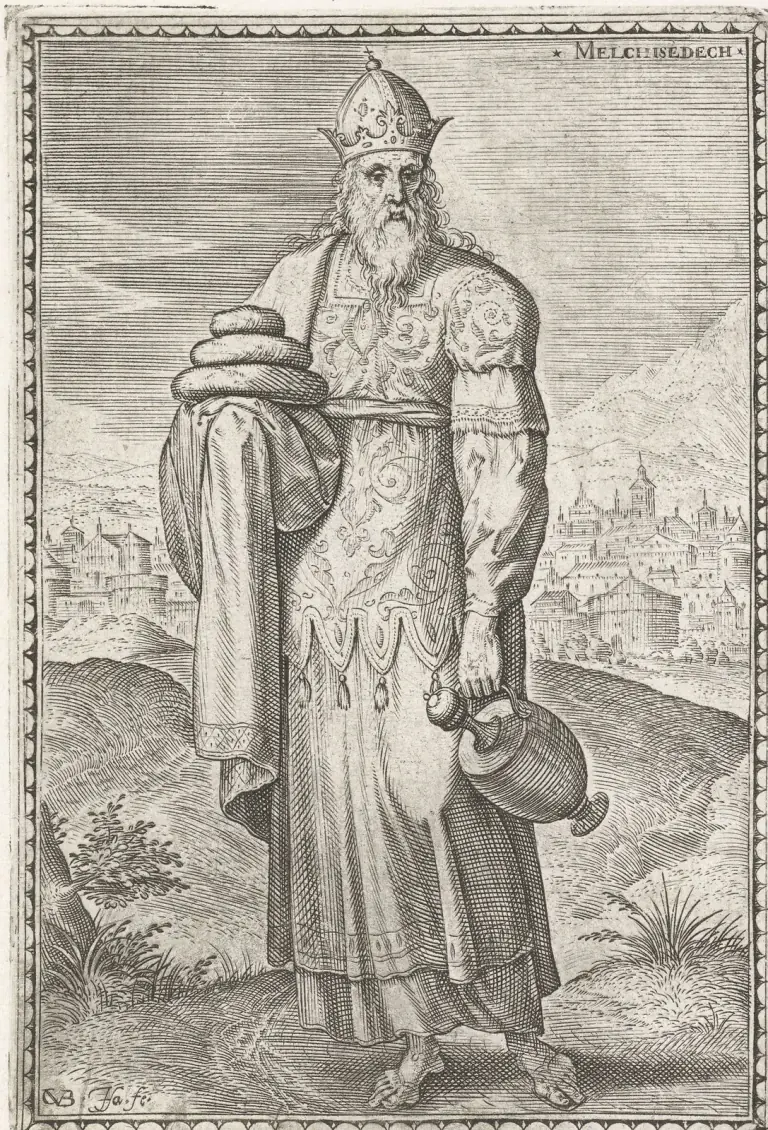
Saint Melchizedek, king of Salem and "priest of God Most High," appears in Genesis for three verses: he brings out bread and wine to Abraham, returning from battle, blesses him, and receives a tenth of everything. 2 Psalm 110 and the Letter to the Hebrews made those three verses the figure of Christ's own priesthood, "a priest forever according to the order of Melchizedek," and the Church still names him in the Mass. 135 The current Roman Martyrology commemorates him on August 26. 11
Bread and wine for Abraham
Genesis 14 tells of a war among kings in which Abraham's nephew Lot was carried off, and of Abraham's pursuit and victory. 2 As Abraham came back, the king of Sodom went out to meet him in the King's Valley. Then, without introduction, "Melchizedek, king of Salem, brought out bread and wine, and being a priest of God Most High, he blessed Abram with these words: Blessed be Abram by God Most High, the creator of heaven and earth; And blessed be God Most High, who delivered your foes into your hand." Then Abraham "gave him a tenth of everything." 2
That is all. He is not mentioned before and is not mentioned again in the story. Abraham then refuses to take so much as "a thread or a sandal strap" from the king of Sodom. 2 The Catholic Encyclopedia adds that Josephus, writing in the first century, says Melchizedek supplied Abraham's army "in a hospitable manner, and gave them provisions in abundance." 1
Who was he?
His name means "king of righteousness," and the Letter to the Hebrews reads the name of his city as "king of peace." 14 Josephus and many after him identified Salem with Jerusalem. 1 The New American Bible note on Genesis says this is the traditional identification, but that the Hebrew text is uncertain at this point, and that instead of "king of Salem" the original may have read "a king allied to him." 2
The same note says that "God Most High," el-elyon in Hebrew, is a title found in Canaanite texts, used here "by the Canaanite priest Melchizedek," and that Abraham sets it in apposition to the name of his own God. 2 The New American Bible note on Hebrews 7 observes that the author of Hebrews assumes Melchizedek was a priest of the God of Israel. 4 Even the tithe is less plain than it looks: the Hebrew says only that "he gave him" a tenth, and the note explains that Abraham is understood as the giver because tithes were what one gave to priests. 2
The Catholic Encyclopedia reports two other opinions. The rabbis identified him with Shem, the son of Noah, which it says was done "rather for polemic than historic reasons," to answer the Christian reading of him as a figure of Christ. 1 And a modern critic had called it "a plausible conjecture that he is a purely fictitious personage," a conjecture which, the encyclopedia says, Kaufmann in the Jewish Encyclopedia "rightly condemns." 1
"A priest forever"
Centuries later a royal psalm takes him up. Benedict XVI, explaining Psalm 110 in 2011, quoted its fourth verse, "The Lord has sworn and will not change his mind, 'You are a priest for ever after the order of Melchizedek,'" and said that "royal and priestly power converge in the figure of Melchizedek." 5 In the psalm, he said, the king will be "a priest for ever, the mediator of the Lord's presence among his people." 5
The Letter to the Hebrews applies the verse to Christ, who did not glorify himself in becoming high priest but was named so by the one who said, "You are a priest forever according to the order of Melchizedek." 3 Its seventh chapter builds an argument on the silence of Genesis. Melchizedek appears "without father, mother, or ancestry, without beginning of days or end of life, thus made to resemble the Son of God, he remains a priest forever." 4 The patriarch Abraham gave him a tenth, and "a lesser person is blessed by a greater"; so even Levi, from whom Israel's priests descended, "was tithed through Abraham." 4
The Catholic Encyclopedia explains that the silence about his birth and death "was part of the divine plan to make him prefigure more strikingly the mysteries of Christ's generation, the eternity of His priesthood," and that Abraham, by acknowledging Melchizedek, confessed the excellence of the priesthood of Christ, of which he was the type. 1 The New American Bible note says the same more cautiously: since Genesis gives no information on his parentage or death, "he is seen here as a type of Christ." 4 The Catechism puts it in one sentence: "The Christian tradition considers Melchizedek, 'priest of God Most High,' as a prefiguration of the priesthood of Christ." 9
The bread and wine
Hebrews says nothing about the bread and wine. The Catholic Encyclopedia notes the silence and explains it: the letter's argument concerned the dignity and duration of Christ's priesthood, not what Melchizedek offered. 1 But the Fathers did not overlook them. Writing about the cup of the Eucharist, Saint Cyprian of Carthage, in the third century, said that "in the priest Melchizedek we see prefigured the sacrament of the sacrifice of the Lord," and asked, "who is more a priest of the most high God than our Lord Jesus Christ, who offered a sacrifice to God the Father, and offered that very same thing which Melchizedek had offered, that is, bread and wine, to wit, His body and blood?" 10
Benedict XVI said the same in 2011: "the offering of bread and wine made by Melchizedek in Abraham's time is fulfilled in the Eucharistic action of Jesus who offers himself in the bread and in the wine." 5 The Catechism sees in his gesture "a prefiguring of her own offering," and says that the presentation of the gifts at Mass "takes up the gesture of Melchizedek." 78 It is on account of the bread and wine, the Catholic Encyclopedia says, that his name is placed in the Canon of the Mass. 1
The Catechism also counts him among the great figures of the Gentiles, who lived under the covenant God made with Noah: "The Bible venerates several great figures among the Gentiles: Abel the just, the king-priest Melchisedek - a figure of Christ - and the upright 'Noah, Daniel, and Job.'" 6
What is Saint Melchizedek the patron saint of?
Saint Melchizedek's feast day
Saint Melchizedek's feast day is August 26. The current Roman Martyrology commemorates him on that day as king of Salem and priest of God Most High, who greeted Abraham returning from his victory with a blessing, offering to the Lord a holy sacrifice, and who was seen as a prefiguration of Christ, king of peace and justice and priest forever, without genealogy. 11
This page found no entry for him in the 1897 English edition of the older Roman Martyrology. 12 No source read says when the commemoration on August 26 was introduced, and the page does not guess.
Praying with Saint Melchizedek
Almost nothing is known about him, and Scripture makes a point of it. Hebrews builds its argument on what Genesis leaves out: no father, no mother, no beginning and no end. 4 A man who appears in three verses of Genesis became one of the clearest figures of Christ in the Old Testament. 16
What he did was small. He came out to meet a returning army with food, blessed the man in front of him, and blessed God for the victory. 2 He was a stranger to Abraham's family and a priest outside its line, and the Catechism places him among the great figures of the Gentiles whom the Bible venerates. 6
His gesture is repeated at every Mass, when the bread and wine are brought to the altar. 8 The Church names him there because of what he offered. 1
Saint Melchizedek, pray for us.
Sources
- 1.John Tierney, "Melchisedech," The Catholic Encyclopedia, Vol. 10 (New York: Robert Appleton Company, 1911).
- 2.Genesis 14, New American Bible, with notes, Libreria Editrice Vaticana.
- 3.Hebrews 5, New American Bible, Libreria Editrice Vaticana.
- 4.Hebrews 7, New American Bible, with notes, Libreria Editrice Vaticana.
- 5.Benedict XVI, General Audience on Psalm 110, November 16, 2011.
- 6.Catechism of the Catholic Church, paragraph 58, Libreria Editrice Vaticana.
- 7.Catechism of the Catholic Church, paragraph 1333, Libreria Editrice Vaticana.
- 8.Catechism of the Catholic Church, paragraph 1350, Libreria Editrice Vaticana.
- 9.Catechism of the Catholic Church, paragraph 1544, Libreria Editrice Vaticana.
- 10.Saint Cyprian of Carthage, Epistle 62, to Caecilius, on the Sacrament of the Cup of the Lord, trans. Robert Ernest Wallis, Ante-Nicene Fathers, Vol. 5 (1886).
- 11.Roman Martyrology, entries for August 26, Santo del giorno, Conferenza Episcopale Italiana (in Italian).
- 12.The Roman Martyrology (Baltimore: John Murphy & Co., 1897).
Saints to turn to next
Others in this collection who are turned to for some of the same things.