Saint Abraham Kidunaia
Fourth century
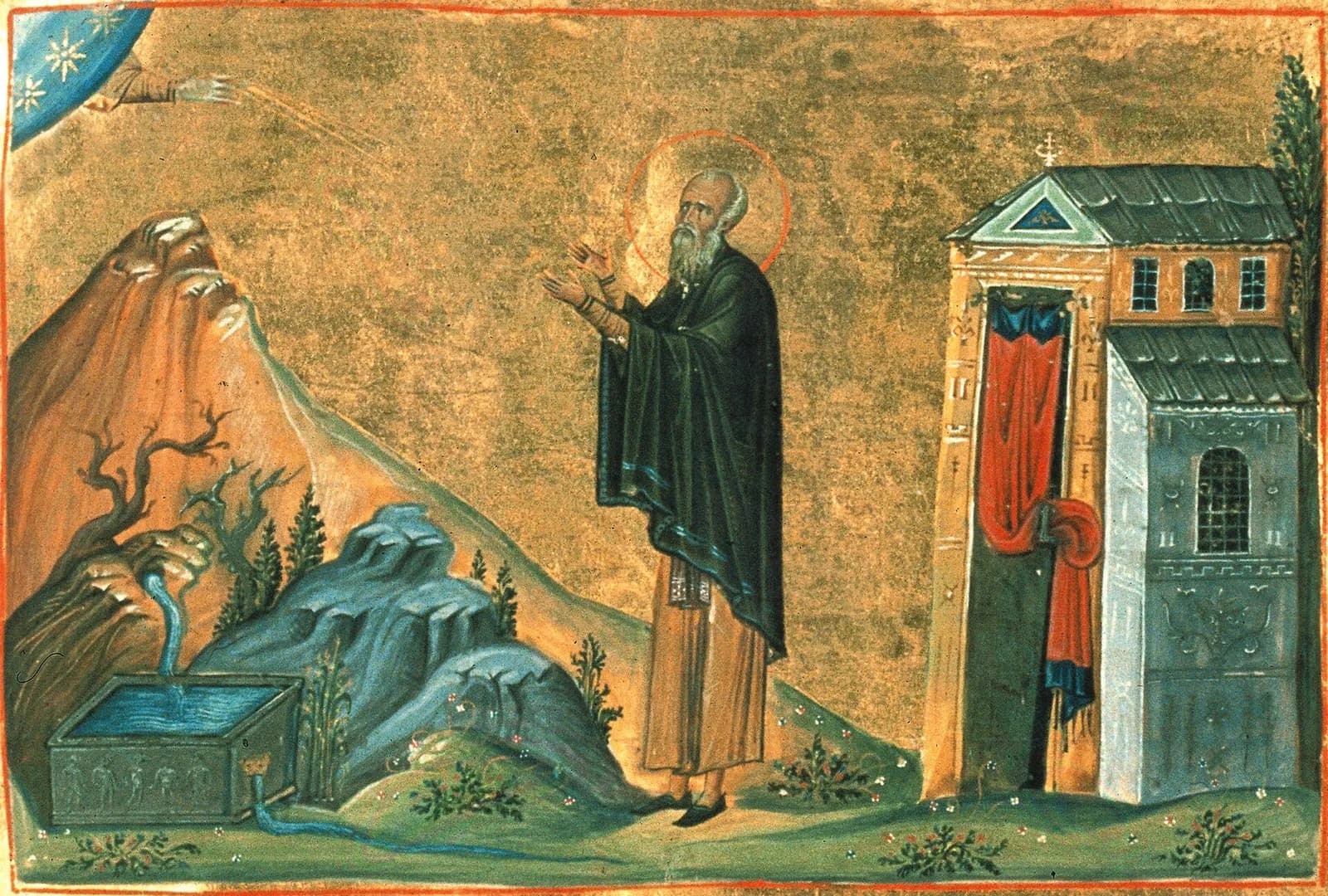
Saint Abraham Kidunaia was a fourth-century hermit from near Edessa, in what is now southeastern Turkey, who walked out of his own wedding feast to live alone with God and spent some fifty years walled into a cell. 134 He left it twice that the sources remember: once at his bishop's order, to preach for three years to a pagan town that stoned him before it asked for baptism, and once, disguised as a soldier, to bring home his niece Mary from the brothel where she had ended up. 134 His Life is attributed to Saint Ephrem the Syrian, and the Roman Martyrology's entry for him mentions it. 12
The bridegroom who left
Abraham was born about 296 near Edessa, in Mesopotamia, to a rich and respected family, according to the Norwegian bishops' saints database. 1 He felt called to a celibate life, but his parents wanted him married, and he did not dare refuse them; Catholic.net's older Spanish life says his mother's tears decided it. 13 In that region the custom was a wedding feast lasting seven days. On the last day, with the house full of guests and music, Abraham slipped away. 13 Robert Ellsberg, in Give Us This Day, puts it more simply: "On his very wedding day, however, Abraham stole off to become a hermit." 4
His family searched for him and found him at last deep in prayer; Catholic.net says it took them seventeen days, and that he was in a cave about a league from the town. 13 They could not persuade him to come back. Catholic.net adds that he spoke to his parents so movingly that even his bride agreed to a lifelong separation. 3 When they had gone he walled up the door of his cell, leaving only a small opening through which food could be passed. 1
When his parents died he inherited everything and asked a friend to give it all to the poor, keeping only a cloak, a goatskin, a bowl and a mat. 13 Ellsberg lists the same few things: "a bowl for his food and drink, a mat on which he slept, and a goatskin garment in which he clothed himself." 4 katolsk.no says he lived like that for fifty years; his biographer says he was never seen to smile, and that in all that time he never changed his goatskin. 1
Three years in Beth-Kiduna
Near his cell was a pagan town, Beth-Kiduna, whose people had resisted every attempt to convert them. 13 The bishop of Edessa told Abraham to leave his cell and preach there, and ordained the reluctant hermit a priest for the purpose. 134 Abraham had the bishop build a church in the town, and he pulled down the pagan temple and broke every idol he found. 1
The townspeople drove him out. He came back by night and went on preaching, and they stoned him and left him half dead. 1 Catholic.net says they also dragged him through the streets three times; Ellsberg says they beat him and nearly stoned him to death. 34 He kept returning, for about three years. Then, quite suddenly, the town gave way: the people were won over by his patience, listened to him and asked for baptism, and he baptized them himself. 134
He stayed a year longer to teach them. Then, katolsk.no says, he felt himself growing too taken up with worldly business, so he left the community in other hands and slipped away one night back to his cell. 1 Ellsberg writes that he "happily returned to his cell." 4
His niece Mary
The story most people know comes next. Catholic.net's life tells it from the beginning: his niece Mary was left an orphan at seven and brought to him. He put her in a cell next to his own and taught her the things of God through a small window. 3 Some years later a man dressed as a monk, who had come to visit Abraham, seduced her. Instead of repenting she ran away to a city two days off and went to live in an inn as a prostitute. 3
For two years Abraham grieved for her without knowing where she was, katolsk.no says. 1 When he learned what had become of her, he found a horse, dressed himself as an army officer, rode to the city and posed as a customer. 13 At first she did not recognize him; then she pushed him away. He held her hand and spoke to her gently, without reproach, and Catholic.net says she broke down in tears and could not look at him. 13 Ellsberg gives the heart of what he said: "To you, your sins seem like mountains, but God has spread his mercy over all He has made. . . . If sparks could set fire to the ocean, then indeed your sins could defile the purity of God." 4 He promised to take her sins on himself if she would only come home. 1
She came. She returned to her cell beside his and lived as a penitent; katolsk.no says that after three years she was given a gift of healing, and that she lived fifteen years more, dying about 360. 13 The story made Abraham enormously popular. 1 The tenth-century nun Hroswitha of Gandersheim made it into a play; the 1910 Catholic Encyclopedia says her "Abraham" and "Paphnutius" "tell in a touching manner of a fallen woman's conversion." 15 katolsk.no adds a caution of its own: this Mary is probably a purely legendary figure, and is easily confused with another former prostitute, Saint Mary of Egypt. 1
His death and his biographer
Abraham died at seventy. 14 When word of his last illness got around, the whole countryside came for his blessing, and after his death people tried to take pieces of his clothing, the first sign of a cult that began at once. 1 His Life is attributed to Saint Ephrem the Syrian, the deacon and Doctor of the Church, whom katolsk.no calls his personal friend and admirer. 123 katolsk.no notes that some sources place him in the sixth century instead. 1 He is shown as a hermit with a long, fire-red beard. 1
What is Saint Abraham Kidunaia the patron saint of?
Saint Abraham Kidunaia's feast day
Saint Abraham Kidunaia's feast day is October 29 in the Roman Martyrology, which enters him at Edessa in ancient Syria as Saint Abraham, anchorite, whose life was written by the deacon Saint Ephrem. 23 The Byzantine calendar keeps him on the same day together with his niece Mary. 1 The older Western date is March 16, which katolsk.no gives as his memorial in the West and on which Give Us This Day remembers him. 14
Praying with Saint Abraham
Abraham wanted one thing, to be alone with God, and twice he was sent back out into the world against that wish. 13 The first time it cost him three years of beatings in a town that did not want him. 14 The second time he risked his good name: a hermit riding into a city in a soldier's clothes to pose as a prostitute's customer. 13
Both times he went back to his cell when the work was done. katolsk.no says he left the converted town because he felt himself becoming too taken up with worldly affairs, an unusual worry for a man who had just baptized a town. 1
His words to Mary, as Ellsberg gives them, measure sin against an ocean that sparks cannot set on fire. 4 She did not believe she could be forgiven, and he did not argue the point with her so much as come and get her. 13 Whether or not there was ever a Mary, the story has been told for sixteen centuries, and a tenth-century nun thought it worth putting on a stage. 15
Saint Abraham Kidunaia, pray for us.
Sources
- 1."Den hellige Abraham av Kiduna," Den katolske kirke (katolsk.no), Catholic Diocese of Oslo (in Norwegian).
- 2.Roman Martyrology, entry for October 29, "Sant'Abramo, anacoreta," as printed in "Santo del giorno," Conferenza Episcopale Italiana (in Italian).
- 3."Abraham Kidunaia de Edesa, Santo," Santoral, Catholic.net, with the Roman Martyrology entry in Spanish (in Spanish).
- 4.Robert Ellsberg, "St. Abraham Kidunaia," Give Us This Day (Liturgical Press), March 16, 2024.
- 5.Nikolaus Scheid, "Hroswitha," The Catholic Encyclopedia, Vol. 7 (New York: Robert Appleton Company, 1910).
Saints to turn to next
Others in this collection who are turned to for some of the same things.