Saint Medard of Noyon
c. 456 - c. 545 or 560
- Parents
- Nectardus, a Frank, and Protagia, a Gallo-Roman 1
- Died
- June 8, about 545 by the encyclopedia; Nominis gives 560, and its French text of the Martyrology 564 12
- Patron saint of
- Farmers and brewers; invoked for fair weather or for rain 2
Saint Medard was a Frankish bishop of the sixth century who moved his see from the undefended town of Vermand to Noyon, took on the diocese of Tournai as well, and gave the religious veil to a queen who had left her husband. 125 To French farmers he is also the saint who settles the summer. If it rains on his feast, June 8, the proverb says it will rain for forty days more. 25
A boy from Salency
He was born about 456 at Salency, in what is now the department of the Oise. 1 His father, Nectardus, was a Frank; his mother, Protagia, was Gallo-Roman. 1 The encyclopedia adds that Saint Gildard, bishop of Rouen, is believed to have been his brother. 1
Léon Clugnet, who wrote the encyclopedia's entry, says his youth "was entirely consecrated to the practise of Christian virtues and to the study of sacred and profane letters." 1 He went with his father on business to Vermand and to Tournai and attended the schools there, "carefully avoiding all worldly dissipation." 1 The Diocese of Beauvais, quoted on the French bishops' Nominis site, likewise has him studying at Vermand and Tournai. 2
The Diocese of Soissons, Laon and Saint-Quentin, also quoted there, tells a story of his childhood. He gave his new clothes to a blind beggar who was nearly naked, and when he was asked what had become of them, he said the man's misery had moved him and he could not help giving them away. 2
Another story of his youth is the one French farmers remember. The Feast Day Cookbook, a 1951 book of saints' days that Catholic Culture reprints, calls it a legend. Medard gave one of his father's finest colts to a peasant who had lost his horse, and at once a torrential rain soaked everyone to the skin except the boy. 5 "It is Saint Médard watering his colts," the farmers say when the June rains come. 5
Priest and bishop
His piety and his learning, "considerable for that time," led the bishop of Vermand to ordain him and then to choose him as his successor. 1 The Beauvais account names that bishop Alomer and dates Medard's ordination to the priesthood to 489. 2 Nominis, in its own summary, also calls him a disciple of Saint Remi. 2 When the old bishop died, in 530 according to the encyclopedia, Medard was made to take the office "in spite of his objections." 1
Vermand, near the later town of Saint-Quentin, was a poor place to keep a cathedral. The north of Gaul was troubled by wars and open to raids, and Clugnet calls Vermand "a little city without defence." 1 In 531, by his account, Medard moved the see to Noyon, the strongest place in the region. 1 Nominis says his see had been destroyed by the barbarian invasions, and the Beauvais account makes him bishop of Noyon in 530. 2 The Roman Martyrology puts it the same way: he was bishop of Saint-Quentin, and after that city was destroyed he moved his chair to Noyon. 3
A year later Saint Eleutherius, bishop of Tournai, died, and Medard was asked to govern that diocese too. He refused, then gave way when King Clotaire himself pressed him. 1 The encyclopedia notes that the two dioceses stayed united until 1146. 1 Nominis adds that he evangelized Flanders. 2
What the Martyrology chooses to say about his years at Noyon is a single line: he took every care to turn the people away from pagan superstition and toward the teaching of Christ. 3 In the sixth century that was still the work in front of a bishop in the north.
The queen at Noyon
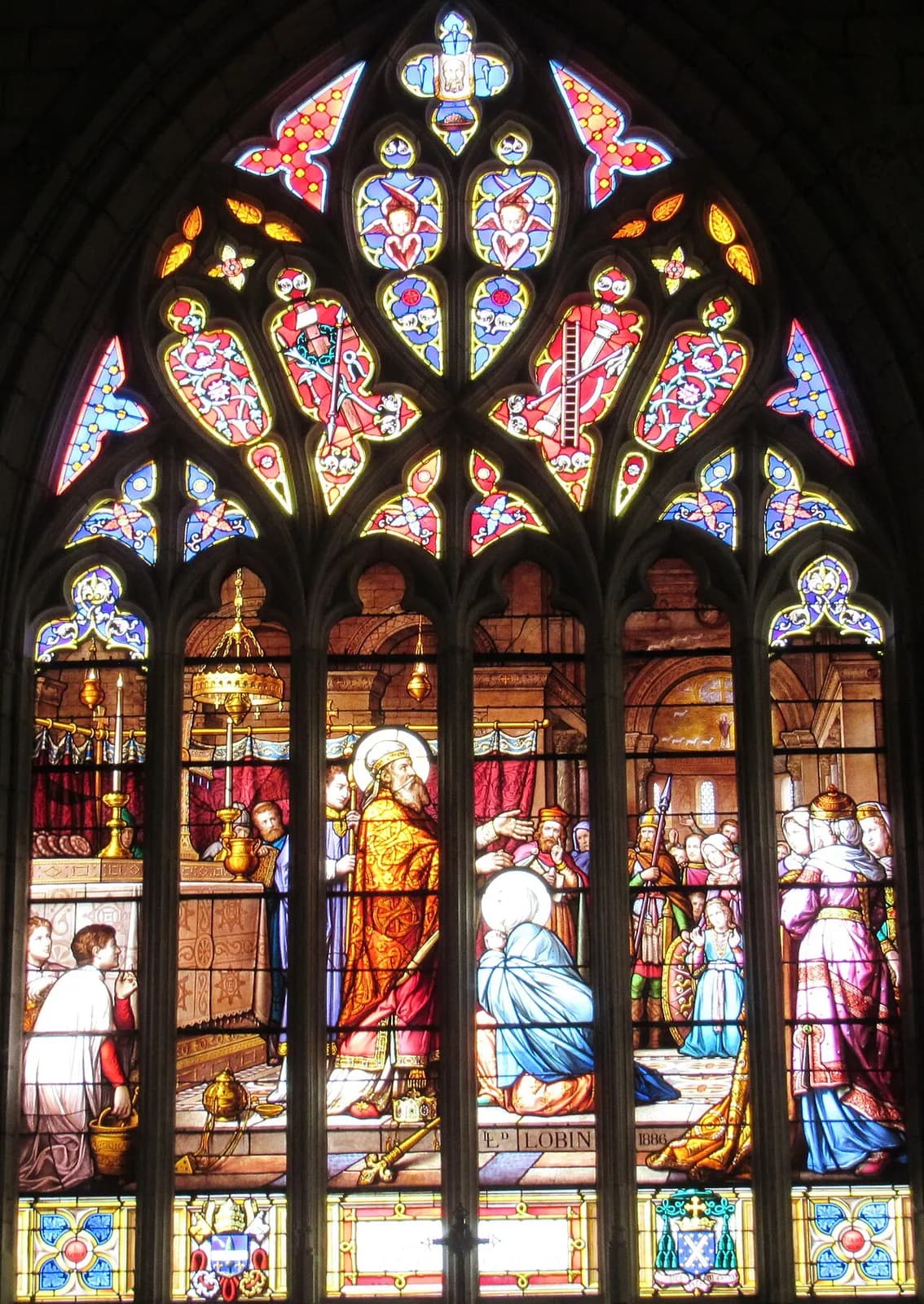
The best-known event of his time as bishop involved the king's own marriage. The cookbook's account says that "when Queen Radegunde left her murderer-husband, King Clotaire, she fled to Medard for refuge and was clothed by him in the religious habit." 5 The Diocese of Beauvais says he received her at Noyon and consecrated her to God in perpetual vows, and Nominis dates the event to 531. 2
It is the scene in the window at the top of this page, made for the church of Saint-Médard at Thouars in 1886: the bishop at the altar, the queen kneeling, the court looking on. The encyclopedia's short article does not mention her at all; the story comes down through the dioceses and the devotional tradition. 125
A bishop who would not punish thieves
The stories told about him are almost all stories of kindness. Nominis says so in so many words: everything reported of him is an act of goodness. He gave generous alms to all the poor, the lazy included. He could never bring himself to punish the petty thieves who stole honey from his hives, eggs from his hens and fruit from his orchard. 2
The cookbook says he was known as a bishop for his kindness to the farming people, and especially the poor among them. 5 It credits him with a custom as well. He set aside the income of twelve acres of his own land for the most virtuous girl of his diocese, and "it was he who started the 'feast of the rose queen.'" 5 For centuries, the book says, a crown of roses was placed on the head of the girl who had most edified the parish. By 1951 the custom survived in some working districts on the outskirts of Paris, though it had become a civic festival in the town hall. 5
Death and the abbey at Soissons
Medard died at Noyon on June 8. 1 The year is uncertain. The encyclopedia says "about 545." 1 Nominis heads its page with 560, and the French text of the Roman Martyrology it reproduces gives 564. 2 Gregory of Tours gives a chapter of the fourth book of his History of the Franks the heading "Death of the holy bishop Medard," and places it just before the death of King Childebert. 4
King Clotaire had visited him at Noyon one last time. 1 After his death the king had the body moved to his own manor of Crouy, at the gates of Soissons, and over the tomb rose a Benedictine abbey that bears Medard's name. 1 It became a royal burial church. When Clotaire himself died, Gregory writes, his four sons carried him to Soissons "and buried him in the church of St. Medard." 4 His son Sigibert, buried first elsewhere, was moved to Soissons in turn, "to the church of the holy Medard which he had built," and laid beside his father. 4
Clugnet sums up his standing in one sentence. Medard "was one of the most honoured bishops of his time, his memory has always been popularly venerated in the north of France, and he soon became the hero of numerous legends." 1 Nominis counts more than thirty-three places in France under his protection, and notes that in some of them, such as Saint-Mard-de-Vaux in Burgundy, his name has been worn down to Mard. 2
What is Saint Medard the patron saint of?
Nominis lists Saint Medard as patron of farmers and of brewers, and as a wonder-worker invoked for fair weather or for rain. 2 The cookbook calls him a "weather saint" and says the stories of how he became one "are many and varied." 5 Most of them go back to the June rain and to his care for the people who worked the land. 25
Saint Medard's feast day
Saint Medard's feast day is June 8. The encyclopedia says that "the Church celebrates his feast on 8 June," the day it gives for his death, and the Roman Martyrology enters him on that date. 13 Nominis keeps June 8 as well. 2 Catholic Culture's note on the day says his cult has traditionally been observed on it, "as mentioned in the Roman Martyrology." 5
The day comes with its proverb. In the cookbook's English: "Should Saint Médard's day be wet / It will rain for forty yet; / At least until Saint Barnabas / The summer sun won't favor us." 5 The French version Nominis prints allows a way out: unless Saint Barnabas cuts the grass from under his feet. 2
Praying with Saint Medard
Medard spent most of his life being asked to carry more than he wanted. He objected to being made a bishop, refused Tournai, and took both in the end. 1 The work he was given was unglamorous and steady: a diocese in a country troubled by war, people still holding to pagan superstition, a see to move behind walls. 13
The stories that stuck to him are small ones. New clothes given to a blind beggar. Honey and eggs and fruit left to the people who stole them. The income of twelve acres for the most virtuous girl in the diocese. 25 Whatever is legend in them, his people remembered him as a man who could not bring himself to be hard on the poor, and Nominis is careful to include the lazy among those he gave to. 2
And there is Radegund. A bishop who owed his second diocese to the king's insistence gave the king's wife the veil when she came to him. 125 Whatever it cost him, the record is that he did it.
For the farmers who still watch the sky on June 8, he is the saint of rain at the right time and sun at the right time. 2 That is not a small thing to pray for, when a year's food depends on it.
Saint Medard of Noyon, pray for us.
Sources
- 1.Léon Clugnet, "St. Medardus," The Catholic Encyclopedia, Vol. 10 (New York: Robert Appleton Company, 1911).
- 2."Saint Médard de Noyon," Nominis, Conférence des évêques de France, quoting the Dioceses of Beauvais and of Soissons, Laon and Saint-Quentin (in French).
- 3.Roman Martyrology, entry for June 8, "San Medardo, vescovo di Saint-Quentin," as printed in "Santo del giorno," Conferenza Episcopale Italiana (in Italian).
- 4.Gregory of Tours, History of the Franks, Book IV, translated by Ernest Brehaut (New York: Columbia University Press, 1916), Internet Medieval Sourcebook, Fordham University.
- 5."June 8: Feast of Saint Medard," Liturgical Year, Catholic Culture, from Katherine Burton and Helmut Ripperger, Feast Day Cookbook (New York: David McKay, 1951).
Saints to turn to next
Others in this collection who are turned to for some of the same things.
- Saint Guy of Anderlechtc. 950 - c. 1012Poverty and simplicityWork and vocation
- Saint Isidore the Farmerc. 1070 - May 15, 1130Work and vocationPoverty and simplicity
- Saint Notburgac. 1265 - 1313Work and vocationPoverty and simplicity
- Saint Wendelin of Trierc. 554 - c. 617Work and vocationPoverty and simplicity