Saint Maximus of Turin
Fourth century - between 408 and 423, or after 465
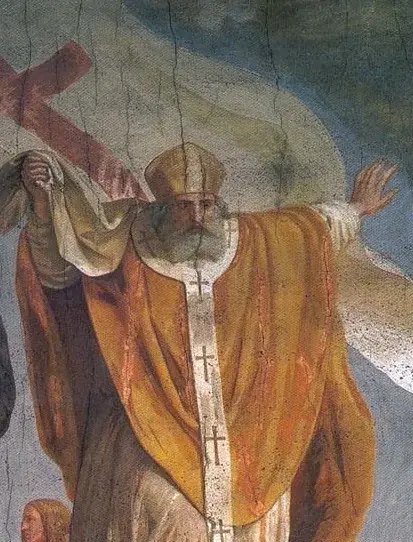
- Lived
- Born about 380, probably in Rhaetia, and died shortly after 465, says the Catholic Encyclopedia 1; died under Honorius and Theodosius the Younger, says Gennadius 3; between 408 and 423, says santiebeati 4
- Patronage
- Turin 1
Saint Maximus was the first known bishop of Turin, at the turn of the fifth century, a preacher whose sermons are almost all that is known of him. 124 In them he told the landowners of a city filling with refugees to share what they had, refused them the excuse of bargains bought from looters, and called the bishop a lookout posted on a rock to warn of what was coming. 2 His feast is June 25. 5
Very little is known
"Very little is known about him," Benedict XVI said of Maximus in 2007, "in compensation, we have inherited a collection of about 90 of his Sermons." 2 The earliest notice is a paragraph by Gennadius of Marseilles: Maximus was "a man fairly industrious in the study of the Holy Scripture, and good at teaching the people extemporaneously." 3 Gennadius then lists the sermons he had read himself, on avarice, on hospitality, on almsgiving, on fasting, on the eclipse of the moon, on the Passion and the feasts of the year, and ends, "He died in the reign of Honorius and Theodosius the younger." 3
He stands first in the list of the bishops of Turin. Fabio Arduino, on santiebeati, explains why: no predecessor is historically established. 4 The current Martyrology calls him the first bishop of the see. 5 The Avvenire introduction on the same page calls him a disciple of Saint Ambrose and of Saint Eusebius of Vercelli, and Arduino says Eusebius, his teacher, called him to the newly founded see. 4
Two pictures of one life
The sources give two quite different lifetimes. Michael Ott, in the 1911 Catholic Encyclopedia, builds his on two signatures. In 451 a Maximus signed, eighth of nineteen, the letter by which the bishops of northern Italy accepted Pope Leo's teaching on the Incarnation; since the order went by age, Ott reckons he was then about seventy. In 465 he signed at a synod in Rome immediately after the pope, the oldest of forty-eight bishops. Ott concludes that he was born about 380, probably in Rhaetia, and died shortly after 465. 1
Ott also takes from one of the sermons that Maximus had seen the martyrdom of three missionaries in the Alpine valley of Anaunia in 397. 1 Arduino reports the same: Maximus witnessed the deaths of Saints Sisinnius, Martyrius and Alexander. 4
Other sources place him a generation earlier. Benedict XVI meets him as bishop of Turin in 398, a year after the death of Ambrose. 2 Gennadius says he died under Honorius and Theodosius the Younger. 3 The Avvenire introduction has him born in the middle of the fourth century and dead between 408 and 423, and Arduino, who gives the signatures of 451 and 465, adds that many historians put his death much earlier, usually about 423. 4 This page does not choose between them.
A city under threat
Turin in his day lay in the path of the barbarian armies that came over the eastern passes into the western Alps. Benedict XVI describes it as permanently garrisoned, and at the worst moments a refuge for people fleeing the unprotected countryside. 2 Ott notes sermons on the coming invasion and on the destruction of the church of Milan by the barbarians. 1
Maximus told his people not to run. "He is an unjust and impious son who abandons his mother in danger," the Avvenire introduction quotes him; "the homeland is in some way a sweet mother." 4 Benedict XVI notes that he also taught the duty of paying taxes, "however burdensome and unpleasant they might appear." 2
He saw the bishop's own task in the same light. In Sermon 92 he asks who the watchmen of the city can be, "other than the most blessed Bishops set on a lofty rock of wisdom, so to speak, to defend the peoples and to warn them about the evils approaching in the distance?" 2 In Sermon 89 he compares bishops to bees: "They are pure in sanctifying, gentle in restoring and severe in punishing." 2
Wealth, looting and the poor
Benedict XVI singled out two sermons on wealth and poverty. "No one thinks about the needs of others," Maximus says in Sermon 17. "In fact, not only do many Christians not share their own possessions but they also rob others of theirs." 2 He reminded the rich that the city was full of strangers and pilgrims. 2
Sermon 18 deals with goods taken in a sack and sold on. "Tell me, Christian, tell me why you snatched the booty abandoned by the plunderers?" he asks, and he will not accept that buying them makes it right: "It is a good thing to make purchases, but that means what is sold freely in times of peace, not goods looted during the sack of a city." 2 Elsewhere he compares the man who nibbles away at his neighbor's boundaries to a wolf. 2
His preaching reached ordinary piety too. Arduino notes his urging to praise God daily with the Psalms, morning and evening and before and after meals, and to make the sign of the cross before every action; and his condemnation of those who sold the forgiveness of sins for money instead of setting a fitting penance. 4 The Avvenire introduction quotes his teasing of people who still trusted in superstitions such as calling out to the moon: the moon is truly in labor among you, he says, when a heavy supper swells your belly and your head nods from too much drink. 4
His writings and his memory
Ott describes the 1784 edition by Bruno Bruni, published by order of Pius VI: 118 homilies, 116 sermons and six treatises, many of uncertain authorship. 1 Benedict XVI speaks of about 90 sermons; Arduino says the authenticity of the collection is being carefully examined but that its main body is certainly his. 24 Ott calls the discourses "usually very brief, and couched in forcible, though at times over flowery language." 1
A Life written after the eleventh century tells how he stopped a passing roe deer so that a thirsty cleric could drink its milk, which is why he is sometimes painted pointing at a roe. Ott calls the Life "entirely unreliable." 1 His tomb is not known; Arduino suggests that the lack of relics is one reason his cult faded, and notes that Turin dedicated a church and a street to him only in the nineteenth century. 4
What is Saint Maximus the patron saint of?
Saint Maximus is the patron saint of Turin. Ott writes that "the city of Turin honours him as its patron." 1 A city is not among the tags this site uses to sort saints by patronage, so the patronage field is left empty and the source's wording stands here and in the fact table.
Saint Maximus's feast day
Saint Maximus's feast day is June 25. The current Roman Martyrology, as the Italian bishops print it, enters him on that day as the first bishop of Turin, who by his fatherly word called crowds of pagans to faith in Christ. 5 The 1897 English edition of the Martyrology keeps the same day, calling him "most celebrated for his learning and sanctity," and Ott gives June 25 as well. 16 Arduino adds that the dioceses of Piedmont and the Aosta Valley keep him on June 25 in their regional calendar. 4
Praying with Saint Maximus
He preached to people who were frightened and some of whom were making money from it. He did not soften either message: stay, and do not profit from your neighbor's ruin. 24
Benedict XVI drew from him the old point that a Christian is also a citizen, and that the two duties belong together. 2 Maximus put it in the plainest terms: pay your taxes, buy only what is sold freely, share what you have with the strangers in your city. 2
Much of his life is lost, even the dates. 134 What remains is the voice of a pastor speaking to a particular town in a bad time, which Gennadius already admired for being done without notes. 3
Saint Maximus of Turin, pray for us.
Sources
- 1.Michael Ott, "St. Maximus of Turin," The Catholic Encyclopedia, Vol. 10 (New York: Robert Appleton Company, 1911).
- 2.Benedict XVI, General Audience on Saint Maximus of Turin, October 31, 2007, Libreria Editrice Vaticana.
- 3.Gennadius of Marseilles, Lives of Illustrious Men, chapter 41, "Maximus," translated by Ernest Cushing Richardson, Nicene and Post-Nicene Fathers, Second Series, Vol. 3 (1892), New Advent.
- 4.Fabio Arduino, "San Massimo di Torino, vescovo," with an introduction from Avvenire and the Roman Martyrology entry, Santi e Beati, santiebeati.it (in Italian).
- 5.Roman Martyrology, entry for June 25, "San Massimo, vescovo," Santo del giorno, Conferenza Episcopale Italiana (in Italian).
- 6.The Roman Martyrology, June 25 (Baltimore: John Murphy Company, 1897), Internet Archive.
Saints to turn to next
Others in this collection who are turned to for some of the same things.
- Saint Alexander Sauli1533 or 1534 - October 11, 1592Poverty and simplicityStudy and teaching
- Saint Antoninus of FlorenceMarch 1, 1389 - May 2, 1459Poverty and simplicityStudy and teaching
- Saint Benedict IIDied 685Poverty and simplicityStudy and teaching
- Saint Brigid of Kildare451 or 452 - February 1, 525Study and teachingPoverty and simplicity