Saint Benedict II
Died 685
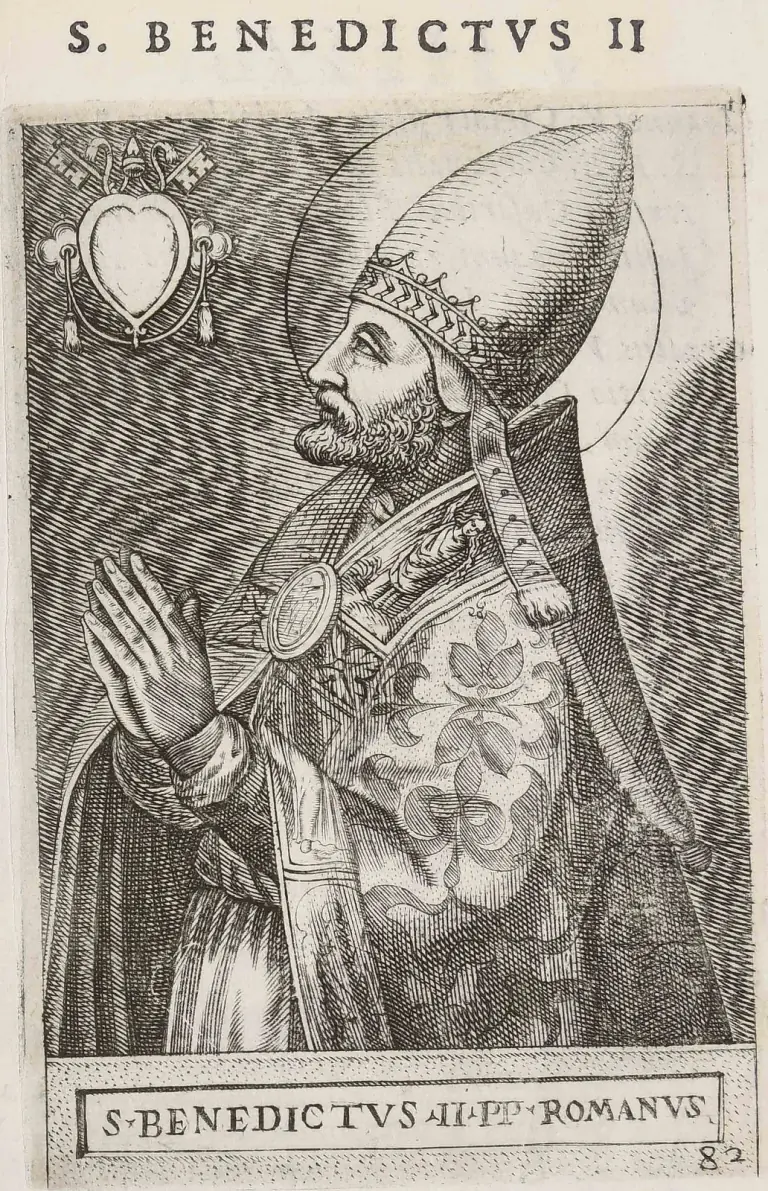
- Known for
- Obtaining from Constantine IV the decree that ended the long wait for imperial confirmation of a new pope 125
Saint Benedict II was a Roman priest, trained from boyhood in the papal school of chant, whom the Liber Pontificalis remembers as humble, gentle and a lover of the poor. 125 Elected in 683, he waited nearly a year for the emperor's confirmation, and in his short reign he obtained a decree that spared his successors the same wait. 125 The Roman Martyrology keeps him on May 8. 3
A Roman of the song school
Benedict was a Roman, the son of a man named John. 15 He was given to the service of the Church as a child and sent to the schola cantorum, the papal school of chant, where he stood out for his knowledge of the Scriptures and for his singing. 12 Horace Mann, who wrote both the Catholic Encyclopedia article and a longer history of these popes, notes that he was skilled in Scripture and in music like his predecessor Leo II. 5
As a priest he was known, in the encyclopedia's words, for "his humility, love of the poor, and generosity." 1 The Liber Pontificalis, the ancient lives of the popes, plays on his name: he showed himself worthy of it, Mann translates, "for in him abounded the grace of heavenly 'benediction.'" 5 It adds that he was a lover of poverty, humble and gentle, patient and generous. 5 The current Roman Martyrology still describes him in almost those terms, as a lover of poverty, humble and meek, who shone for his patience and his almsgiving. 3
His epitaph, which Mann prints in Latin, speaks of his rising to the papal chair by the law of the fathers, which Mann takes to mean that he had passed in order through every grade of the clergy. 5 katolsk.no says the same in plain terms: he had served in all the grades and was a priest when he was chosen. 2
Elected, and kept waiting
Leo II died in the summer of 683. 2 katolsk.no says Benedict was elected early in July of that year. 2 He was not consecrated until June 26, 684, after a vacancy that the encyclopedia and Mann both put at more than eleven months. 15 As with Leo before him, the delay was the emperor's: no pope could be consecrated until Constantinople had confirmed the election. 2
He did not sit idle. While still only, as he styled himself, "a priest, and in God's name the elect of the Holy See," he wrote to the notary Peter, whom Leo had sent to Spain, urging him to carry out Leo's instructions "and procure with all zeal the subscriptions of the bishops to the decisions of the Council." 5 The council was the Third Council of Constantinople, the sixth ecumenical council, which had condemned Monothelitism, the teaching that Christ had only one will. 12 Mann points out that letters like this one show the pope-elect governing the Roman Church himself during the vacancy. 5
Spain and the council
The mission to Spain went less smoothly than Rome had hoped. katolsk.no observes that Rome had not reckoned with the independence of the Visigothic Church. 2 King Ervig summoned the Fourteenth Council of Toledo in November 684, and it accepted the council's decrees, but only after examining them closely for itself. 25 Saint Julian, the archbishop of Toledo, who presided, sent the pope a statement of the Spanish faith, which Mann calls their "Apology." 5
Benedict was satisfied with its doctrine but not with all of its language. 25 Mann says he disliked the phrases "will begot will" and "three substances in Christ," and sent the document back for revision. 5 Here the sources tell the sequel differently. katolsk.no says that when Julian heard of the pope's criticism, he sent back an indignant reply. 2 Mann places the sharp answer at the Fifteenth Council of Toledo in May 688, after Benedict was dead: the Spanish bishops defended their phrases from the Fathers and remarked that their teaching would seem sublime to lovers of truth, if objectionable to ignorant rivals. Julian then wrote a second apology, which Pope Sergius accepted as orthodox. 5
The emperor's decree
Benedict was on good terms with the Emperor Constantine IV, and he obtained from him the decree for which he is chiefly remembered. 125 Mann quotes the Liber Pontificalis: the emperor granted that whoever was elected to the Apostolic See should be consecrated at once, without delay. 5
What the decree actually changed is disputed, and the sources say so. The encyclopedia says it either abolished imperial confirmation altogether or let it be obtained from the exarch, the emperor's governor in Italy. 1 katolsk.no reads it as moving the approval to the exarch, so that a new pope could take office with the least possible delay, and Vatican News says the same. 24 Mann sets out both views and calls the abolition of any secular confirmation the more obvious meaning of the words, while leaving the reader, as he puts it, to "decide for himself" what the earlier custom had been. 5
Mann also links Benedict to a set of formulas in the Liber Diurnus, the papal chancery book, for announcing an election without asking anyone's confirmation. Several of their phrases speak of the sixth council as recent and of Constantine as still alive, and Mann concludes they were drawn up for Benedict. 5
The emperor showed his regard in another way. He sent the pope locks of hair from his two young sons, Justinian and Heraclius, and Benedict received them in state with the clergy and the army. 125 In the early Middle Ages, Mann explains, receiving a child's first-cut hair meant adopting the child, and so the pope became the adoptive father of the two princes. 15
Macarius and Wilfrid
Macarius, the patriarch of Antioch deposed by the council for Monothelitism, was still in Rome. 12 katolsk.no says he was confined in a monastery there. 2 When his orthodox successor died, Benedict tried once more to win him back, hoping to restore him to his see: for forty days, Mann writes, he had one of his own counselors visit Macarius. 5 It did no good. Macarius, in Mann's words, "died, as he had lived, in obstinate heresy." 5
Benedict also took up the cause of Saint Wilfrid of York, who had been driven from his see and had appealed to Rome. 25 The encyclopedia counts him among the popes who favored Wilfrid. 1 katolsk.no says his order that Wilfrid be restored, issued before his consecration, had no effect. 2 Two decades later Wilfrid, appealing to Rome again, would point to the decisions of Popes Agatho, Benedict and Sergius in his favor. 5
Easter of 685, and the churches of Rome
Benedict was generous to his clergy. On Easter Day, March 26, 685, following custom, he bestowed honors and favors on clergy of every rank, and katolsk.no calls it fitting that this was his last great ceremony. 25 katolsk.no adds that he restored the right of sanctuary in Rome's churches, which the city's quarreling factions had stopped respecting to the point of forcing their way inside after their enemies. 2
He restored many of Rome's churches, the encyclopedia says. 1 katolsk.no names the work he carried on at Saint Peter's and San Lorenzo in Lucina, and the adornment of San Valentino on the Via Flaminia and Santa Maria ad Martyres, the old Pantheon. 2
Soon after Easter he fell ill. 5 By the encyclopedia's account he died on May 8, 685; Mann and katolsk.no say he died shortly after Easter and was buried on May 8 in Saint Peter's. 125 He left gifts to the clergy, to the deaconries that cared for the poor, and to the lay sacristans of the churches; katolsk.no puts the bequest at thirty pounds of gold. 125
What is Saint Benedict II the patron saint of?
Saint Benedict II's feast day
Saint Benedict II's feast day is May 8 in the current Roman Martyrology, which enters him at Rome on that day, just after Pope Boniface IV. 3 Vatican News lists him on May 8 as well. 4
The older date was May 7. The Roman Martyrology of 1897 enters him that day: "At Rome, of St. Benedict, pope and confessor." 6 Mann's 1902 history notes that the Bollandists treat him on May 7, the day of his commemoration in the Roman Martyrology, and katolsk.no still keeps May 7. 25
Praying with Saint Benedict II
Benedict spent nearly a year as pope-elect waiting on a distant emperor, and he used the time to keep his predecessor's work going, writing to a notary in Spain to finish what Leo had begun. 25 What he gained in the end was a shorter wait for the men who came after him. 15
He pressed the Spanish bishops over their wording, and their tart answer came only after he was dead. 5 With Macarius he spent forty days of patient visits on a man who never changed his mind. 5 Neither effort came out the way he would have wanted, and the record does not pretend otherwise. 25
What his biographer chose to remember was simpler: a boy trained to sing in the Church, a priest who loved the poor, a pope who was humble, gentle and patient, and whose last gifts went to his clergy and to the deaconries that fed the hungry of Rome. 15
Saint Benedict II, pray for us.
Sources
- 1.Horace Mann, "Pope St. Benedict II," The Catholic Encyclopedia, vol. 2 (New York: Robert Appleton Company, 1907).
- 2."Den hellige pave Benedikt II," compiled by Per Einar Odden, Helgener, salige og andre, katolsk.no, the Catholic Church in Norway (in Norwegian).
- 3.Roman Martyrology, entry for May 8, "San Benedetto II, papa," Santo del giorno, Conferenza Episcopale Italiana (in Italian).
- 4."St. Benedict II, Pope," Saints of the day, May 8, Vatican News; and "s. Benito II, papa," Santo del día, May 8, Vatican News (in Spanish).
- 5.Horace K. Mann, The Lives of the Popes in the Early Middle Ages, vol. 1, part 2 (London: Kegan Paul, Trench, Trübner, 1902), "St. Benedict II," as digitized on the Internet Archive.
- 6.The Roman Martyrology, May 7 (Baltimore: John Murphy Company, 1897).
Saints to turn to next
Others in this collection who are turned to for some of the same things.
- Saint Alexander Sauli1533 or 1534 - October 11, 1592Poverty and simplicityStudy and teaching
- Saint Antoninus of FlorenceMarch 1, 1389 - May 2, 1459Poverty and simplicityStudy and teaching
- Saint Brigid of Kildare451 or 452 - February 1, 525Study and teachingPoverty and simplicity
- Saint Caesarius of Arlesc. 470 - August 27, 542 or 543Study and teachingPoverty and simplicity