Saint Caesarius of Arles
c. 470 - August 27, 542 or 543
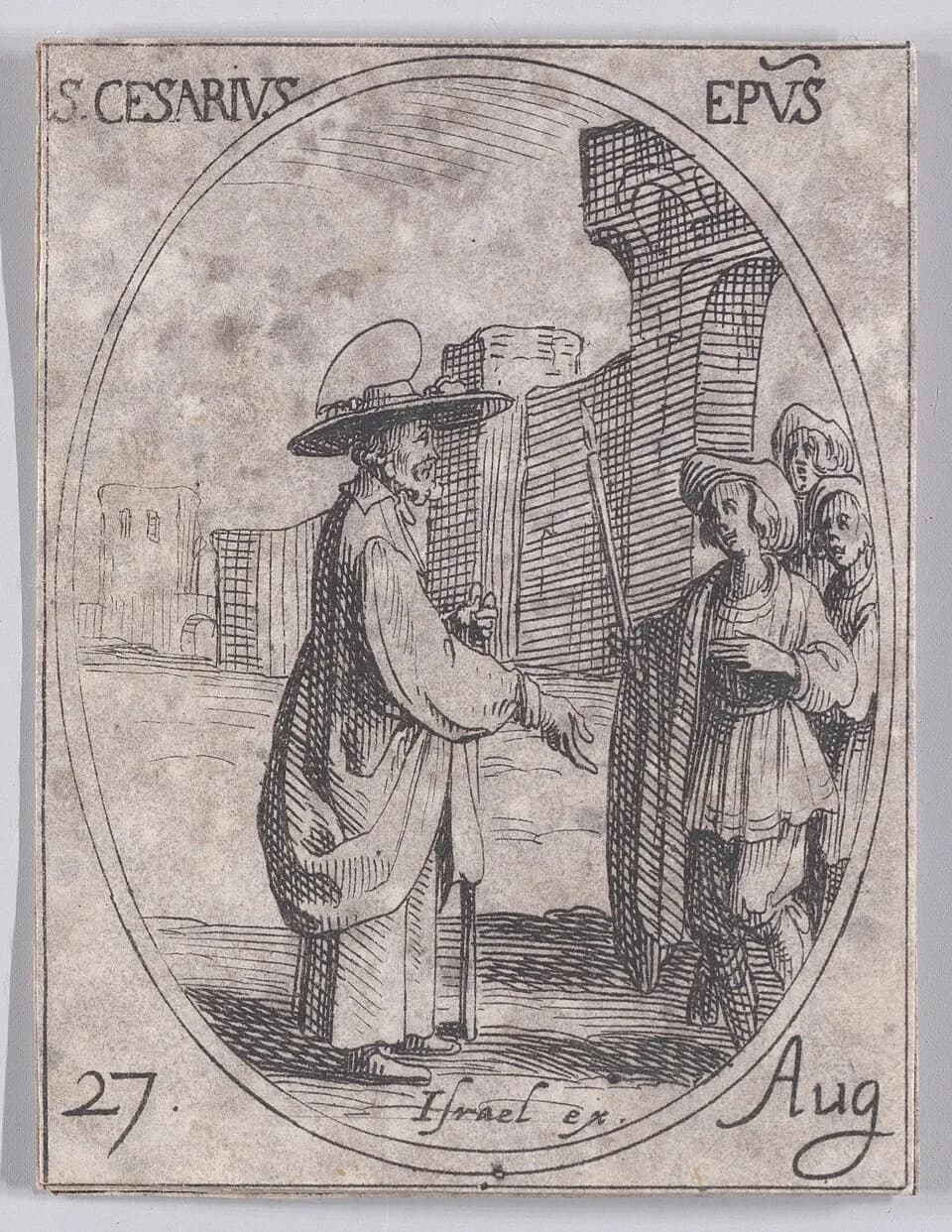
- Councils
- Agde (506), Arles (524), Carpentras (527), Orange and Vaison (529), Marseilles (533) 1
- Local patronage
- Secondary patron of the Archdiocese of Aix-en-Provence and Arles since 1964 2
Saint Caesarius of Arles was a monk of Lérins who became bishop of Arles around 502 and held the see for forty years while Visigoths, Ostrogoths and Franks took the city in turn. 12 He preached for a quarter of an hour at a time in the language of farmers and market traders, wrote the first rule made for a community of nuns, and drafted the canons on grace that the Second Council of Orange adopted in 529. 12 The Roman Martyrology keeps him on August 27, and France on August 26. 25
From Chalon to Lérins
He was born about 470 near Chalon-sur-Saône, in Burgundy, the son of Gallo-Roman landowners. 12 The life printed by the Archdiocese of Aix and Arles sets the scene: the last western emperor was about to disappear, the Burgundians who ruled around Chalon were Arian Christians, and the boy grew up sharing land with them. 2
At eighteen, against his family's wishes, he received the tonsure from the bishop of Chalon. Two or three years later he slipped away without telling them and went to the island monastery of Lérins. 2 There his austerities were so severe that he ruined his health, and the abbot sent him, unwilling, to Arles to recover. 12
In Arles the bishop, Aeonus, took to him. 1 The diocesan life says the two were relatives, and that the cultivated families of the city tried to give the young monk a classical polish. He studied for a while under an African teacher of rhetoric. One night he fell asleep over his book and dreamed that a serpent was eating the arm that rested on it, and he gave up secular literature for good. 2 Aeonus ordained him deacon and priest and, according to the same life, put him in charge of a monastery outside the city. 12
A bishop under three kingdoms
When Aeonus died, Caesarius was chosen to succeed him. The encyclopedia dates this 502 or 503; the Aix chronology puts the succession in December 502 and the consecration in 503. 12 The Martyrology says he accepted against his will. 5 The encyclopedia calls him "the foremost bishop of Gaul" in his time. 1
Arles changed hands more than once while he was bishop, and each new power suspected him. Under the Visigoth king Alaric II he was accused of plotting to hand the city to the Burgundians and was exiled to Bordeaux without trial. The king relented and let him hold the Council of Agde in 506. 1 After the siege of Arles in 508 the Ostrogoths suspected him in turn, and the diocesan life says he was imprisoned and threatened with death. 12 In 513 he had to answer to King Theodoric at Ravenna, who cleared him and treated him with honor. 1
From Ravenna he went on to Rome. Pope Symmachus gave him the pallium, which the encyclopedia says is "said to be the first occasion on which it was granted to any Western bishop," confirmed him as metropolitan, and on June 11, 514, renewed for him the office of vicar of the Apostolic See in Gaul. 1
Bread, ransom and a hospital
The Aix life dwells on what he did for the people the wars left stranded. After the siege of 508 the Ostrogoths brought crowds of prisoners into the city, and they camped in the churches and lived on the bread the bishop's house handed out each day. His steward warned him that if he kept feeding them there would be nothing for his own table the next day. Caesarius told him to give out the loaves as usual. If there was nothing tomorrow, he said, they would all fast together. 2
He then emptied the church treasury to buy the captives back, selling the silver ornaments and even the sacred vessels, and scandalized a good many of his own flock. 2 At Ravenna, Theodoric gave him a heavy silver dish as a keepsake. He had it auctioned at once, and with what the court then gave him he freed, among others, the whole population of Orange, whom the Goths had carried off. 2 The same life says he was the first bishop in the West to build a hospital and staff it. 2
Fifteen-minute sermons
He is remembered chiefly as a preacher. The encyclopedia calls him "the first great Volksprediger of the Christians whose sermons have come down to us," using the German word for a preacher to the people. 1 The Aix life tells how it began. Arles had been used to learned bishops who could speak for two hours, and one day, as Caesarius rose to preach after the Gospel, he watched the church empty. He had the doors shut after the Gospel from then on, and he promised to keep to ten or fifteen minutes. 2
His images came from daily life: in the encyclopedia's list, "the sea, the market, the vineyard, the sheepfold, the soil." 1 He preached against drunkenness, concubinage, neglect of Mass and the pagan customs that still lingered, and he expected a good deal of his hearers. 12 On long winter nights, he told them, anyone could manage three hours of reading Scripture or listening to it read. 2
Preaching was then the bishop's privilege, which left country people with almost none. In 529 he had the Council of Vaison give parish priests the right to preach and deacons the right to read a homily of the Fathers, and had priests take in young readers to train, which the Aix life calls the beginning of parish schools. 2 He gathered his own sermons into collections and sent copies as far as Italy and Spain for other clergy to use. 2 The Martyrology remembers him for exactly this. 5
He borrowed freely from Saint Augustine and took no care of his own name, so that for centuries many of his sermons passed under Augustine's. 123 The count of what survives varies. The encyclopedia reports scholars' tallies from 103 to 158; the Aix life says the Benedictine Germain Morin spent fifty years restoring 238 to him; the French bishops' Nominis page says 250. 123
Orange and the rule for nuns
As papal vicar he presided over a series of councils: Arles in 524, Carpentras in 527, Orange and Vaison in 529, Marseilles in 533. 1 The Second Council of Orange settled a long quarrel in Gaul over grace and free will by condemning what is called Semipelagianism. Its decrees were drawn almost word for word from Augustine, the Aix bulletin says Caesarius wrote them, and Pope Boniface II confirmed them on January 25, 531. 12
The work he cared about most was a monastery for women at Arles, placed under his sister Caesaria. 12 The Aix chronology dates the foundation 512, and Nominis, citing the diocese, 507. 23 For it he wrote what the encyclopedia calls "the first rule drawn up for women living in perfect community." 1 The nuns promised to stay until death, spun wool, made their own clothes and copied the Scriptures, and the pope exempted the house from the bishop's authority. Saint Radegund later took the rule for her abbey of the Holy Cross at Poitiers. 1 In his will he left Caesaria a large cloak she had made for him. 1
He died at Arles on August 27. The encyclopedia gives the year as 543, on the authority of Malnory; the Aix bulletin and the Martyrology entry as Nominis prints it give 542. 123
What is Saint Caesarius of Arles the patron saint of?
None of the sources consulted names Saint Caesarius of Arles as the patron of a trade, an illness or a cause, and this page does not supply one. 123 What they do record is local. He was proclaimed secondary patron of the Archdiocese of Aix-en-Provence and Arles in 1964, and Nominis notes that he is the patron saint of the Provençal town of Charleval. 23
There is also an open cause to have him declared a Doctor of the Church. The Archdiocese of Aix and Arles says it was first raised with Rome in 1853, taken up again from 1937 to 1942, and relaunched in recent years, and that on November 4, 2018, the bishops of France voted in favor of asking for it. 24
Saint Caesarius of Arles's feast day
The Roman Martyrology lists Saint Caesarius of Arles on August 27, the day he died. 25 He is not on the general Roman calendar. The calendar proper to France has kept his memorial on August 26 since the reform of 1969, and Nominis lists that day as an optional memorial. 23 In November 2016 the French bishops voted to ask that he be added to the calendar of the whole Church. 2
Praying with Saint Caesarius of Arles
Caesarius wanted to be a hermit and was not allowed to be. His own austerities put him in a sickbed in Arles, and the rest of his life was spent among people, which he had gone to Lérins to leave. 2 The encyclopedia's phrase for the result is "a perfect monk in the episcopal chair." 1
His answer to an empty church was to change himself. He shortened the sermon, dropped the fine language, and put up with being told he talked like a peasant. 2 Then he gave the work away, to parish priests, to deacons, and to anyone who would copy his collections, without caring whose name ended up on them. 2
The story of the loaves is hard to turn into a rule. He fed prisoners of war, most of them pagans or heretics by his own lights, with bread his household needed, and sold the sacred vessels to ransom them. 2 His flock was angry, and the diocesan life does not pretend otherwise. It adds only that he left his church richer than he found it. 2
A page of his preaching is still a reasonable thing to pray with. It is brief, it explains the day's reading in words a farmer could follow, and it closes by going back over what was said. 12
Saint Caesarius of Arles, pray for us.
Sources
- 1.Thomas Shahan, "St. Caesarius of Arles," The Catholic Encyclopedia, vol. 3 (New York: Robert Appleton Company, 1908).
- 2."Saint Césaire d'Arles, Docteur de l'Église ?", Aquensis sedis Acta, bulletin of the chancery of the Archdiocese of Aix-en-Provence and Arles, September 6, 2018, with a life by Marie-Josée Delage and a note on his cult by Hervé Chiaverini (in French).
- 3."Saint Césaire d'Arles," Nominis, Conférence des évêques de France (in French).
- 4."Saint Césaire d'Arles docteur de l'Église : les évêques de France disent oui," Archdiocese of Aix-en-Provence and Arles, November 9, 2018 (in French).
- 5.Roman Martyrology entry for August 27, "Santo del giorno," Chiesa Cattolica Italiana (in Italian).
Saints to turn to next
Others in this collection who are turned to for some of the same things.
- Saint Fulgentius of Ruspec. 468 - c. 533Study and teachingCouragePoverty and simplicity
- Saint Józef BilczewskiApril 26, 1860 - March 20, 1923Study and teachingCouragePoverty and simplicity
- Saint Peter Damian1007 - February 21, 1072Study and teachingCouragePoverty and simplicity
- Saint Pier Giorgio FrassatiApril 6, 1901 - July 4, 1925Poverty and simplicityCourageStudy and teaching