Saint Fulgentius of Ruspe
c. 468 - c. 533
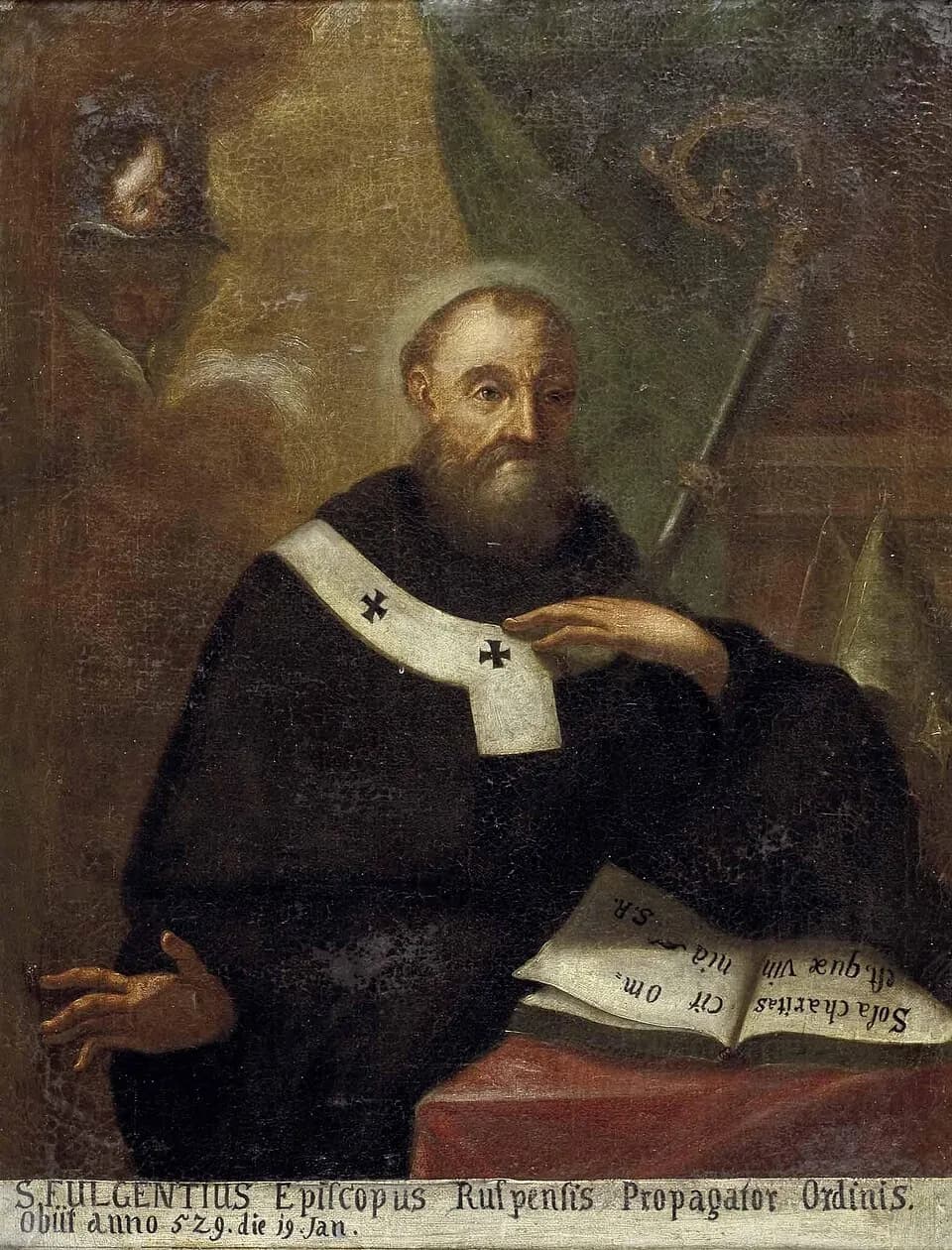
- Family
- Grandson of Gordianus, a senator of Carthage; son of Claudius and Mariana 1
Saint Fulgentius of Ruspe was a senator's grandson who collected taxes for the Vandal rulers of North Africa, left that career for a monastery, was made bishop of a seaport he had never seen, and spent most of his years as bishop exiled in Sardinia by an Arian king. 123 The Catholic Encyclopedia calls him "the principal theologian of the sixth century, if we do not count St. Gregory," and the Augustinians remember him as "the pocket Augustine." 13 The Roman Martyrology enters him on January 1, and the Augustinian Order keeps his feast on January 3. 23
A senator's grandson
He was born at Telepte in the Roman province of Byzacena, in what is now Tunisia. 13 The Catholic Encyclopedia gives the year as 468, the Augustinians as 462. 13 His grandfather Gordianus, a senator of Carthage, was stripped of his possessions by the Vandal invader Genseric and banished to Italy. After he died, his two sons came back to Africa, found the family house in Carthage made over to Arian priests, and recovered some property in Byzacena. 1
One of those sons, Claudius, was the father of Fulgentius, and he died early. His mother, Mariana, brought him up. 1 She had him learn Greek before Latin. He is said to have memorized all of Homer at an early age. 1
As a young man he ran the household under his mother's authority and caught the eye of the provincial authorities, who made him a procurator. 1 The Augustinians put it plainly: he worked in the Vandal administration and was responsible for collecting taxes. 34
His mother at the monastery door
A desire for religious life came over him while he held that office. 1 What settled it, the encyclopedia and the Augustinians agree, was reading Saint Augustine's commentary on Psalm 36. 13 The Augustinian Recollects tell it another way: he had watched monks and been struck by their freedom, their charity and their detachment. 5
He went to a monastery founded by a bishop named Faustus, whom the Vandal king Hunneric had driven from his see. Faustus knew him and hesitated, and the young man had to plead his way in. 15 Then his mother came. She stood at the door crying out in tears to see her son, and he gave no sign that he was inside. 1 He made his worldly goods over to her, which left his younger brother dependent on her as well. 1
When persecution forced Faustus to flee, Fulgentius moved to a small monastery nearby whose abbot, Felix, had been his friend in the world. Felix tried to hand him the office. After what the encyclopedia calls a contest of humility they agreed to share it: Felix looked after the house and the guests, and Fulgentius taught. 1
Turned back from Egypt
He had been reading John Cassian on the monks of Egypt, and he wanted to see them. 1 So he took ship at Carthage for Alexandria with one companion, Redemptus. 1
They got as far as Syracuse. The bishop there, Eulalius, told him: "The lands to which you wish to travel are separated from the communion of Peter by an heretical quarrel." 1 The Augustinians name the trouble as the influence of monophysitism on Egyptian monasticism. 3 Fulgentius stayed some months with Eulalius, then consulted an exiled African bishop living as a monk on a small island off Sicily, who told him to go home but "not to forget the Apostles." 1 So he went on pilgrimage to Rome, where he heard the Gothic king Theodoric address the senate. 13
Back in Africa he slipped away again, to live as an ordinary monk in a strict abbey on a rocky island, where he copied books and wove fans from palm leaves. 1 Felix would not give him up. He had Bishop Faustus order him back and ordain him a priest so that he would stay an abbot. 1
Bishop of a town he had never seen
King Thrasimund, an Arian, allowed no Catholic bishops to be elected in Africa. In 508, by the encyclopedia's account, the bishops who could still meet decided to defy him and fill every vacant see quietly on the same day. 1 Several cities wanted Fulgentius, and he hid until he thought the elections were over. The seaport of Ruspe had not yet chosen, and it chose him. "Against his will he was consecrated bishop of a town he had never seen." 1 The Augustinians date his election to 502. 34
He went on living as a monk. He owned one poor tunic for winter and summer, went barefoot or in sandals, and wore the same tunic at the altar, saying that it was the heart and not the garment that should be changed for Mass. 1
Very soon the new bishops were all exiled. Some sixty of them were gathered in Sardinia, where Fulgentius, one of the juniors among them, drafted the letters they sent in common. 1
The king's ten questions
About 515 Thrasimund issued ten questions as a challenge to the Catholic bishops and summoned Fulgentius to Carthage to answer for them all. 1 He submitted a short written reply, which survives. The king then had a longer set of objections read aloud to him once, refused him a copy, and demanded answers on the spot. When Fulgentius said he could not remember them from a single hearing, the king accused him of lacking confidence in his own case. He answered with three books addressed to Thrasimund. 1
While in Carthage he taught constantly on the Trinity and reconciled many Catholics whom the Arians had rebaptized. That frightened the Arian bishops, who secured his banishment. 1 He was put aboard ship at night so the city would not know. Contrary winds held the vessel in port for several days, and nearly all of Carthage came down to take leave of him and receive Communion from his hand. 1
In Sardinia a second time, he built an abbey beside the Basilica of St. Saturninus at Calaris and governed forty monks there. 15 When Thrasimund died in 523, his successor Hilderic restored freedom to the African Church, and the exiles came home. 15 The Roman Martyrology remembers both banishments and the homecoming. 2
Home to Ruspe
Back at Ruspe he insisted that Felix alone be superior of the monastery there, and asked his abbot's leave for the smallest things. 1 He turned to his diocese. His clergy were to dress plainly, live near the church, work their own gardens, and sing the psalms with care for the pronunciation. He corrected some with words and others, the encyclopedia adds, with scourging. 1
A year before his death he abruptly left everything and sailed to a monastery he had built on a small rock, to read, fast and weep before God alone. People complained of his absence, and he came back. 1 Then he fell ill, and for seventy days he kept repeating one prayer: "O Lord, give me patience here, and forgiveness hereafter." 1 He called his clergy and monks together and asked their pardon for any harshness. What he owned went to the poor. 1
He died on January 1. The encyclopedia gives the year as 533, in the sixty-fifth year of his life and the twenty-fifth as bishop; the Augustinians say 527 and the Recollects 532. 135
The pocket Augustine
His books are about the Trinity, the Incarnation and grace. The best known is "De Fide," a summary of the faith written for a man named Peter who was leaving on pilgrimage. 1 He is, in the encyclopedia's phrase, "saturated with St. Augustine's writings and way of thinking," and the Augustinians say he was popularly known as "the pocket Augustine." 13
The encyclopedia does not flatter him. It records that he held unbaptized infants to be punished with eternal fire and all pagans and heretics to be lost, and it calls these "harsh doctrines." 1 Its praise is for his method: "His thought is always logical and his exposition clear." 1 Nearly everything known of his life comes from a biography by one of his own disciples, almost certainly the canonist Ferrandus. 15
What is Saint Fulgentius of Ruspe the patron saint of?
None of the sources used for this profile names Saint Fulgentius of Ruspe as the patron saint of any place, trade or cause. 13 The Augustinians, who have kept his feast since 1581, see in him something close to it: a figure for the many men and women who over the centuries have looked to Saint Augustine and his Rule when founding new religious communities. 3
Saint Fulgentius of Ruspe's feast day
Praying with Saint Fulgentius of Ruspe
Most of what he wanted, he did not get. He wanted Egypt and got as far as Sicily. He wanted to be the least monk in a strict house, and his friend had him ordained to keep him an abbot. He hid from the episcopate and was caught by the one city that was running late. 1 Each time he took the work he had been handed and did it thoroughly.
The exile is the center of the story. The Martyrology sums up his life as a bishop who suffered much under the Vandals, was twice sent to Sardinia, and on his return fed his people with the word of truth and grace for the years he had left. 2
There is a harder scene near the beginning, and the source does not soften it: his mother weeping at the monastery door while he stayed silent inside. 1 The same biography that records it also records the old bishop, at the end, asking his clergy to forgive any want of sympathy he had shown them. 1
His last prayer asked for two things, patience now and forgiveness later. 1 He said it for seventy days. 1
Saint Fulgentius of Ruspe, pray for us.
Sources
- 1.John Chapman, "St. Fulgentius," The Catholic Encyclopedia, Vol. 6 (New York: Robert Appleton Company, 1909).
- 2.Roman Martyrology, entry for January 1, "San Fulgenzio, vescovo," as printed in "Santo del giorno," Conferenza Episcopale Italiana (in Italian).
- 3."January 3 - Saint Fulgentius of Ruspe," The Augustinians (augustinian.org).
- 4."Saint Fulgentius (462-527)," Augustinian Saints and Blesseds, Midwest Augustinians, Province of Our Mother of Good Counsel.
- 5."Saint Fulgentius of Ruspe, faithful shepherd in times of crisis," General Curia of the Order of Augustinian Recollects, January 3, 2026.
Saints to turn to next
Others in this collection who are turned to for some of the same things.
- Saint Caesarius of Arlesc. 470 - August 27, 542 or 543Study and teachingPoverty and simplicityCourage
- Saint Józef BilczewskiApril 26, 1860 - March 20, 1923Study and teachingCouragePoverty and simplicity
- Saint Peter Damian1007 - February 21, 1072Study and teachingCouragePoverty and simplicity
- Saint Pier Giorgio FrassatiApril 6, 1901 - July 4, 1925Poverty and simplicityCourageStudy and teaching