Saint Mary of Clopas
First century
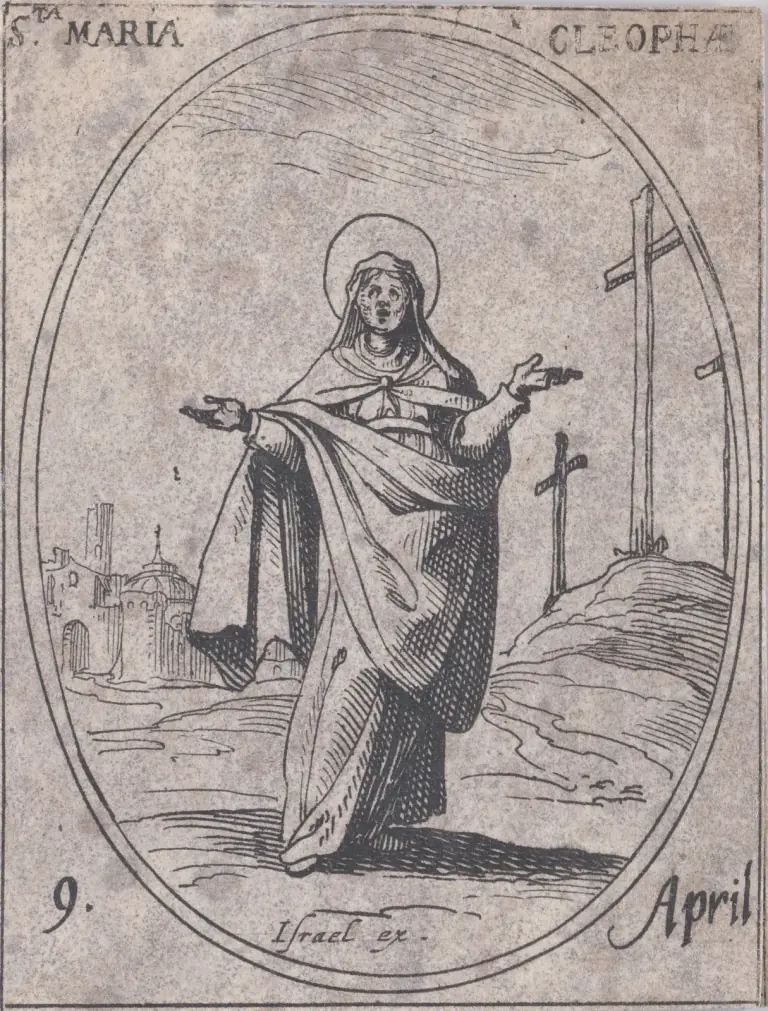
- In the Gospels
- At the cross in John 19:25; probably the Mary, mother of James and Joseph, at the cross and the tomb 123
Mary of Clopas is one of the women who stood by the cross of Jesus, named once, in the Gospel of John, as "his mother's sister, Mary of Cleophas." 2 She is usually taken to be the Mary, mother of James and Joseph, who watched the burial and went to the tomb on Easter morning with Mary Magdalene, though the Catholic Encyclopedia calls her relationship to the Virgin "obscure." 134 The Church keeps her on April 24 together with Salome. 12
At the cross
Her name occurs once. "Now there stood by the cross of Jesus, his mother, and his mother's sister, Mary of Cleophas, and Mary Magdalen." 2 Hugh Pope, writing in the 1910 Catholic Encyclopedia, notes that the title "occurs only in John 19:25." 1 The Douay-Rheims spells the name Cleophas; the Greek, Pope says, is "more correctly Clopas." 1
The other Gospels name women at the cross too. Mark says that "there were also women looking on afar off: among whom was Mary Magdalen, and Mary the mother of James the less and of Joseph, and Salome," women who had followed Jesus in Galilee "and ministered to him." 3 Matthew has "Mary Magdalen, and Mary the mother of James and Joseph, and the mother of the sons of Zebedee." 5 Comparing the lists, Pope concludes that they "would seem to identify her with Mary, the mother of James the Less and Joseph." 1
At the tomb
If that identification holds, Mary of Clopas was at the burial and at the empty tomb. Mark says that "Mary Magdalen, and Mary the mother of Joseph, beheld where he was laid." 3 When the sabbath was over, "Mary Magdalen, and Mary the mother of James, and Salome, bought sweet spices, that coming, they might anoint Jesus." 4 They found a young man in white who told them, "Be not affrighted; you seek Jesus of Nazareth, who was crucified: he is risen, he is not here." 4
Matthew calls her "the other Mary." She sat with Mary Magdalene "over against the sepulchre" on the evening of the burial, and the two came back at dawn on the first day of the week. 56 They ran from the tomb "with fear and great joy," and on the way "Jesus met them, saying: All hail. But they came up and took hold of his feet, and adored him." 6 Luke lists "Mary of James" among the women who told the apostles. 7
Pope explains the shorthand. "Mary of James" on its own would read as wife or sister of James, he says, but since the fuller form "Mary the mother of James and Joseph" keeps recurring, it must mean the same. 1 The current Roman Martyrology joins her with Salome for exactly this: the holy women who came with Mary Magdalene to the tomb on Easter morning to anoint the Lord's body and were the first to hear that he had risen. 12
His mother's sister?
John's phrase is the puzzle. Read one way, it names four women: the mother of Jesus, her sister, Mary of Clopas and Mary Magdalene. Read another, "his mother's sister" and "Mary of Cleophas" are the same woman. 12 Pope reports that some have tried to make the unnamed sister Salome, the mother of the sons of Zebedee, but thinks "St. John's reticence concerning himself and his relatives seems conclusive against this." 1
Saint Jerome, writing against Helvidius in the fourth century, took the second reading. Mary the mother of James the Less, he wrote, "was the wife of Alphæus and sister of Mary the Lord's mother, the one who is called by John the Evangelist Mary of Clopas, whether after her father, or kindred, or for some other reason." 8 He made the point to show that the "brethren of the Lord" were the sons of this Mary and not of the Virgin. 8 Even so, he left room: "I do not wish to argue for or against the supposition that Mary the wife of Clopas and Mary the mother of James and Joses were different women." 8
The 1897 English edition of the Roman Martyrology called her outright the "sister of the most Blessed Mary, Mother of God." 13 The Norwegian bishops' saints database (katolsk.no) reads "sister" in the wide Hebrew sense, as a relative, and makes her the Virgin's sister-in-law. 10 Pope calls her relationship to the Blessed Virgin simply "obscure." 1
Clopas, Alphaeus and Cleopas
The sister-in-law reading rests on a chain. Eusebius records from the second-century writer Hegesippus that "Clopas was a brother of Joseph," and that his son Symeon became bishop of Jerusalem after James. 9 Elsewhere he speaks of "Mary, the wife of Clopas, who was the father of Symeon." 9 The apostle James the Less is called the son of Alphaeus, so if Alphaeus and Clopas were one man, Mary would be the wife of Joseph's brother. 1
Jerome made that identification. 18 Pope sees "grave difficulties" in it. Luke uses both names, he points out, and would hardly have done so for one person; and he cannot see how the Aramaic behind Alphaeus became Clopas. 1 katolsk.no adds that most linguists think the identification very doubtful. 11
There is also Cleopas, one of the two disciples on the road to Emmaus in Luke. 7 Catholic.net's Spanish entry treats him as Mary's husband. 14 katolsk.no warns that it is not at all certain the Cleopas who went to Emmaus is the Clopas of John, and Pope derives the two names differently. 111
Her sons, and the legends
The Gospels give her two sons, James the Less and Joseph. 35 Later writers give more. katolsk.no names four sons, James, Simeon, Joseph and Judas, the "brothers" of Jesus in Matthew 13:55, and counts them as his cousins. 11 Catholic.net calls her the mother of Jude Thaddeus, James the Less, Simon and Joseph. 14
Legend took her further. One tradition reported by katolsk.no has her die at Ciudad Rodrigo in Spain; another, which katolsk.no dates to the eleventh century, brings her to Provence with Mary Magdalene and Salome, where the Three Marys are honored together on May 25. 10 She is usually shown with a jar of ointment. 10
What is Saint Mary of Clopas the patron saint of?
Saint Mary of Clopas's feast day
Saint Mary of Clopas's feast day is April 24. 12 The current Roman Martyrology, in the text published by the Italian bishops, commemorates on that day at Jerusalem the holy women Mary of Clopas and Salome, who came with Mary Magdalene to the Lord's tomb on Easter morning and were the first to hear the news of the Resurrection. 12 Catholic.net gives the same entry. 14
Older calendars kept her alone on April 9. The 1897 Martyrology has her there, "in Judea," and katolsk.no gives April 9 as her own day, with April 15 and April 24 also mentioned. 1013 The Three Marys are kept together on May 25. 10
Praying with Saint Mary of Clopas
The whole of what is certain about her is that she stood by the cross. 12 John puts her name between the mother of Jesus and Mary Magdalene, among the few who did not leave. 2
If she is the Mary of the other Gospels, then she also watched where he was buried, waited out the sabbath, bought spices and went at dawn to do the last thing that could be done for a dead man. 34 It was that errand that brought her to the empty tomb. 412
Matthew says the women ran from the tomb "with fear and great joy." 6 Mark ends with the fear alone: "they said nothing to any man; for they were afraid." 4 The Church remembers her as one of the first to hear that he had risen. 12
Saint Mary of Clopas, pray for us.
Sources
- 1.Hugh Pope, "Mary of Cleophas," The Catholic Encyclopedia, Vol. 9 (New York: Robert Appleton Company, 1910).
- 2.John 19, Douay-Rheims Bible (Challoner revision).
- 3.Mark 15, Douay-Rheims Bible (Challoner revision).
- 4.Mark 16, Douay-Rheims Bible (Challoner revision).
- 5.Matthew 27, Douay-Rheims Bible (Challoner revision).
- 6.Matthew 28, Douay-Rheims Bible (Challoner revision).
- 7.Luke 24, Douay-Rheims Bible (Challoner revision).
- 8.Jerome, The Perpetual Virginity of Blessed Mary (Against Helvidius), chapters 13-16, translated by W.H. Fremantle, G. Lewis and W.G. Martley, Nicene and Post-Nicene Fathers, Second Series, Vol. 6 (Buffalo: Christian Literature Publishing Co., 1893), as hosted by New Advent.
- 9.Eusebius, Church History, Book III, chapters 11 and 32, translated by Arthur Cushman McGiffert, Nicene and Post-Nicene Fathers, Second Series, Vol. 1 (Buffalo: Christian Literature Publishing Co., 1890), as hosted by New Advent.
- 10."De tre Mariaer (Maria Magdalena, Maria av Kleofas og Maria Salome) (1. årh)," Den katolske kirke (katolsk.no), Catholic Diocese of Oslo (in Norwegian).
- 11."Den hellige Kleofas (1. årh)," Den katolske kirke (katolsk.no), Catholic Diocese of Oslo (in Norwegian).
- 12.Roman Martyrology, entry for April 24, "Sante donne Maria di Cleofa e Salomè," as printed in "Santo del giorno," Conferenza Episcopale Italiana (in Italian).
- 13.The Roman Martyrology, April 9 (Baltimore: John Murphy Company, 1897).
- 14.Ángel Amo, "María de Cleofás, Santa," with the Roman Martyrology entry for April 24, Catholic.net (in Spanish).
Saints to turn to next
Others in this collection who are turned to for some of the same things.
- Saint Bridget of Swedenc. 1303 - July 23, 1373Marriage and familySuffering and illness
- Saint Clotildec. 474 - June 3, 545Marriage and familySuffering and illness
- Saint Elizabeth of Portugal1271 - July 4, 1336Marriage and familySuffering and illness
- Saint EustaceMartyred at Rome, in 118 by tradition; other accounts give 140 or 188Marriage and familySuffering and illness