Martyrs of Košice
Died 1619
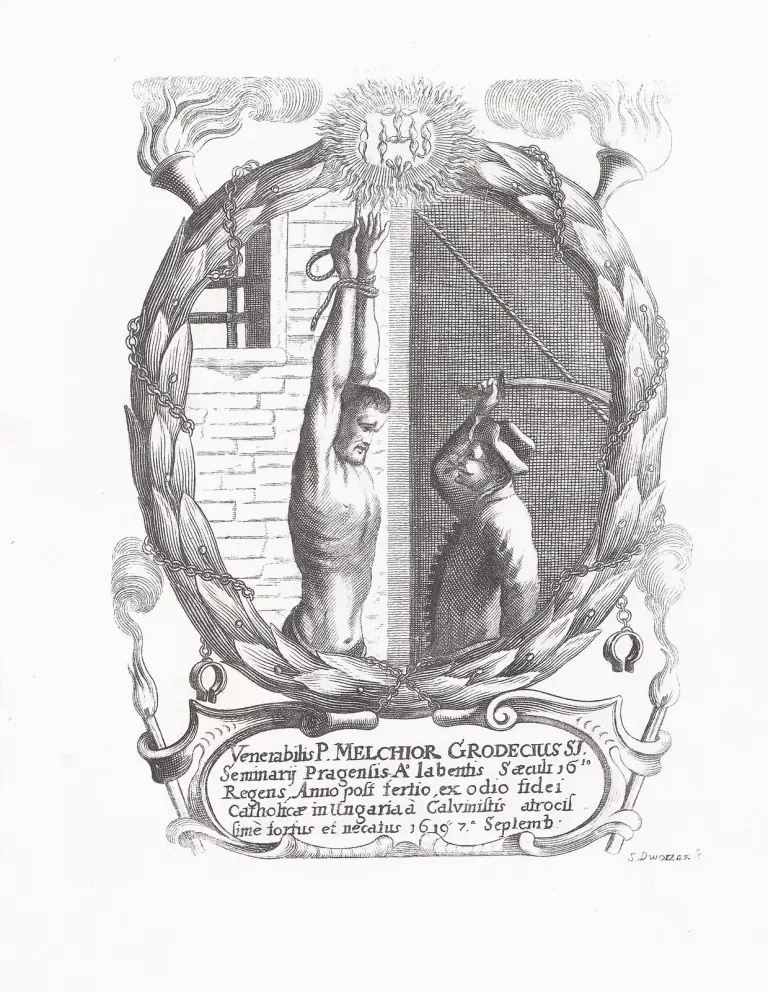
- Who
- Mark of Križevci (Marko Krizin, Marcus Crisinus), canon of Esztergom; Stephen Pongrácz, S.J.; Melchior Grodziecki, S.J. 137
- Beatified
- By Pius X in 1905 4
- Feast day
- September 7 7
The Martyrs of Košice were three Catholic priests from three nations, a Croatian canon and two Jesuits, one Hungarian and one Polish, who were killed together at Košice, in what is now Slovakia, in September 1619. 13 When Calvinist troops took the city in the first years of the Thirty Years' War, the three were imprisoned, starved, offered their freedom if they would renounce the Catholic faith, and tortured and put to death when they refused. 47 Their feast is September 7. 7
Three priests, three nations
John Paul II, who canonized them at Košice in 1995, introduced them one by one. Mark of Križevci was a canon of Esztergom who had come from his native Croatia to serve a Church short of priests, and who, like the good shepherd and not the hired hand, did not abandon his flock when danger came. 1 Stephen Pongrácz was a Hungarian Jesuit from Transylvania who had left behind the prospect of a brilliant worldly career. 1 Melchior Grodziecki was a Polish Jesuit from Silesia who had spent years in Prague as an educator of the young. 1
The three new saints, the Pope said, belonged to three different nations but shared the same faith, and it held them together in death. 1 He asked that their example strengthen understanding between the peoples of the region, and in particular between Slovaks and the Hungarian minority. 1
Mark of Križevci
Catholic.net, in a series of articles by the Jesuit Jaime Correa Castelblanco, gives the lives in more detail. Mark was born at Križevci (in Hungarian, Kőrös) in Croatia in 1588 and sent at twelve to the Jesuit college in Vienna, where Melchior was a few years ahead of him. 4 He studied philosophy at Graz, decided to become a diocesan priest rather than a Jesuit, and entered the German-Hungarian College in Rome in November 1611. 4
Ordained in 1615, he went home to Croatia and worked among the villages. 4 Peter Pázmány, archbishop of Esztergom and his old Jesuit teacher, made him rector of the seminary at Trnava and then a canon of the cathedral, and the chapter gave him the administration of the abbey lands of Széplak near Košice. 4 His visits to Košice brought him back to his two Jesuit friends, and in July 1619 the three made an eight-day retreat together. 4
Stephen Pongrácz and Melchior Grodziecki
Stephen was born in 1582 into a leading Hungarian family, Catholic.net says, at a castle near Alba Iulia in Transylvania. 5 He studied with the Jesuits at Cluj, entered the Society at Brno in 1602, and studied at Prague and Graz. 5 Ordained, he became known as a preacher whose sermons brought many Hungarians back to the Catholic faith, so that a Calvinist preacher named Alvinczy is reported to have said that as long as this Jesuit lived, neither he nor the Reformed religion would have a quiet day. 5 He came to the garrison at Košice in 1618 at the request of its Catholic governor, Andrew Dóczy. 5
Melchior was born in 1584. 6 Catholic.net places his birth at Cieszyn in Silesia; John Paul II, greeting Polish pilgrims, said he came from Grodziec, a village between Bielsko and Cieszyn. 26 He entered the Society at Brno a year after Stephen, and the two were friends from the novitiate. 6 Ordained at Prague in 1614, he cared for the Czech-speaking faithful around the city and especially for poor boys. 6
The sources tell his move to Košice differently. John Paul II said that he was forced to leave Prague with the other Jesuits when the Thirty Years' War broke out, traveled through Moravia and Slovakia, and settled at Košice. 1 Catholic.net says his superiors sent him there, after the war had cut short his final year of formation, as chaplain to the Catholic soldiers of the imperial garrison. 6
The siege of Košice
On September 3, 1619, Catholic.net says, the Calvinist commander George Rákóczi arrived before Košice with a large army, demanded the surrender of the city and of its governor, and gave his word that no one who submitted peacefully would suffer violence. 4 The city council agreed, and Dóczy was handed over. 4 The three priests were then confined to their rooms under guard, and Stephen's demand to be tried before proper judges was refused. 5
For three days they were given nothing to eat or drink, Catholic.net says, and when they asked for food the guards mocked them by offering meat on a Friday. 5 Knowing that the law of abstinence did not bind them in such need, but that eating would be paraded as proof that they had given up their faith, they agreed together to refuse it. 5 The current Roman Martyrology names hunger first among the things that could not make them deny the Catholic faith. 7
Mark was offered the abbey of Széplak for his own if he would accept Calvin's teaching. He replied that the commander was giving away what was not his to give, that he did not sell his faith, and that if they wanted to kill him he was ready to give his life for the Catholic faith. 5 On the afternoon of September 6 he was offered his freedom for a ransom; he accepted on condition that it cover his two friends, and when that was refused he chose to stay with them. 45 Stephen answered for the three: if that was their crime, they would die for the faith. 5
The night of September 6
The three heard one another's confessions and prepared to die. 5 The current Martyrology says that neither hunger nor the torture of the wheel and of fire could bring them to deny the Catholic faith. 7 Of Mark's death Catholic.net says that he was beaten with clubs and swords and urged to go over to the side that was fighting the Catholic Habsburgs for the freedom of his country. 4 He said that God forbid he should be the enemy of anyone working for his country's freedom, and Stephen, hearing him, called out not to deny the faith. 4 Mark told him not to be afraid: he would never betray the faith and would rather die; he loved his country, but he was a Catholic. He was burned with torches and beheaded. 4
At dawn the three bodies were thrown into a sewer well. Stephen was still alive and lived there some twenty hours, repeating only the names of Jesus and Mary. 5 When the chapel sacristan told him that the Catholic senator who might have rescued him had also been killed, he answered that God's will be done, and died soon after. 5 Six months later the Countess Katalin Pálffy obtained a proper burial, and their remains now rest in the Ursuline church at Trnava. 5
Cult and canonization
Their cult began at once, John Paul II said, and the Church declared them blessed at the start of the twentieth century after a careful process. 3 Catholic.net gives the year of their beatification by Pius X as 1905, and says that Cardinal Pázmány had already asked Urban VIII for permission for their public cult. 45 John Paul II canonized them at Košice on July 2, 1995. 13
He told the Slovak Church that they gave their lives without yielding to a civil power that wanted to force them into apostasy, and that they accepted death in a spirit of faith and of love for their persecutors. 3 He also asked that the Protestants who suffered in the same troubled century be remembered, and spoke of the twenty-four members of the evangelical churches put to death at Prešov, before whose memorial he prayed during the same visit. 13
What are the Martyrs of Košice the patron saints of?
The Martyrs of Košice's feast day
The feast day of the Martyrs of Košice is September 7, the day they died. The current Roman Martyrology, as the Italian bishops print it, enters the three together on that day at Košice in the Carpathians. 7
Praying with the Martyrs of Košice
They were friends before they were martyrs: schoolmates in Vienna, novices together at Brno, companions on an eight-day retreat two months before they died. 456 They prepared for death the same way, by hearing one another's confessions. 5
Mark was the one with a way out, a ransom offered to him alone. 45 He would take it only if it covered the other two, and when it would not, he stayed. 45
Under torture he was urged to join the side that was fighting for his country's freedom. He would not be made to choose: he loved his country, he said, and he was a Catholic. 4
John Paul II canonized them as a sign for peoples who had long been divided, and in the same visit prayed at the memorial of Protestants who had died for their consciences. 13 The three martyrs, he said, accepted death with love for their persecutors. 3
Martyrs of Košice, pray for us.
Sources
- 1.John Paul II, Homily for the canonization of the three Martyrs of Košice, Košice, July 2, 1995 (in Italian), vatican.va.
- 2.John Paul II, Angelus, Košice, July 2, 1995 (in Italian), vatican.va.
- 3.John Paul II, General Audience, July 5, 1995 (in Spanish), vatican.va.
- 4.Jaime Correa Castelblanco, S.J., "Marco Crisino (Krizevcanin), Santo," Catholic.net (in Spanish).
- 5.Jaime Correa Castelblanco, S.J., "Esteban (István) Pongracz, Santo," Catholic.net (in Spanish).
- 6.Jaime Correa Castelblanco, S.J., "Melchor Grodziecki, Santo," Catholic.net (in Spanish).
- 7.Roman Martyrology, entry for September 7, Santo del giorno, Conferenza Episcopale Italiana (in Italian).
Saints to turn to next
Others in this collection who are turned to for some of the same things.