Saints Martinian and Saturian
d. 5th century (c. 458, says katolsk.no)
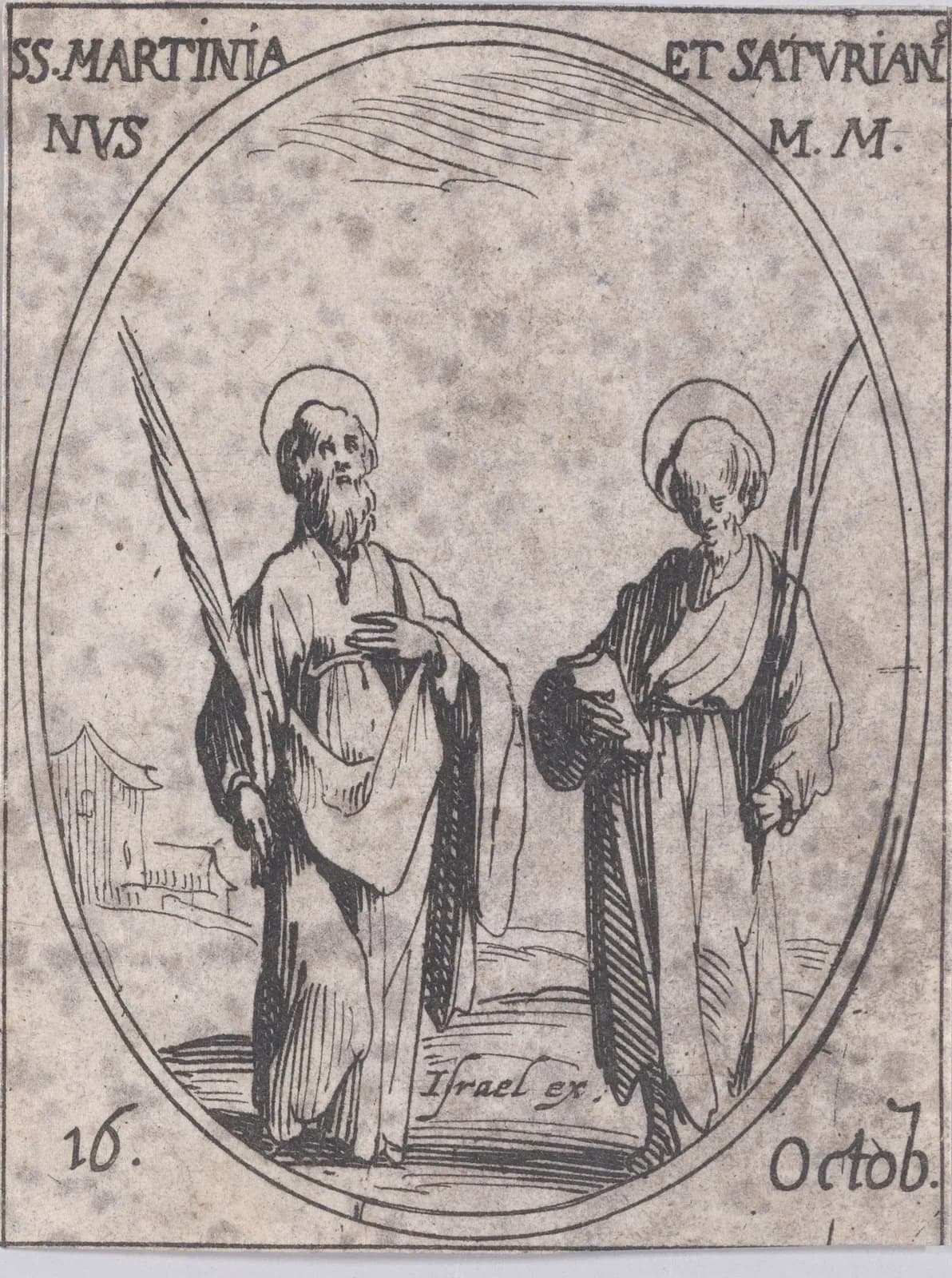
- Exiled to
- A Moorish king named Capsur, in the desert 1
Saints Martinian and Saturian were brothers and slaves in the household of a Vandal officer in Africa in the fifth century, when the Arian king Geiseric ruled there. 12 A fellow slave named Maxima, who had vowed her life to God, refused to marry Martinian and instead won him for Christ, and he won his three brothers. 1 Exiled to a pagan Moorish king, they converted the people they were sent to, and were killed for it. 12 Victor of Vita, who knew Maxima, wrote their story down within living memory. 1
An armorer and a housekeeper
The story is told by Victor, a bishop of Vita in the province of Byzacena, in his history of the persecution of the Catholics of Africa under the Vandal kings Geiseric and Huneric. 14 Patrick Healy, in the 1912 Catholic Encyclopedia, says the first book of that history, which covers Geiseric's reign, is drawn from the accounts of others, and that Victor exaggerates at times, but that "he records little that did not happen." 4 Victor himself vouches for parts of this story: he says he knew Maxima, and that a jailer swore to him under oath that one of its miracles had happened. 1
Victor introduces the household plainly. A Vandal, one of the officers the Vandals called millenarii, owned four brothers: Martinian, Saturian and two more. 1 He also owned a woman named Maxima, whom Victor calls a remarkable handmaid of Christ, beautiful in body and in heart. 1 Martinian was an armorer and stood high in his master's favor, and Maxima ran the whole household. 1
The master decided that the way to bind his two best servants to him was to marry them to each other. 1 Martinian, Victor says, wanted the marriage as young men do. Maxima had already given herself to God and would not have a human husband. 1 When they were brought to the bedroom she told him that she had dedicated her body to Christ, that she already had a true husband in heaven, and that if he wished, he too could serve the one she had chosen. 1 He listened. Victor says that by obeying the virgin, the young man gained his own soul. 1
The monastery at Tabraca
Without the Vandal knowing, Martinian persuaded his brothers to share in what he had found, as brothers share an inheritance. 1 One night the four of them slipped away with Maxima and joined the monastery at Tabraca, which was then governed by an abbot named Andrew, whom Victor calls a noble shepherd. 1 Maxima lived in a community of women not far off. 1
The Roman Martyrology tells the conversion slightly differently. It says the brothers were converted by Maxima, their companion in slavery. 2 Victor's account is that she converted Martinian, and Martinian his brothers. 1
Their master searched for them, with questions and bribes, and found them. 1 He put them in chains and tortured them. Victor says he wanted not only to force the couple together, but, worse, to make all of them be baptized again into the Arian church, which he calls defiling the ornament of their faith. 1 Klemens Löffler, writing on the Vandals in the same encyclopedia, says they "treated the Catholics more harshly than other German peoples." 5
Beaten and healed
The case came to King Geiseric himself, who ruled that the master should go on tormenting his slaves until they gave in. 1 Victor describes the instruments: heavy clubs cut with spurs like the teeth of a saw, which broke bones and left splinters in the flesh. 1 The Martyrology remembers that they were beaten with great clubs and torn to the bone for holding to the true faith. 2
Victor says that the next day, Christ healing them, they were whole again, and that this happened often and over a long time, with no marks left. 1 Maxima was shut in harsh confinement and stretched in the stocks. 1 As the servants of God visited her, the heavy timbers that held her rotted and fell apart in front of everyone. 1 Victor says the man in charge of her custody swore to him that it was so. 1
Then, Victor writes, the master's own house began to fall. He died, and his sons died, and the best of his servants and animals with them. 1 His widow gave the slaves away to a kinsman of the king named Sersao. When trouble came to Sersao's household in turn, he reported it to Geiseric. 1
Missionaries in exile
Geiseric let Maxima go. Victor says the king, confounded and beaten, released her to do as she wished, and that at the time he wrote she was still alive, a virgin and the mother of many virgins of God, and well known to him. 1 The Martyrology says she ended her life in holiness in a monastery, where she had become the mother of many virgins. 2
The brothers were sent to a pagan Moorish king named Capsur, who lived in a part of the desert called Caprapicti. 1 There they saw sacrifices they could not accept, and they began, by their preaching and by the way they lived, to draw the people toward God. 1 Victor says they won a great multitude, in a place where the name of Christ had never been heard. 1
The converts needed baptism. The brothers sent messengers across the desert to a Roman city and asked its bishop for a priest and ministers, and he sent them gladly. 1 A church was built and a great number were baptized; out of wolves, Victor writes, a flock of lambs. 1 The Martyrology records that they were condemned to death for leading others to Christ. 2
Behind the chariots
Capsur reported the conversions to Geiseric. 1 Victor says the king, stirred by envy, ordered the brothers tied by the feet behind running four-horse chariots and dragged back and forth through the thorny brush of the woods until they died. 1 He arranged it so that each could watch the others die. 1 katolsk.no describes it as being tied behind horses and dragged to death, and dates it to 458. 3 Victor gives no year.
As the horses ran past one another and the Moors wept, the brothers caught sight of each other and said goodbye. 1 Victor gives their words: "frater ora pro me: implevit deus desiderium nostrum: taliter pervenitur ad regnum caelorum." 1 Brother, pray for me; God has granted what we longed for; this is how one comes to the kingdom of heaven. They died praying and singing psalms. 1
Victor adds that miracles went on at the place where they died, and that a bishop named Faustus told him he had been present when a blind woman received her sight there. 1
What are Saints Martinian and Saturian the patron saints of?
Saints Martinian and Saturian's feast day
The feast of Saints Martinian and Saturian is October 16. 23 The current Roman Martyrology commemorates them on that day as martyrs in Africa together with their two brothers, under the Arian king Geiseric, and remembers Maxima in the same entry. 2 katolsk.no gives the same date and notes that their names stand in the Martyrology. 3
Praying with Saints Martinian and Saturian
Nothing in this story begins with anyone free. Maxima and the brothers were property, married to each other by order and hunted down when they left. 1 What changed their lives was one woman saying no to her master's plan on her wedding night, and saying it as an invitation. 1
Martinian passed the gift on to the people nearest him, his brothers. 1 Years later, sent away as slaves to a country with no Christians, the four of them did the same thing again, and asked a bishop to come and baptize the people who had listened. 1
Victor does not soften the end. They were killed slowly, in sight of each other, and the last thing he records them saying is a request for prayer. 1 Maxima outlived them and spent her freedom gathering other women to God. 12
Saints Martinian and Saturian, pray for us.
Sources
- 1.Victor of Vita, Historia persecutionis Africanae provinciae, Book I, sections 30-38, ed. Karl Halm, Monumenta Germaniae Historica, Auctores Antiquissimi III.1 (Berlin: Weidmann, 1879) (in Latin).
- 2.Roman Martyrology, entry for October 16, "Santi Martiniano e Saturiano e due fratelli, martiri," as printed in "Santo del giorno," Conferenza Episcopale Italiana (in Italian).
- 3."De hellige Martinian, Saturian, Maxima av Mauretania og deres ledsagere (d. 458)," Den katolske kirke (katolsk.no), Catholic Diocese of Oslo (in Norwegian).
- 4.Patrick Healy, "Victor Vitensis," The Catholic Encyclopedia, Vol. 15 (New York: Robert Appleton Company, 1912).
- 5.Klemens Löffler, "Vandals," The Catholic Encyclopedia, Vol. 15 (New York: Robert Appleton Company, 1912).
Saints to turn to next
Others in this collection who are turned to for some of the same things.
- Saint CyprianBirth unknown - September 14, 258CourageConversionSuffering and illness
- Saint EustaceMartyred at Rome, in 118 by tradition; other accounts give 140 or 188ConversionCourageSuffering and illness
- Saint Gregory the Illuminatorc. 257 - c. 337 (both dates uncertain)ConversionSuffering and illnessCourage
- Saint John Paul IIMay 18, 1920 - April 2, 2005CourageSuffering and illnessConversion