Saint Maron
Died about 410, or in 433
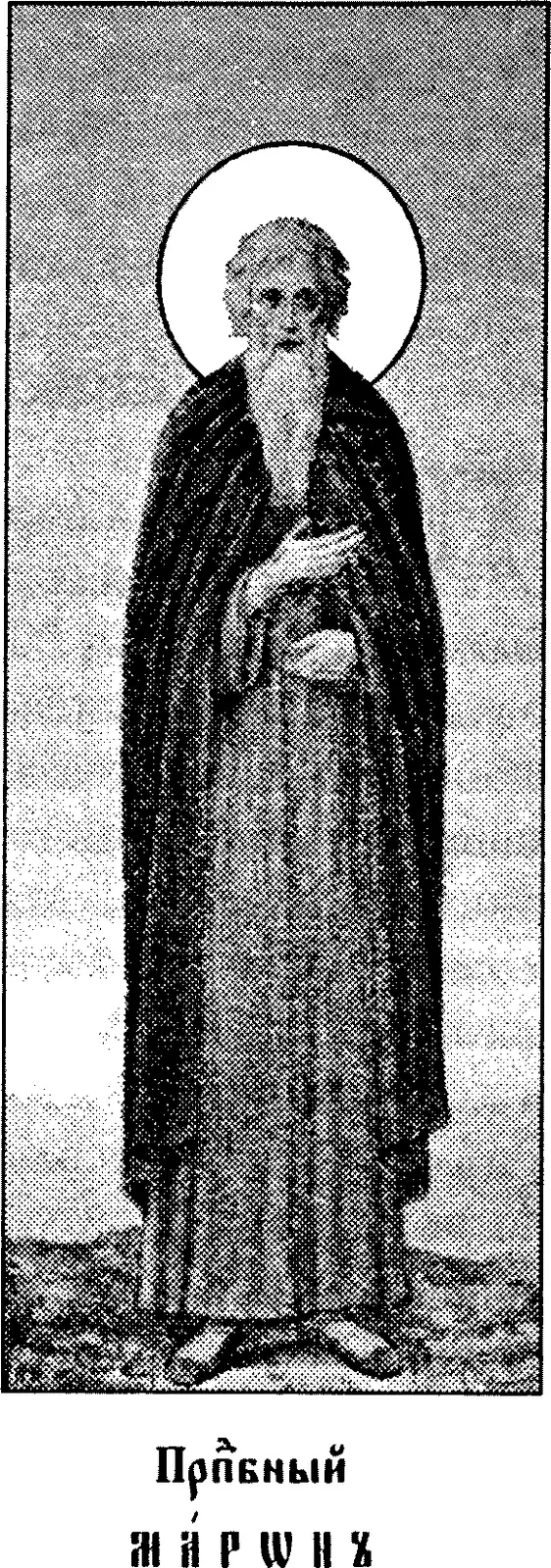
- Died
- In 433, say Butler and katolsk.no 13; the Maronite jubilee for the 1,600th anniversary of his death closed in 2011 4
- Venerated
- By the Maronites as their patriarch, patron and founder, says katolsk.no 3
Saint Maron was a hermit in Syria who lived under the open sky on a mountain, turned a pagan temple into a place of prayer, and trained so many others to live as he did that his bishop counted the monks of a whole diocese as the fruit of his teaching. 13 A monastery was built at his tomb, and from it, the Roman Martyrology says, came the Christian community that bears his name: the Maronites. 6 His feast is February 9. 6
A hermit under the sky
Butler, following the account Theodoret of Cyrrhus wrote of the Syrian monks, says Maron chose a mountain for his solitude and lived there "for the most part in the open air." 1 He had a small hut covered with goatskins to keep off the weather, but he seldom used it, even when the weather was at its worst. 1 The current Roman Martyrology places the mountain near Apamea in Syria. 6
There was a pagan temple on the mountain. Maron dedicated it to the true God and made it his house of prayer. 13 Butler says he was ordained a priest in 405, because of his reputation for holiness. 1
He had learned from a master. Butler names him as Saint Zebinus, who "surpassed all the solitaries of his time" in perseverance in prayer, praying whole days and nights standing, and in old age leaning on a staff to keep praying. 1 The Norwegian bishops' saints database (katolsk.no) says Zebinus answered visitors in as few words as possible so as to spend the most time in conversation with God. 3
Prayer through the night
Maron kept his master's constancy in prayer, but not his brevity with visitors. He "received all visitants with great tenderness," Butler says, and urged them to stay, "though few were willing to pass the whole night in prayer standing." 1 katolsk.no says the same: visitors were received kindly and encouraged to pray with him, which often meant standing all night. 3
People came for healing too. Butler says God gave him "the gift of curing all distempers, both of body and mind," and that "he prescribed admirable remedies against all vices." 1 His name spread, and so did his way of life. He founded many monasteries in Syria and trained many hermits, and Theodoret, bishop of Cyrrhus, said that the great number of monks in his diocese were the fruit of Maron's teaching. 13
The best known of his disciples was Saint James of Cyrrhus, who, Butler says, "gloried that he had received from the hands of St. Maro his first hair-cloth." 1
A letter from Chrysostom
Saint John Chrysostom, banished from Constantinople, wrote to him from Cucusus, his place of exile. 13 Butler says Chrysostom "had a singular regard for him," asked for his prayers, and begged to hear from him at every opportunity. 1 katolsk.no adds that the letter survives as Chrysostom's thirty-sixth. 3
The quarrel over his body
He died after a short illness, which, Butler says, citing Theodoret, showed how weak his long penance had left his body. 1 Butler and katolsk.no both give the year as 433. 13
There followed what Butler calls "a pious contest" among the neighboring provinces over where he should be buried. The people of a large town carried off the body and built a spacious church over the tomb, with a monastery beside it. 1 Butler admits in a footnote that three monasteries bore his name, one near Apamea, one on the Orontes between Apamea and Emesa, and one in the Palmyrene, and that it is not certain which held his body; he thought the second most likely. 1 The current Martyrology says simply that a famous monastery was built at his tomb. 6
Beit-Marun and the Maronites
The monastery of Saint Maron, Beit-Marun, between Apamea and Emesa on the Orontes, is well attested from the sixth century. 2 The 1910 Catholic Encyclopedia says its monks suffered for their loyalty to the Council of Chalcedon, and that in 517 they complained to Pope Hormisdas that the Monophysites had massacred 350 of them. 2 Their abbot, Butler notes, was styled primate of all the monasteries of Second Syria. 1
The Maronites take their name from Maron through this monastery. 236 How their early history should be told is disputed. Butler says they took the name in the fifth century, held to Chalcedon, and have always kept communion with Rome apart from a short time. 1 The 1910 Catholic Encyclopedia article on the Maronites reads the documents differently: it holds that the monks of Beit-Marun later took the Monothelite side, and that the Maronites' claim of unbroken orthodoxy cannot be shown, though it also sets out their own account. 2 katolsk.no says their origin is disputed and that they have been united with Rome since 1182. 3
Whatever their early history, the Maronites hold Maron as their father. katolsk.no says they regard him as their patriarch, patron and founder and name him in the canon of their Mass. 3 In 2011 Benedict XVI greeted the new Maronite patriarch as "the 87th Successor of St Maron, Father and Head of the Church of Antioch for Maronites." 5
A jubilee and a statue
The Maronite Church kept a jubilee year for the 1,600th anniversary of Maron's death. Benedict XVI, writing in February 2011, said that year was "drawing to a close," and that "a few days ago, at the end of the Jubilee, I blessed the statue of St Maron at St Peter's Basilica." 4 That anniversary counts back to about 410, more than twenty years earlier than the date Butler and katolsk.no give. 134
In April, receiving Patriarch Béchara Boutros Raï, the pope called his election "the most eminent fruit of the numerous graces" the saint had obtained for his Church. 5 katolsk.no adds that his cult was confirmed by Pope Benedict XIV in 1753, and that he is shown as a hermit, praying or preaching in front of his hut. 3
What is Saint Maron the patron saint of?
Saint Maron's feast day
Saint Maron's feast day is February 9. The current Roman Martyrology, as the Italian bishops publish it, remembers him that day as a hermit on a mountain near Apamea, "wholly given to harsh penance and to contemplation." 6
February 9 is the Maronites' own date. Butler, who places him on February 14, says that "the Maronites keep the feast of St. Maro on the 9th, the Greeks on the 14th of February." 1 katolsk.no likewise gives February 14, and February 9 among the Maronites. 3
Praying with Saint Maron
Maron's life, as Butler tells it from Theodoret, was mostly prayer, much of it standing, much of it at night, and most of it outdoors. 1 He took over a temple built for other gods and prayed in it. 13
He did not keep the life to himself. Where his master gave visitors as few words as possible, Maron asked them to stay, and prayed with them through the night if they would. Few would. 13
The sources disagree about when he died and where he was buried. 14 What lasted was what he passed on: hermits, monasteries, and in the end a Church that still calls him father. 135
Saint Maron, pray for us.
Sources
- 1.Alban Butler, "St. Maro, Abbot," February 14, in The Lives of the Fathers, Martyrs, and Other Principal Saints, Vol. I (New York, 1895), Project Gutenberg eBook #20450.
- 2.J. Labourt, "Maronites," The Catholic Encyclopedia, Vol. 9 (New York: Robert Appleton Company, 1910).
- 3."Den hellige Maro av Beit-Marun," Den katolske kirke, the saints database of the Catholic Church in Norway, katolsk.no (in Norwegian).
- 4.Benedict XVI, Letter to Cardinal Nasrallah Pierre Sfeir on his resignation as Patriarch of Antioch for Maronites, February 26, 2011.
- 5.Benedict XVI, Address to His Beatitude Béchara Boutros Raï, Patriarch of Antioch for Maronites, April 14, 2011.
- 6.Roman Martyrology, entry for February 9, "San Marone, eremita," Santo del giorno, Conferenza Episcopale Italiana (in Italian).
Saints to turn to next
Others in this collection who are turned to for some of the same things.