Saint Mark of Arethusa
Fourth century; date of death uncertain
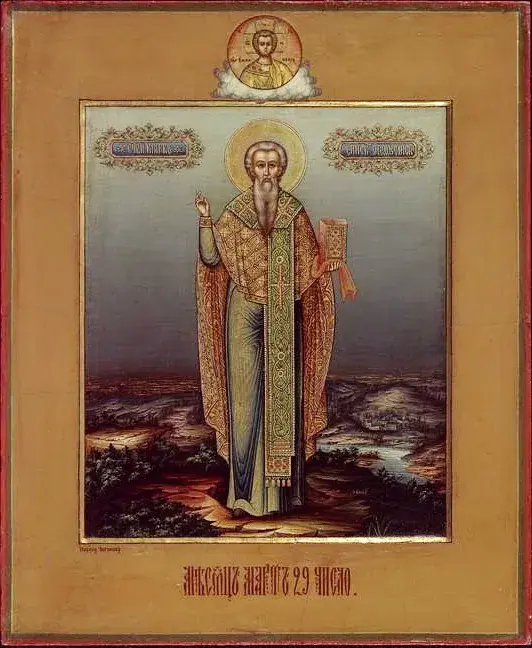
Saint Mark was bishop of Arethusa in Syria in the fourth century, and an old man when the pagans of his city strung him up in a basket smeared with honey for the wasps, because he would not pay a single coin toward rebuilding a temple he had pulled down. 123 Gregory Nazianzen, who told the story after Julian's death, adds that Mark had once helped save the life of the boy who became the emperor Julian the Apostate. 1 He is also remembered, less comfortably, for a creed he wrote at a council of the Arian years, and the sources still do not agree on what to make of it. 5678
A bishop of the council years
Almost nothing is known of where he came from. He first appears among the bishops of the East in the long quarrels that followed the Council of Nicaea, when the question of how the Son is related to the Father divided the Church and emperors summoned one council after another to settle it. 45
In 351 the emperor Constantius called a synod at Sirmium, on the Danube, to deal with Photinus, the bishop of that city, whose teaching on Christ, Sozomen says, was opposed alike by the defenders of Nicaea and by the followers of Arius. 4 The church historian Socrates lists Mark of Arethusa first among the Eastern bishops present. 5 They deposed Photinus, and Socrates says the decision was "universally commended as honorable and just." 5 What followed he liked less. The bishops published new statements of faith, "viz.: one which Mark of Arethusa composed in Greek; and others in Latin, which harmonized neither in expression nor in sentiment with one another, nor with that dictated by the bishop of Arethusa." 5 Sozomen, writing a little later, describes the Greek formulary as saying neither that the Son is consubstantial with the Father nor that he is of like substance, while condemning those who taught that the Son had no beginning. 4
Sozomen mentions him twice more. When Eudoxius, who held with Aëtius that the Son is unlike the Father, made himself bishop of Antioch, he did so without the sanction of George of Laodicea, "of Mark, bishop of Arethusa; of the other Syrian bishops." 4 And in 359, when Constantius was preparing the twin councils of Ariminum and Seleucia, Mark was among the bishops at the court at Sirmium whom the party of Valens of Mursa pressed to sign a formula with no mention of the word substance. 4 Sozomen does not say what Mark did.
The boy he saved
Gregory Nazianzen, in the first of his invectives against Julian, written after the emperor's death, adds a detail the other historians leave out. When Julian's whole family was in danger, Gregory says, "amongst those who saved the villain when his whole family was in danger, and carried him off by stealth, this Marcus was one." 1 Gregory turns it into a bitter joke: for that deed alone, he says, Mark perhaps deserved what was later done to him, "because he had unwittingly preserved such a pest to the whole world!" 1
Alban Butler, in the eighteenth century, fills in the circumstances. When Constantius put to death his uncle Julius Constantius, brother of Constantine the Great, the two younger sons, Gallus and Julian, "narrowly escaped the sword. In that danger Mark concealed Julian, and secretly supplied him with necessaries for his subsistence." 6
The temple at Arethusa
Under the Christian emperors Mark had pulled down a pagan temple at Arethusa and built a church in its place. 12 Gregory and Theodoret place this under Constantius; Sozomen under Constantine; Butler says it was done "by the authority of Constantius." 1236 Gregory says he turned many from paganism "no less by the sanctity of his life than through the power of his preaching." 1 Sozomen is cooler: Mark had brought the pagans to Christianity "more spiritedly than persuasively," and the city had long held it against him. 3
When Julian became emperor and restored the old worship, the temples Christians had destroyed were to be rebuilt at their expense. 36 At Arethusa Mark was ordered either to rebuild the temple or to pay for it. 3 He first fled, which all three early writers defend as obedience to the Gospel command to flee from one city to another. 123 Then he learned that members of his flock had been seized and were being tortured in his place, and he came back and gave himself up. 123
The basket and the wasps
Gregory, Theodoret and Sozomen tell what followed in much the same order. Gregory says the old man was led through the city by "men and women, old and young," was "dragged through the streets," "thrust into the sewers," and "tossed in the air from one set of school-boys to another, who caught that noble body on the points of their writing-styles." 1 His legs were squeezed with slip-knots to the bone, and his ears cut through with twine. 13 Then they smeared him with honey and pickle, put him in a basket and hung it up at noon in the heat of summer for the bees and wasps. 123
Through all of it, the sources agree, he would not pay. Gregory explains why that mattered. While the sum was large, his refusal could be taken for poverty, so his tormentors kept lowering it, until "the sum demanded was extremely small, and very easy for him to pay," and many people were ready to pay it for him. 1 He would not have it paid. 1 Theodoret gives his answer: "it is as impious to give an obole as to give all." 2 Butler renders it that "it would be an impiety to give them one farthing towards such a work." 6
He answered them from the basket. In Theodoret, he mocked them: "You are groundlings and of the earth; I, sublime and exalted." 2 Gregory has him say "that he approved of the omen, beholding himself raised on high, and them humbled and lying below him." 1 Sozomen adds that it reminded him of the difference there would be between them in the life to come. 3
Gregory and Sozomen both report that the prefect, a pagan whom both admired, rebuked the emperor over it. 13 In Gregory's version he asked, "Are we not ashamed, Sire, to be so much beaten by all Christians as to be unable to get the better of a single old man, that has undergone every kind of torture?" 1
How it ended
The sources part company here. Theodoret says that in the end "they let him go, and could not refrain from admiring his constancy." 2 Butler agrees, adds that several of his tormentors afterward asked him to teach them the faith, and says he "died in peace under Jovian or Valens." 6 Sozomen's chapter begins by saying that he "was put to a very cruel death," but what it goes on to tell is the torture, ending with Mark enduring it "with such unshaken fortitude that even the pagans praised him." 3 katolsk.no says one version has Julian pardon him, but that he is usually said to have died a martyr about 362. 7 The current Martyrology speaks of violent persecution and does not call him a martyr. 8
The question of his faith
Butler, who honored the courage, did not hide his doubts about the rest. Mark "had been long engaged in the errors and intrigues of the Semi-Arians," he wrote, "but the encomiums given him by St. Gregory Nazianzen, Theodoret, and Sozomen, when they relate his sufferings, show that towards the end of the reign of Constantius, he joined in the orthodox communion." 6 In Butler's day, he noted, Mark was "not named in the Roman Martyrology." 6 The 1897 English edition of the Martyrology indeed has no entry for him on March 29. 9
katolsk.no tells the same history from the other side. The creed he wrote at Sirmium, it says, led the historian and cardinal Caesar Baronius to accuse him of Arianism unjustly, and Baronius removed his feast when he revised the Roman Martyrology in the sixteenth century; the Bollandists have since cleared him. 7 The current Martyrology, as the Italian bishops print it, goes furthest: it says that in the time of the Arian controversy he never strayed from the right faith. 8
What is Saint Mark of Arethusa the patron saint of?
Saint Mark of Arethusa's feast day
Saint Mark of Arethusa's feast day is March 29. 78 The current Roman Martyrology, as the Italian bishops print it, commemorates him on that day as bishop of Arethusa in Syria, who never strayed from the right faith in the Arian controversy, suffered violent harassment under Julian the Apostate, and was hailed by Saint Gregory Nazianzen as an outstanding man and an elder of most holy life. 8 Butler gave the same day as the one on which "some Greeks rank among the saints" Mark, bishop of Arethusa. 6 The 1897 English Martyrology has no entry for him on March 29, though it does list Cyril of Heliopolis there. 9
Praying with Saint Mark
Mark ran, at first. Gregory, Theodoret and Sozomen all took care to say that the flight was no failure, and all three tell why he came back: other people were being hurt in his place. 123
What he refused was small by the end. Gregory saw the point of that: as long as the sum was large, nobody could tell whether he was refusing out of conscience or out of poverty, and when it had shrunk to almost nothing, and friends would gladly have paid it, he still said no. 1
The man in the basket had once hidden the child who became his persecutor. 16 None of the early writers says that he spoke of it.
His life does not come down to us tidy. He wrote a creed that later readers judged harshly, and the Church has disagreed with itself about him for centuries. 5678 Gregory called him "that admirable man." 1
Saint Mark of Arethusa, pray for us.
Sources
- 1.Gregory Nazianzen, Oration 4, First Invective Against Julian, 86-91, trans. C. W. King, in Julian the Emperor (London: George Bell and Sons, 1888), as printed by Tertullian.org.
- 2.Theodoret, Ecclesiastical History, III.3, trans. Blomfield Jackson, Nicene and Post-Nicene Fathers, Second Series, Vol. 3 (Buffalo, NY: Christian Literature Publishing Co., 1892), as printed by New Advent.
- 3.Sozomen, Ecclesiastical History, V.10, trans. Chester D. Hartranft, Nicene and Post-Nicene Fathers, Second Series, Vol. 2 (Buffalo, NY: Christian Literature Publishing Co., 1890), as printed by New Advent.
- 4.Sozomen, Ecclesiastical History, IV.6, IV.12 and IV.16, trans. Chester D. Hartranft, Nicene and Post-Nicene Fathers, Second Series, Vol. 2 (1890), as printed by New Advent.
- 5.Socrates Scholasticus, Ecclesiastical History, II.29-30, trans. A. C. Zenos, Nicene and Post-Nicene Fathers, Second Series, Vol. 2 (1890), as printed by New Advent.
- 6.Alban Butler, "St. Mark, Bishop and Confessor," March 29, in The Lives of the Fathers, Martyrs, and Other Principal Saints, January, February, March (New York, 1895), Project Gutenberg eBook #20450.
- 7."Den hellige Markus av Arethusa ( -~362)," Den katolske kirke (katolsk.no), Catholic Diocese of Oslo (in Norwegian).
- 8.Roman Martyrology, entry for March 29, "San Marco, vescovo di Aretusa," as printed in "Santo del giorno," Conferenza Episcopale Italiana (in Italian).
- 9.The Roman Martyrology, March 29 (Baltimore: John Murphy Company, 1897), Internet Archive.
Saints to turn to next
Others in this collection who are turned to for some of the same things.