Saint Marie of the Incarnation
October 28, 1599 - April 30, 1672
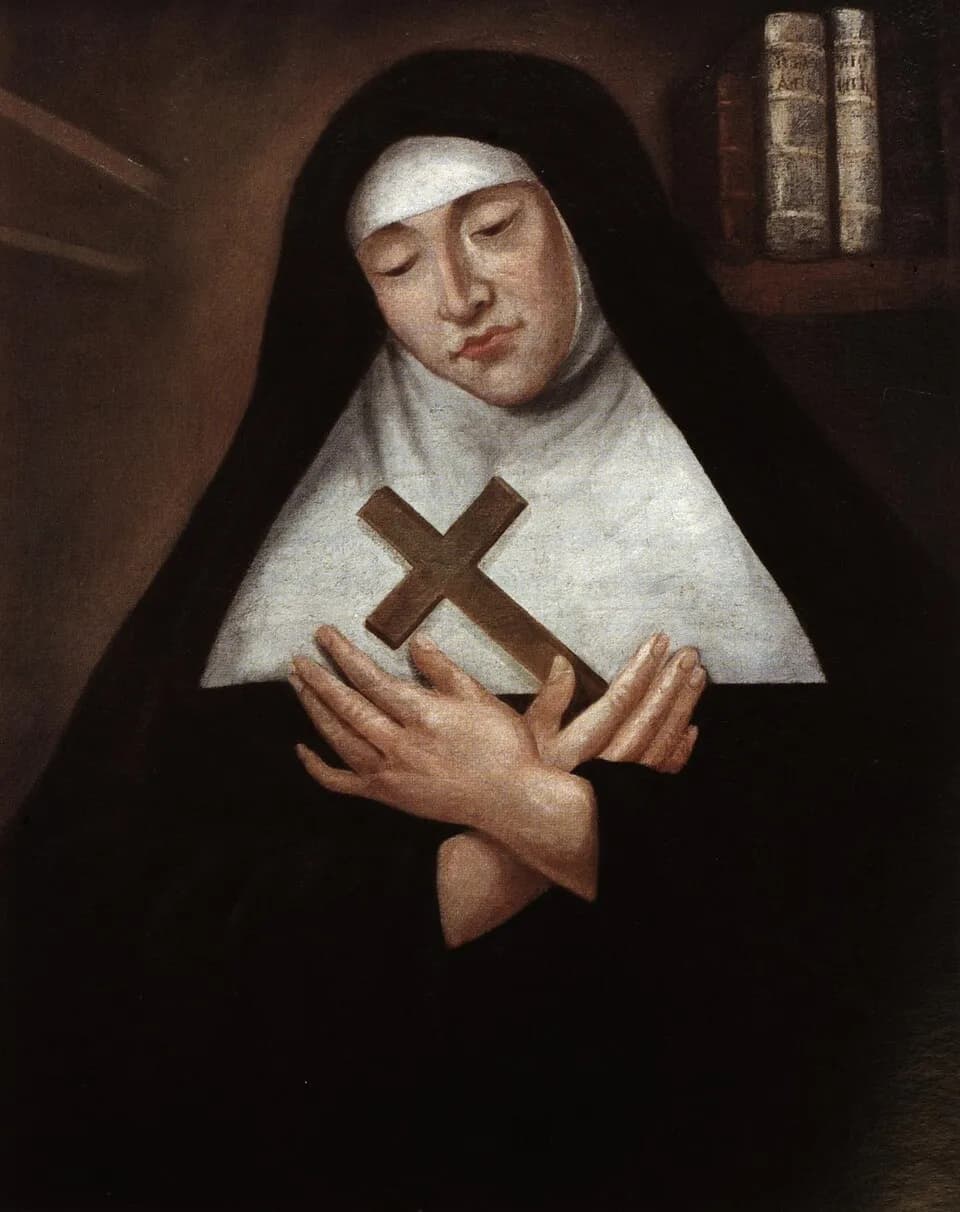
Saint Marie of the Incarnation was Marie Guyart, a widow from Tours who managed her brother-in-law's transport business on the docks, entered the Ursulines in 1631, and in 1639 sailed for Quebec to found what the Catholic Encyclopedia calls "the first Ursuline convent on the western continent". 25 She spent thirty-three years there teaching French and Native girls, and her letters and spiritual writings led Bossuet to compare her to Teresa of Avila. 12 Pope Francis declared her a saint on April 3, 2014, and her feast is April 30. 2
Wife, mother and widow in Tours
She was born at Tours on October 28, 1599. 12 The encyclopedia describes her father as a bourgeois by birth and her mother as connected with an illustrious house. 1 At seven, the Canadian bishops relate, she dreamed that the Lord asked her to be his, and she said yes. 2
At seventeen she was drawn to the cloister, but she obeyed her parents and married Claude Martin, a master silk worker. 12 The encyclopedia calls the marriage a source of trials whose one consolation was the birth of a son. 1 Martin died two years later. The bishops say she was nineteen and the baby, also named Claude, six months old; John Paul II counts her a mother at eighteen and a widow at twenty. 24 Her husband's business turned out to be on the verge of bankruptcy. She wound it up, was left penniless, and went back to live with her family and raise her son. 2 Her relatives proposed a second marriage, and she refused it. 4
Her prayer deepened in these years. The bishops speak of a strong sense of the presence of God, with whom she spoke "with intimacy". 2 In 1621 her brother-in-law asked her to manage his transport company, and she spent her days in a stable at the harbor that served as storehouse and shelter for the longshoremen, sometimes staying on the wharf late into the night to oversee the loading and unloading of goods. 2 "Those worries never diverted my attention from God who was my constant preoccupation," she wrote of that time. 2
The Ursulines of Tours
In 1631 she asked her sister to look after her son, who was twelve, and entered the novitiate of the Ursulines of Tours, taking the name Marie of the Incarnation. 12 Two years after her entry the convent put her in charge of the novices. 1 Her son grew up to be a Benedictine, Dom Claude, and wrote his mother's biography. 1
When she was about thirty-four she felt what the encyclopedia, quoting her, calls new impulses of "the apostolic spirit which transported her soul even to the ends of the earth". 1 John Paul II cited the passage of her autobiography in which she says that her body was in the monastery while the Spirit of Jesus carried her mind to the Indies, to Japan, to America, to Canada and the Hurons. 4 She told her confessor that she wanted to go to America, and after much hesitation he approved. 1
The means came from Madeleine de Chauvigny de la Peltrie, a wealthy French widow who had decided to put her fortune and herself at the service of a mission in Canada. 125 In 1639 her superiors invited her to follow her conviction that God was calling her to Canada, there "to create a house for Jesus and Mary." 2
Quebec
The sources tell the crossing with different dates. The encyclopedia's article on her has the party sail from Dieppe on April 3, 1639, and land at Quebec on July 4 after a dangerous voyage of three months. 1 The bishops say she embarked on May 4, and the encyclopedia's article on the Ursulines also says May. 25 With her and Madame de la Peltrie went two other Ursulines and four hospital sisters, by the bishops' count, or three Ursulines and three hospital sisters, by the encyclopedia's. 25 The hospital sisters founded the Hôtel-Dieu of Quebec. 5
"The first thing we did was to kiss the ground of the place to which we had come to fulfill our lives in the service of God and the Indigenous people," she wrote later. 2 She never went back to France. 2
The sisters lived at first in a little house in the lower town. 1 In the spring of 1641 the foundation stone was laid for a monastery on the site where the Ursulines of Quebec still were when the encyclopedia was written, and Marie was its superior. 15 She began learning the Native languages as soon as she arrived. 1 The school took French and Native girls as boarders and educated them together. 2 She fed the Huron and Algonquin adults who came to the door and gave them Christian instruction, and the bishops describe a door always open to everyone, from governors to woodsmen, for advice and material help. 2
The colony lived under the threat of Iroquois attack, and the encyclopedia says she stood firm through it and comforted the downcast. 1 On December 29, 1650, fire destroyed the monastery. The sisters sheltered through the winter with the hospital sisters and then with Madame de la Peltrie, and on May 29 of the following year Marie inaugurated the new building. 1 In May 1653, John Paul II recalled, she offered herself inwardly to God as a sacrifice for the good of Canada. 4
Her writings
She wrote the Constitutions and Rule of the Ursulines of Quebec in 1647. 2 The bishops credit her with dictionaries, grammars, catechisms and prayer books in four First Nations languages; John Paul II mentions catechisms in Huron, Iroquois and Algonquin. 24
She kept up a correspondence with relatives, friends and benefactors in France, and nearly 300 of her letters survive. 2 An edition was printed in Paris between 1677 and 1681, and the encyclopedia calls its account of events in Canada one of the sources for the history of the French colony from 1639 to 1671. 1 At the request of her son she wrote an autobiographical memoir on "her states of prayer and of grace". 2 The encyclopedia also lists a retreat, with a short exposition of the Canticle of Canticles, and an explanation of the mysteries of the faith compiled for young religious. 1
It was this side of her that drew Bossuet's comparison with Saint Teresa of Avila. The bishops give his phrase as "the Teresa of New France"; John Paul II has it as the Teresa of the New World. 24
She died at Quebec on April 30, 1672, after what the encyclopedia counts as forty years of labors, thirty-three of them in Canada. 12 The Holy See gave her the title of Venerable in 1877. 5 John Paul II beatified her on June 22, 1980, in the same ceremony as Bishop François de Laval, and Pope Francis canonized both on April 3, 2014, by what Vatican Radio calls an equipollent or equivalent canonization. 246
What is Saint Marie of the Incarnation the patron saint of?
None of the sources used for this page names Saint Marie of the Incarnation as the patron of anything, and the page does not supply a patronage. 123 Vatican Radio calls her the founder of the Ursulines in Canada, and Pope Francis spoke of her and Laval as the two missionaries who, in a manner of speaking, founded the Church in Quebec. 36
Saint Marie of the Incarnation's feast day
Praying with Saint Marie of the Incarnation
Looking back over her life from childhood, she wrote, "God never led me by a spirit of fear, but by love and trust." 2 That is the note of everything the bishops quote from her. She spoke to God with familiarity, and the prayers they record are short and practical: "My love, there is no way I can do all these tasks; please do them for me. Otherwise, they will not get done." 2
She did not have a quiet life in which to become a mystic. She was a wife, a mother, a widow, the head of a business, a nun, a mystic and a missionary, a list John Paul II recited at her beatification as evidence that contemplation and action were joined in her. 4 She once prayed on the way to a building site, "Come, Blessed Mother, let's go see our workers". 2
The hardest fact in her story is the twelve-year-old she left with her sister. 2 The sources used here do not say what that cost either of them, and the page will not guess. They do say that he became a monk, that he asked her to write down her life of prayer, and that she wrote to him, "When I see myself becoming powerless, I try to lose myself in him". 12
Every day she recited a prayer of her own that, in the bishops' description, went around the world in spirit asking for the conversion of all the souls Christ had redeemed. 2 Pope Francis, thanking God for her with pilgrims from Canada, drew the consequence for them: to honor those who suffered to bring the Gospel means being ready "to fight the good fight of faith with humility, meekness, and mercy, in our daily lives." 3
Saint Marie of the Incarnation, pray for us.
Sources
- 1.Pierre Auguste Fournet, "Ven. Marie de l'Incarnation," The Catholic Encyclopedia, vol. 9 (New York: Robert Appleton Company, 1910).
- 2."Saint Marie of the Incarnation (1599-1672)," Canada's Saints and Blesseds, Canadian Conference of Catholic Bishops.
- 3.Pope Francis, Homily at the Mass of thanksgiving for the equivalent canonization of two Canadian saints, Vatican Basilica, October 12, 2014.
- 4.Pope John Paul II, Homily at the beatification of five Servants of God, June 22, 1980 (the paragraphs on Marie of the Incarnation are in French).
- 5.Mother Mary Fidelis, "The Ursulines," The Catholic Encyclopedia, vol. 15 (New York: Robert Appleton Company, 1912).
- 6."Pope invites Quebecers to honour missionary heritage," Vatican Radio, October 12, 2014.
Saints to turn to next
Others in this collection who are turned to for some of the same things.
- Saint Agnes of Montepulcianoc. 1268 - April 1317PrayerWork and vocationDiscernment
- Saint Andrew Avellino1521 - November 10, 1608DiscernmentWork and vocationPrayer
- Saint Benedict of Anianec. 750 - February 11, 821DiscernmentPrayerWork and vocation
- Saint Benedict of Nursiac. 480 - March 21, 547PrayerWork and vocationDiscernment