Saints Marian and James
Martyred 259
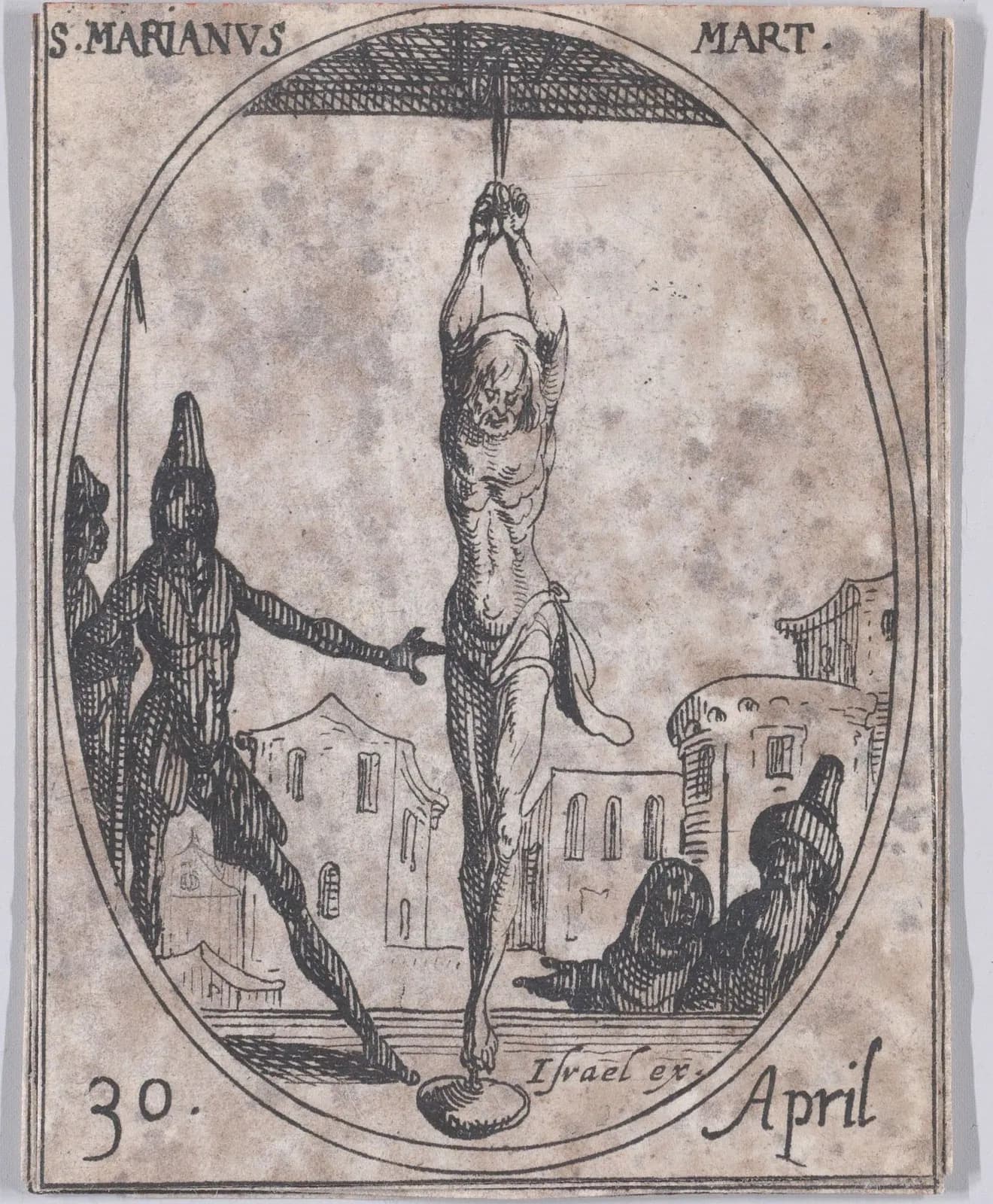
- Relics
- Later brought to Gubbio in Umbria, says katolsk.no 3
Saints Marian and James were a reader and a deacon of the Church in North Africa, beheaded with a crowd of other Christians at Lambaesis in Numidia on May 6, 259. 12 A friend who was arrested with them and released wrote down what happened, including the dreams they told him in prison, and its translator judged the account authentic and contemporary. 1
An account by a friend
The Passion of Saints Marian and James opens with its author explaining why he is writing. The two martyrs, he says, "charged that their warfare ... should through me come to the knowledge of the brethren," and he was the obvious man for it, being bound to them "not only by the common bond of the Gospel, but also by fellowship in life and private ties." 1 He never gives his own name.
E.C.E. Owen, who translated the text in 1927, called it "authentic and contemporary." 1 His reason is that its details fit the laws of the moment exactly. The emperor Valerian's first edict, in 257, struck at bishops, priests and deacons and forbade Christian assemblies; his second, in 258, ordered the clergy put to death. 1 The Passion shows bishops brought back from exile to die, a narrator who was not one of the higher clergy questioned and let go, and a reader tortured on suspicion of being something more, which is what those laws would produce. 1
Owen adds that Saint Augustine preached on the two martyrs in his Sermon 284, singling out Marian's mother. 1
Arrest near Cirta
The three friends were traveling together into Numidia when they reached Muguae, a suburb of Cirta, where the persecution was at its worst. 1 Two bishops, Agapius and Secundinus, were being taken from exile to the governor, and on the way they stayed at the friends' lodging; the narrator says their talk left Marian and James ready "to follow the guidance of the fresh footprints of their glory." 1
Two days later, the narrator writes, "a furious bevy of centurions and a disorderly crowd" came to the country house where they lived. 1 He himself was taken to Cirta. Marian and James followed him there, and in encouraging him gave themselves away: "they betrayed by the frankness of their joy that they were Christians." 1 They were questioned, confessed, and were put in prison. 1
There they were tortured, and the reason Marian was singled out is a small, bitter detail. James, the Passion says, insisted on confessing himself "not a Christian only, but a deacon," and so exposed Marian, "because he only confessed to being a reader, as indeed he was." 1 Owen explains that the authorities suspected Marian of hiding that he too was a deacon, since the law reached the higher clergy. 1 Marian was hung up by the top joints of his thumbs, with unequal weights tied to his feet. 1 When it was over he was put back in prison, where he and James and the others prayed together. 1
The dreams in prison
That night Marian dreamed of a high white tribunal where a judge was sentencing the confessors to the sword, and of a voice calling, "Make Marian come up." 1 As he climbed, Cyprian of Carthage, beheaded the year before, appeared at the judge's right hand, lifted him up, smiled and said, "Come, sit with me." 1 The dream ended in a green country of cypresses and pines, where Cyprian filled a bowl at a spring, drank, and handed it to Marian; he woke saying "Thanks be to God." 1
James then remembered a dream of his own. Days earlier, riding with the others in a carriage at midday, he had fallen into a deep sleep and seen a youth of great height in a shining robe, who ran past and tossed two purple girdles into his lap, "one for you, Marian, and one for me," saying, "Follow me quickly." 1 A fellow prisoner named Aemilian, a man of equestrian rank who had lived celibate from boyhood to nearly fifty, told them a dream too. 1
From Cirta the prisoners were sent on to the governor, and a bystander who confessed in court on the spot went with them. 1 They ended in the prison at Lambaesis. 1 There, the Passion says, the governor kept the clergy apart and killed the lay Christians first, over many days, and Marian and James began to be "a little downcast" that their own turn was so late. 1
Death at Lambaesis
On the night before he died, James dreamed that the martyred bishop Agapius was holding a joyful banquet, and that a boy, one of the twins martyred with their mother three days before, ran up with a garland of roses round his neck and told him and Marian, "to-morrow you also will dine with us." 1 The next day the governor sentenced the clergy. 1
The place of execution was a river valley between high banks, where the slopes served as seats "as in a theatre." 1 There were so many to behead that the condemned were set in rows and the executioner moved down the lines. 1 Blindfolded, some said they saw white horses with riders in white, and Marian, the narrator says, foretold the coming of plagues, captivity, famine and earthquakes. 1
Afterward Marian's mother, who was named Mary, rejoiced over her son and kissed the wounds in his neck. 1 The narrator compares her to the mother of the Maccabees. 1 The Martyrology sums up the day in a sentence: after cruel tortures, comforted by divine grace, the two died by the sword together with many others. 2
The inscription and the relics
Georges Goyau, writing on the diocese of Constantine in the 1908 Catholic Encyclopedia, records a Latin inscription "cut in the rocks at the entrance to the Rummel Pass" at Cirta that names Saints Marian and James as martyrs "either at Cirta or Lambesa during the same persecution." 4 The same article lists the martyrs of Cirta under Valerian, among them the bishops Agapius and Secundinus who appear in the Passion. 4
katolsk.no, the Norwegian bishops' saints database, counts Marian and James among some twenty-eight martyrs of Cirta and Lambaesis in 259, and says their relics were later brought to Gubbio in Umbria. 3 On the question of who had already confessed the faith once, the sources part ways. In Owen's text of the Passion it is James who "had already once triumphed over the attacks of the Decian persecution." 1 The Martyrology and katolsk.no say it was Marian who had come through the persecution of Decius before. 23
What are Saints Marian and James the patron saints of?
Saints Marian and James's feast day
The feast day of Saints Marian and James is May 6 in the current Roman Martyrology, which keeps them at Lambaesis in Numidia on that day. 2 Owen also dates their death to May 6, 259. 1
Older calendars kept them on April 30. katolsk.no gives April 30 as their common feast and explains that the Roman Martyrology divided this group by place, with the martyrs of Cirta on April 29 and those of Lambaesis on April 30, as Ado of Vienne had done; the Bollandists put them all on April 30, following Bede. 3 It adds that May 4, May 6 and May 12 are also found. 3
Praying with Saints Marian and James
Marian was tortured because his friend told the truth about himself. James would not hide that he was a deacon, and the officials, suspecting that Marian was a deacon too and hiding it, hung him by the thumbs. 1 Nothing in the Passion suggests either man resented the other. They went back to their cell and prayed together. 1
Much of what the narrator remembers is what they told each other in prison: a judge, a bowl of water at a spring, two purple belts, a boy with roses. 1 He wrote it down because they asked him to, so that ordinary Christians "might be armed by the trials of the past." 1
The hardest part of the story is the waiting. The governor killed the laity first, and the clergy watched for days while others went ahead of them. 1 The Passion does not pretend this was easy; it says they were downcast. 1
At the end there is Mary, Marian's mother, kissing the wounds in her son's neck. 1 The narrator calls it joy, and perhaps it was. It was also grief, and the story leaves her there.
Saints Marian and James, pray for us.
Sources
- 1."Passion of SS. James and Marian," in E.C.E. Owen, trans., Some Authentic Acts of the Early Martyrs (Oxford: Clarendon Press, 1927), pp. 105-118, with Owen's introduction. Internet Archive.
- 2.Roman Martyrology, entry for May 6, "Santi martiri Mariano e Giacomo," as printed in "Santo del giorno," Conferenza Episcopale Italiana (in Italian).
- 3."Den hellige Agapius av Numidia og 27 ledsagere (d. ~259)," Den katolske kirke (katolsk.no), Catholic Diocese of Oslo (in Norwegian).
- 4.Georges Goyau, "Constantine (Cirta)," The Catholic Encyclopedia, Vol. 4 (New York: Robert Appleton Company, 1908).
Saints to turn to next
Others in this collection who are turned to for some of the same things.