Saint Maria Micaela of the Blessed Sacrament
January 1, 1809 - August 24, 1865
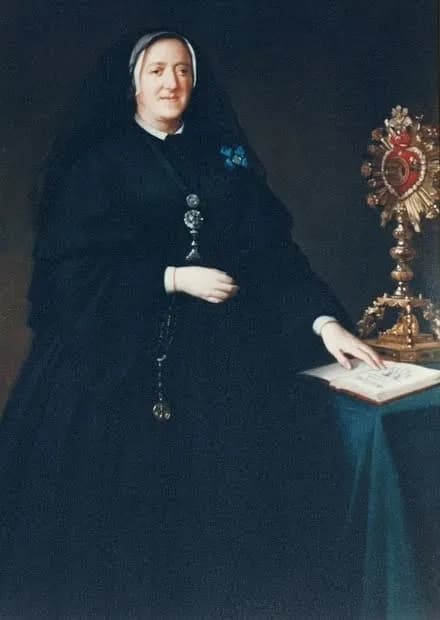
Saint Maria Micaela of the Blessed Sacrament was a Spanish noblewoman, the Viscountess of Jorbalán, who left her house in Madrid in 1850 to live with women coming out of prostitution, and founded a religious congregation to go on doing it. 24 The Roman Martyrology says that she gave her life to rescuing girls who had been led astray and women in prostitution, out of a great love and a desire to win souls for God. 1 She died of cholera in Valencia in 1865, caught while nursing others, and Pius XI canonized her in 1934. 26
A noble family in a hard century
She was born in Madrid on New Year's Day, 1809, while Spain was at war with Napoleon, and baptized three days later in the parish of San José. 46 The Claretians give her name as Micaela Desmaisières López de Dicastillo y Olmedo. 6 The war drove the family across the border into France, and the Claretians say her father and her brother Luis died there unexpectedly. 6 The Ursuline sisters at Pau gave her the education expected of a girl of her rank. 6
The family's troubles did not end with the war. One sister, Engracia, suffered a severe mental illness; another, Manuela, was forced into exile because of her husband's politics. 69 Micaela was engaged to a young nobleman, and the marriage never happened. The Claretians say it was called off the night before the wedding over slanderous rumors about her family, and that she was "profoundly humiliated." 6 ACI Prensa says instead that after three years the young man withdrew because his relatives told him to. 9
For years she lived two lives at once. Under the direction of a Jesuit, Father Carasa, she rose early to pray, receive Communion and visit the poor, and spent her evenings at the theater, at lectures and at balls, as her position required. 6 ACI Prensa says this was in Paris and Brussels, where her brother served as Spain's ambassador. 9 The Claretians call her life there "a life of outstanding care for the poor." 6
The girl with the shawl
On February 6, 1844, she visited the Hospital of San Juan de Dios in Madrid. 24 ACI Prensa says a charitable woman named María Ignacia Rico took her there, on Father Carasa's advice. 9 The hospital took in women in prostitution who had fallen ill, many of them with venereal disease, and according to the Claretians she "had known nothing of the existence of such women, let alone the scorn and abuse to which they were subjected." 69
One young woman in particular stayed with her. The congregation calls her "the girl with the shawl," and Micaela told her story at length in her autobiography. 24 Cardinal Vincent Nichols, preaching on her anniversary in 2016, described her as "a victim of prostitution who was the daughter of a prominent banker." 8 Micaela wrote that it was from that story, and many others like it, that her first idea came: a house where such women could live for a while and be taught the faith, until a way was found to settle them in work or send them home. 4
She opened it in Madrid in 1845. 3 The Claretians describe a school, opened with several companions, "to train battered women for gainful employment." 6 Her friends were appalled that a woman related to the richest families in Spain should look after prostitutes, and many stopped acknowledging her. 69
Pentecost in Paris
In 1847, soon after arriving in Paris, she made the Spiritual Exercises, and on Pentecost Sunday, May 23, she received what the congregation calls a mystical grace. 24 In her own account she saw God as so great, so powerful, so good, so loving and so merciful that she resolved to serve no other Lord. 4 From then on, the congregation says, her life changed radically, and she gave herself both to Eucharistic contemplative prayer and to charity. 2
On October 12, 1850, she left her own house and moved in with the women. 24 She had heard the Lord say to her, in so many words, that he wanted her in his work, and with Father Carasa's help she took it as the decisive call. 4 The Claretians say she left her elegant home for "a miserable hovel." 6
Slander and the Blessed Sacrament
The work cost her money she did not have, and her good name. The Claretians say she was "dogged by slander and suffered attempts on her life," sometimes slept fully dressed in case the house was raided, and more than once stood alone in a brothel to protect a woman who was being held there against her will. 6 ACI Prensa tells of one such rescue in which she was insulted and stoned and walked out with the girl anyway. 9
At one point a priest came to remove the Blessed Sacrament from her house, sent, ACI Prensa says, by an archbishop who had been told stories about her. 89 Cardinal Nichols quotes what she said about it: "If the Lord goes away from this house, I will go with him; nothing will make me leave the work…But without Him I will not stay here, not even for an hour!" 8 ACI Prensa says the priest knelt to pray, changed his mind, and left without it. 9 Nichols also quotes her plainer summary: "The Holy Sacrament is my life and my element." 8
Writing to her sisters, in the Claretians' translation, she said: "Difficult to find another Founder of community that has been accused, maligned and scolded like me. My actions have been judged in the worst way possible." 6
Mother Sacramento and the Adoratrices
Saint Anthony Mary Claret, the archbishop who became her confessor, helped her spiritually and with money, and had a large part in drafting the congregation's constitutions and getting them approved. 6 Both of them, the Claretians note, suffered "unspeakable slander in the press." 6 She took the name Mother Sacramento, and called her sisters Adorers, Handmaids of the Blessed Sacrament and of Charity. Cardinal Nichols remarked that the two names say all that needs saying about her. 68
The sources date the founding differently. The congregation gives 1856, the year it also opened a house in Zaragoza. 23 The Claretians agree on 1856, and add that she and seven companions took simple vows on the feast of the Epiphany, January 6, 1859; ACI Prensa dates the founding itself to that day. 69 The congregation's Europe-Africa province says the first Adoratrices made their profession on January 1, 1857. 4 Cardinal Nichols said the foundation was "formally established" on November 24, 1866, after her death. 8 On one date they agree: she made her perpetual profession in Madrid on June 15, 1860. 46
Houses followed in Valencia in 1858, Barcelona in 1861, Burgos in 1863, and Santander and Pinto in 1864. 3 When she died there were seven. 236
Cholera in Valencia
In 1865 cholera struck Spain, and she went to Valencia to help. 6 The congregation says she caught the disease through caring for the women. 2 She died there on August 24, 1865, and the Claretians call her "a martyr to charity." 126 ACI Prensa's account gives the year as 1856 and the disease as typhus; every other source here gives 1865. 9
Pius XI declared her virtues heroic in 1922, beatified her in 1925, and canonized her on March 4, 1934. 26 The congregation dates the beatification to June 7 and the Claretians to July 25. 26 More than three thousand Spaniards went to Rome for the canonization, and in his homily the pope singled out two virtues in her, a tireless, unconquerable fortitude and a most ardent charity. 5 Claret was later named a patron of her institute. 6
The Adoratrices went to Italy in 1899, to Buenos Aires in 1910, to Asia in 1928 and to Africa in 1933. 10 Their work is still hers: helping women in prostitution, victims of trafficking and women suffering other kinds of exploitation and violence to get free and rebuild their lives. 10 Cardinal Nichols, in 2016, recalled the twenty-seven sisters killed in the Spanish Civil War. 8
What is Saint Maria Micaela the patron saint of?
Saint Maria Micaela's feast day
The Roman Martyrology enters Saint Maria Micaela on August 24, the day she died in Valencia. 1 The Claretian Missionaries, whose founder was her confessor, keep her memorial on June 15 in their proper calendar. 67 June 15 is also the date of her perpetual profession in 1860. 46 This page lists her under August 24 and gives both dates.
Praying with Saint Maria Micaela
Her life turned on one visit to a hospital ward. She was thirty-five, devout, generous with alms, and she had never known that the women she met there existed. 46 The congregation says simply that her eyes were opened, and the next year she opened a house. 234
What held her to the work was the Blessed Sacrament. She said she would leave the house before she would stay in it without the Lord, and the name she took for herself was simply Sacramento. 8 Cardinal Nichols, preaching to her sisters, put adoration first and charity after it, as its daily expression. 8 Her congregation still says that Jesus, alive in the Eucharist, is the foundation of its prayer and of its service. 10
She paid for it with her good name. Her old friends dropped her, a bishop and her own spiritual director believed the stories told about her, and she wrote that few founders had ever been so accused and maligned. 69 ACI Prensa says that in that case the truth came out and her accusers apologized, and that she had not defended herself in the meantime. 9 Other slanders followed. She went on with the work, and she died of a disease she caught doing it. 26
Saint Maria Micaela of the Blessed Sacrament, pray for us.
Sources
- 1.Roman Martyrology, entry for August 24, "Santa Maria Michela del Santissimo Sacramento Desmaisières, vergine," as printed in "Santo del giorno," Conferenza Episcopale Italiana (in Italian).
- 2."Santa María Micaela," Adoratrices Esclavas del Santísimo Sacramento y de la Caridad, general government of the congregation (in Spanish).
- 3."Historia," Adoratrices Esclavas del Santísimo Sacramento y de la Caridad, general government of the congregation (in Spanish).
- 4."Nuestra fundadora," Adoratrices, Province of Europe-Africa (in Spanish).
- 5."Santa María Micaela: 91 años de santidad y entrega a las personas más vulnerables," Adoratrices, Province of Europe-Africa, March 4, 2025 (in Spanish).
- 6."June 15 - St Mary Micaela of the Blessed Sacrament, Foundress of the Sisters of Adorers," Ephemeris, Claretian Missionaries.
- 7."Calendario litúrgico de los Misioneros Hijos del Inmaculado Corazón de María," proper Missal and Lectionary of the Claretian Missionaries (in Spanish).
- 8.Cardinal Vincent Nichols, homily at the Mass for the 150th anniversary of St Maria Micaela, Our Lady of Mount Carmel and St Simon Stock, Kensington, March 4, 2016, Diocese of Westminster.
- 9."Biografía de Santa María Micaela del Santísimo Sacramento," ACI Prensa (in Spanish).
- 10."Quiénes somos," Adoratrices Esclavas del Santísimo Sacramento y de la Caridad, general government of the congregation (in Spanish).
Saints to turn to next
Others in this collection who are turned to for some of the same things.
- Saint Germanus of Parisc. 496 - May 28, 576Poverty and simplicityCouragePrayer
- Saint James the LessFirst centuryPrayerPoverty and simplicityCourage
- Saint Joseph of LeonessaJanuary 8, 1556 - February 4, 1612CouragePoverty and simplicityPrayer
- Saint Józef BilczewskiApril 26, 1860 - March 20, 1923CouragePrayerPoverty and simplicity