Saint Germanus of Paris
c. 496 - May 28, 576
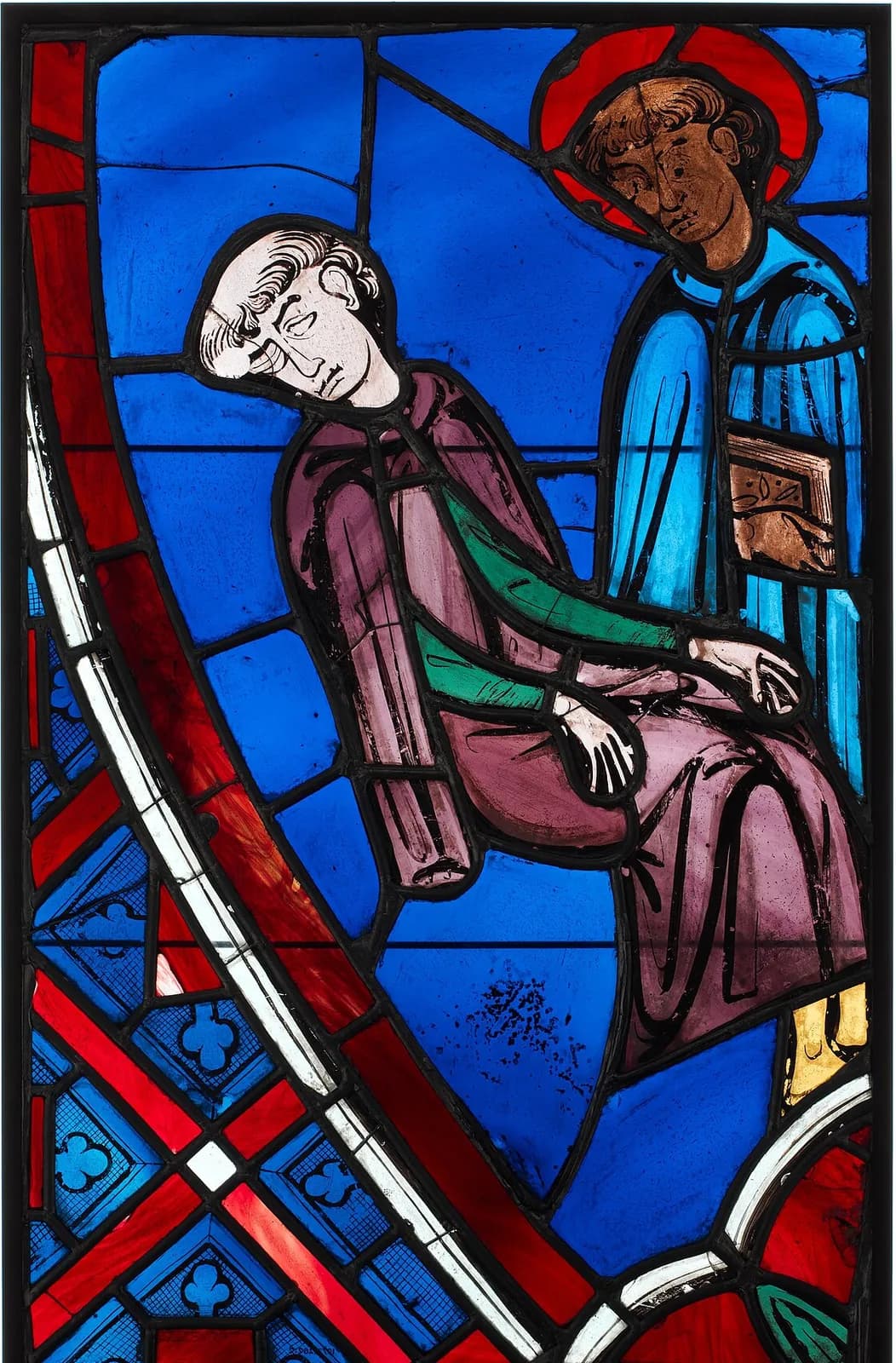
- Councils
- Paris (557 and 573) and Tours (566) 1
Saint Germanus of Paris, Saint Germain in French, was an abbot from Burgundy whose monks rebelled because he kept giving their bread to the poor, and who became bishop of Paris in the 550s under Childebert, the son of Clovis. 13 He spent twenty years trying to restrain the Merovingian kings and to make peace between them. He was buried in the church he had dedicated outside the city, which has been called Saint-Germain-des-Prés ever since his relics were moved into it. 12 His feast is May 28. 15
The abbot who gave everything away
He was born about 496 near Autun, in Burgundy. 14 The French bishops' page says that his life is known through his friend Venantius Fortunatus, the Latin poet, and it repeats, as something people tell, a story about his birth: that his mother did not want the child and tried to end the pregnancy, and failed. 3
He studied at Avallon, and also at Luzy under a cousin named Scapilion, who was a priest. 13 The French bishops add that he then lived for fifteen years as a monk in a small local community. 3 At thirty-four he was ordained by Saint Agrippinus, bishop of Autun, and became abbot of Saint-Symphorien, a monastery near the town. 1
It did not go smoothly. "His characteristic virtue, love for the poor, manifested itself so strongly in his alms-giving, that his monks, fearing he would give away everything, rebelled." 1 The French bishops say the same thing more dryly: the monks were not delighted with an abbot who handed their bread to the poor. 3 Catholic Culture's excerpt adds that he used to keep watch in the church for most of the night while the community slept. 4
Bishop of Paris
He was in Paris when its bishop, Eusebius, died. King Childebert kept him there, and he was consecrated with the consent of clergy and people. 1 The encyclopedia dates this 555. Catholic Culture's excerpt says 554, and the Diocese of Paris says about 552, adding that it was probably the king who imposed him on the diocese after a long run of bishops who had left little mark. 124
Catholic Culture alone tells a story from before his election: "One night, in a dream, he thought a venerable old man presented him with the keys of the city of Paris, and said to him that God committed to his care the inhabitants of that city, that he should save them from perishing." 4 The same account says he tried with many tears to decline the office. 4
Becoming a bishop changed little in how he lived. The Martyrology notes that he kept a monk's way of life in the see of Paris. 5 "His house was perpetually crowded with the poor and the afflicted, and he had always many beggars at his own table." 4 The French bishops remember him for cures and for freeing prisoners and slaves as a matter of course, and they say he would often keep only a tunic and give the rest of his clothing to a poor man, so that the beggar was warm while the bishop froze. 3
Childebert, by the encyclopedia's account, had been a very worldly king, and under Germanus's influence he reformed. 1 The bishop persuaded him to stamp out the pagan practices still alive in Gaul and to forbid the excesses that went with most Christian festivals. 1 He attended councils at Paris in 557 and 573 and at Tours in 566. 1 The Diocese of Paris adds that, like other bishops of his day, he encouraged devotion to the saints of Gaul, his own predecessor Saint Marcel in particular. 2
The church of Saint Vincent
The encyclopedia tells how the church began. Childebert, at war in Spain, besieged Saragossa, whose people had put themselves under the protection of the martyr Saint Vincent. The king spared the city, and its bishop gave him the saint's stole. Back in Paris he had a church built in the suburbs to hold the relic. 1 About the same time he fell dangerously ill at his palace of Celles, and the encyclopedia says his own charter, granting those lands to the church of Paris, attests that Germanus healed him. 1
Germanus dedicated the church to Saint Vincent, and a monastery grew up beside it. 12 The French bishops name the foundation the abbey of Sainte-Croix-Saint-Vincent. 3 The date is a problem. The encyclopedia prints 588, which is twelve years after the death it gives for Germanus, and says it was December 23, the very day Childebert died. The Diocese of Paris prints 538, which is earlier than its own date for his becoming bishop. 12 Neither can be right as printed, and this page does not choose between them.
When he died, his body was laid in the chapel of Saint Symphorien in the vestibule of the church. In 754 his relics were moved into the body of the church in the presence of King Pepin and his son Charlemagne, then a child of seven. From that time, the encyclopedia says, the church was known as Saint-Germain-des-Prés. 1 The Diocese of Paris notes that a slab in the chapel of Saint Symphorien still marks the place. 2
Among warring kings
Childebert was followed by Clotaire, and at Clotaire's death in 561 the kingdom was divided among his four sons. Paris fell to Charibert, whom the encyclopedia calls "a vicious, worthless creature." Germanus excommunicated him in 568 for his immorality. 1
After Charibert died, his brothers fought over what he left. Sigebert and Chilperic went to war, urged on, the encyclopedia says, by their wives, Brunehaut and Fredegunde, and Paris came into Sigebert's hands. Germanus wrote to Brunehaut asking her to use her influence to prevent more fighting. The letter survives. 1 It did no good. Sigebert set out against Chilperic despite the bishop's warning and was assassinated on the way, in 575. 1
Germanus died the following year, on May 28, 576, before peace was restored. 1 Catholic Culture's excerpt says he was eighty. 4 Besides the letter to Brunehaut, a treatise on the old Gallican liturgy has come down under his name, which the encyclopedia describes only as "attributed to Germain." 1
What is Saint Germanus of Paris the patron saint of?
None of the sources consulted for this page names Saint Germanus of Paris as the patron of anything, and the page does not supply a patronage. 1234 The Diocese of Paris lists him among its own saints, and says the abbey whose church took his name had great influence until the Revolution. 2 He is a different person from Saint Germanus of Auxerre, with whom he shares a name; the encyclopedia gives each bishop his own article. 1
Saint Germanus of Paris's feast day
Saint Germanus of Paris's feast is May 28. The Catholic Encyclopedia states it, the Diocese of Paris keeps a memorial that day, and the Roman Martyrology lists him under it. 125 It is the day of his death in 576 by the encyclopedia and Catholic Culture, and the day of his burial by the Diocese of Paris. 124 Catholic Culture lists him for the day as a commemoration from the Roman Martyrology, on what is otherwise an ordinary weekday of the general calendar. 4
Praying with Saint Germanus of Paris
What most of his sources say first about him is that he gave things away, as an abbot until his monks revolted, and as a bishop until he was down to a tunic. 134 It was not prudent, and his monks said so.
He also failed at the largest thing he tried. He could reform one king, and he could excommunicate another, but he could not stop Clotaire's sons from making war on each other, and he died with it still going. 1 The encyclopedia says plainly that he labored for peace "with little success." 1
What he kept, through twenty years in the capital of a violent kingdom, was the life he had lived at Autun. "The same simplicity and frugality appeared in his dress, table, and furniture," Catholic Culture's excerpt says, and the Martyrology says much the same in a line. 45
Saint Germanus of Paris, pray for us.
Sources
- 1.Andrew MacErlean, "St. Germain," The Catholic Encyclopedia, vol. 6 (New York: Robert Appleton Company, 1909).
- 2."Saint Germain," Saints parisiens, Diocèse de Paris (in French).
- 3."Saint Germain de Paris," Saint du jour, 28 mai, Église catholique en France, Conférence des évêques de France (in French).
- 4.Catholic Culture, Liturgical Year, May 28, 2026 (St. Germanus, Bishop, Roman Martyrology), with an excerpt from The Daily Gospel.
- 5.Roman Martyrology entry for May 28, "Santo del giorno," Chiesa Cattolica Italiana (in Italian).
Saints to turn to next
Others in this collection who are turned to for some of the same things.
- Saint James the LessFirst centuryPrayerPoverty and simplicityCourage
- Saint Joseph of LeonessaJanuary 8, 1556 - February 4, 1612CouragePoverty and simplicityPrayer
- Saint Józef BilczewskiApril 26, 1860 - March 20, 1923CouragePrayerPoverty and simplicity
- Saint Katharine DrexelNovember 26, 1858 - March 3, 1955Poverty and simplicityPrayerCourage