Saint Joseph of Leonessa
January 8, 1556 - February 4, 1612
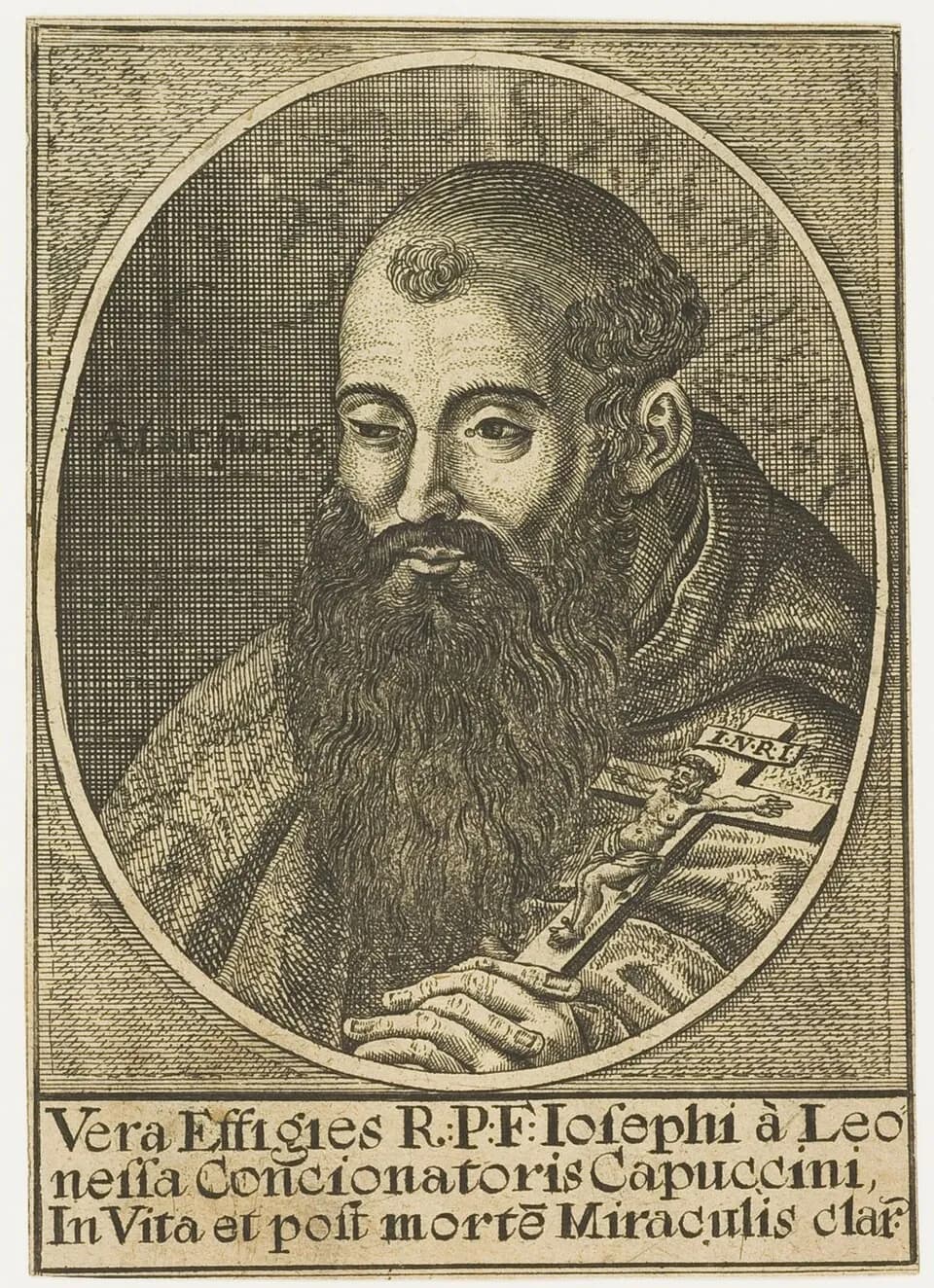
- Entered the Capuchins
- 1572, at Assisi; professed January 8, 1573 2
- Ordained
- September 24, 1580, at Amelia 2
- Constantinople
- Sent in 1587 to serve Christian captives; tortured on the hook; back in Italy in 1589 12
- Patron of
- The missions in Turkey, by proclamation of Pius XII; Leonessa, by proclamation of Paul VI 2
Saint Joseph of Leonessa was a Capuchin priest who went to Constantinople in 1587 to serve Christian captives, was hung from a beam on the hook for three days, and survived. 12 He then spent more than twenty years walking the mountain villages of central Italy, preaching several times a day to farmers and shepherds and washing and feeding the poor himself. 12 He died on February 4, 1612, and that day is his feast. 123
Eufranio of Leonessa
He was born on January 8, 1556, at Leonessa, which the encyclopedia places in Umbria and CapDox in the Alta Sabina, near Rieti, and he was named Eufranio. 12 CapDox, the Australian Capuchins' archive, names his parents as Giovanni Desideri and Serafina Paolini and says he was orphaned at twelve; the 1910 Catholic Encyclopedia spells the family name Desiderio. 12 The encyclopedia remembers a pious child who built little altars, prayed in front of them, and got his friends to pray with him. 1
An uncle took charge of his schooling, at Viterbo and then at Spoleto, and planned a good marriage for him. 12 The encyclopedia says that in his sixteenth year he fell ill with a fever and, once recovered, joined the Capuchins without consulting his uncle. 1 CapDox puts it more pointedly: "To avoid an arranged noble marriage, he slipped away" to the little Capuchin friary of the Carcerelle at Assisi. 2 He made his novitiate there and his profession on January 8, 1573, his seventeenth birthday. His relatives tried to take him home and failed. 12
In religion he was Joseph. The encyclopedia says he was known for his abstinence and that he used to address his own body as "Brother Ass" and tell it, "there is no need to feed thee as a noble horse would be fed: thou must be content to be a poor ass." 1
A preacher for farmers and shepherds
He was a serious student. CapDox says he loved the teaching of Saint Bonaventure and prepared for preaching with theology, Scripture and moral theology. 2 He was ordained a priest at Amelia on September 24, 1580, and received his license to preach from the Capuchin vicar general on May 21, 1581. 2
He felt the pull of a hidden life of prayer and decided against it. One of his notes survives: "The one who loves contemplative life has a grave duty to come out into the world to preach, especially when the ideas of the world are very confused and iniquity abounds in the land." 2 He could have made a name in city pulpits, CapDox says, and chose the villages and small mountain towns of Umbria, Lazio and Abruzzo instead. "He always considered himself a preacher for farmers, shepherds, mountain folk and children." 2
One early episode comes from the testimony gathered for his canonization. A band of about fifty bandits had been terrorizing Arquata del Tronto, and the authorities could do nothing with them. When Joseph came through begging alms, the townspeople asked him to step in. He went up to the bandits' hideouts, got them together in a little church, and with his cross in his hand talked them into changing their lives. They were among his most attentive listeners when he came back to preach the Lent. 2
Constantinople and the hook
In 1587 his superior general sent him to Constantinople to minister to the Christians held captive there. 1 He and his companions lodged in a derelict house that had belonged to Benedictine monks, and their poverty drew crowds of curious Turks. 1 He worked among the captives in the galleys and, CapDox adds, among plague victims. 12 He also preached in the city every day, and for that he was thrown into prison and released only when the Venetian agent intervened. 1
Then he tried to reach the sultan, whom CapDox names as Murad III. The encyclopedia says he sought to enter the palace to preach before him. 1 CapDox says he wanted to intercede for the people he was helping. 2 He was seized and condemned to die on the hook. In CapDox's description, "He was suspended from a beam by means of a hook through the tendons of his right hand and foot." 2 He hung there for three days. 12
How he came down is told three ways. The encyclopedia says "he was miraculously released by an angel." 1 CapDox, translating a study published in 2000, says he "was miraculously saved (by an angel or by human intervention) and he quickly recovered." 2 Vatican News says simply that he was "arrested, tortured and driven out." 3
He was back in Italy in 1589, at thirty-three. 2 The encyclopedia says he brought with him a Greek archbishop who had apostatized and who was reconciled to the Church when they reached Rome; CapDox, in its account of Constantinople, speaks of his converting a Greek bishop. 12
Where the others did not want to go
He went back to the roads of Abruzzo and Umbria, to the harsh, poor places "where the others did not want to go." 2 The encyclopedia says he sometimes preached six or seven times a day. 1 His companions found it hard to keep up with the forced marches, sometimes in the worst weather and without food. 2 He taught catechism to peasants and children and had the children learn their prayers by heart. 2
The preaching came with practical works. From a handful of grain scraped together house by house he started grain cooperatives. He organized Monti di Pietà, lending institutions meant as an alternative to usury, along with hospices for travelers and small hospitals. 2 In the Jubilee year of 1600 he preached the Lent at Otricoli, a town on the pilgrim road to Rome, and when he saw how poor many of the pilgrims were he fed them, washed their clothes and cut their hair. 1 At Todi he worked a garden with his own hands and gave the produce to the poor. 1
He visited the jails and stayed with men condemned to death, and he walked into feuds. 2 A witness at his process said: "Whenever he heard of brawls or hatred he would hurry there straightaway in the hope of restoring the adversaries to eternal life. He did not worry about the weather, or snow, and places hard to reach. Consequently he often lost his toenails, as in Leonessa, Montereale and Amatrice." 2 He liked to set up huge, heavy crosses on mountain tops, carrying them up in procession. 2
Amatrice
Worn out by work and penance and suffering from an incurable illness, he spent his last days in the friary at Amatrice and died there on Saturday, February 4, 1612, aged fifty-six. 2 Shortly before, he had written three long letters reaffirming his fidelity to the teaching of the Church. 2
Clement XII beatified him on June 22, 1737, and Benedict XIV canonized him on June 26, 1746. 12 By then his body was no longer at Amatrice. On October 18, 1639, CapDox relates, the people of Leonessa "took advantage of an earthquake to carry out a 'sacred theft'" and carried it home, where it is venerated in the sanctuary that bears his name. 2
What is Saint Joseph of Leonessa the patron saint of?
According to CapDox, "Pius XII proclaimed him patron of the Missions in Turkey," and "Paul VI proclaimed him principal patron of Leonessa." 2 CapDox also calls him "minor principal patron of the Capuchin province of Abruzzo," and says confraternities were founded under his patronage at Otricoli, Amatrice and Leonessa, some of which still exist. 2 The other two sources name no patronage. 13
Saint Joseph of Leonessa's feast day
Praying with Saint Joseph of Leonessa
The torture in Constantinople is what people remember, and it takes up a few sentences in each source. 123 Most of what they record is the twenty-odd years afterward: a friar walking between mountain villages in the snow, preaching to whoever was there. 2
CapDox says he saw Jesus in the poor just as he did in the crucifix and the tabernacle, and the details bear it out. He found people clothes and shoes, washed them, cut their hair, deloused them, and cleaned their wounds. 2 The encyclopedia has him doing the same for pilgrims at Otricoli. 1
He drew all of it from prayer. He spent hours before the tabernacle, at night as well, and carried a crucifix on his chest; witnesses said his face changed color as he walked along thinking about the five wounds. 2
He had wanted solitude and argued himself out of it on the grounds of charity. "It would be wrong and against charity," he wrote, "to hold on to that which has been founded on and given for the sake of charity." 2
Saint Joseph of Leonessa, pray for us.
Sources
- 1.Lawrence Hess, "St. Joseph of Leonessa," The Catholic Encyclopedia, vol. 8 (New York: Robert Appleton Company, 1910).
- 2."Saint Giuseppe da Leonessa," CapDox, Capuchin Friars of Australia; translation based on Costanzo Cargnoni in Sulle orme dei santi (Rome, 2000), 21-28.
- 3."St. Joseph of Leonessa, Capuchin friar," Saint of the Day, 4 February, Vatican News.
Saints to turn to next
Others in this collection who are turned to for some of the same things.
- Saint Germanus of Parisc. 496 - May 28, 576Poverty and simplicityCouragePrayer
- Saint James the LessFirst centuryPrayerPoverty and simplicityCourage
- Saint Józef BilczewskiApril 26, 1860 - March 20, 1923CouragePrayerPoverty and simplicity
- Saint Katharine DrexelNovember 26, 1858 - March 3, 1955Poverty and simplicityPrayerCourage