Saint Marcellus the Centurion
d. October 30, 298
- Historical record
- The Acts of his trial are regarded as very reliable 1
- Patron saint of
- Conscientious objectors, and the city and province of León 4
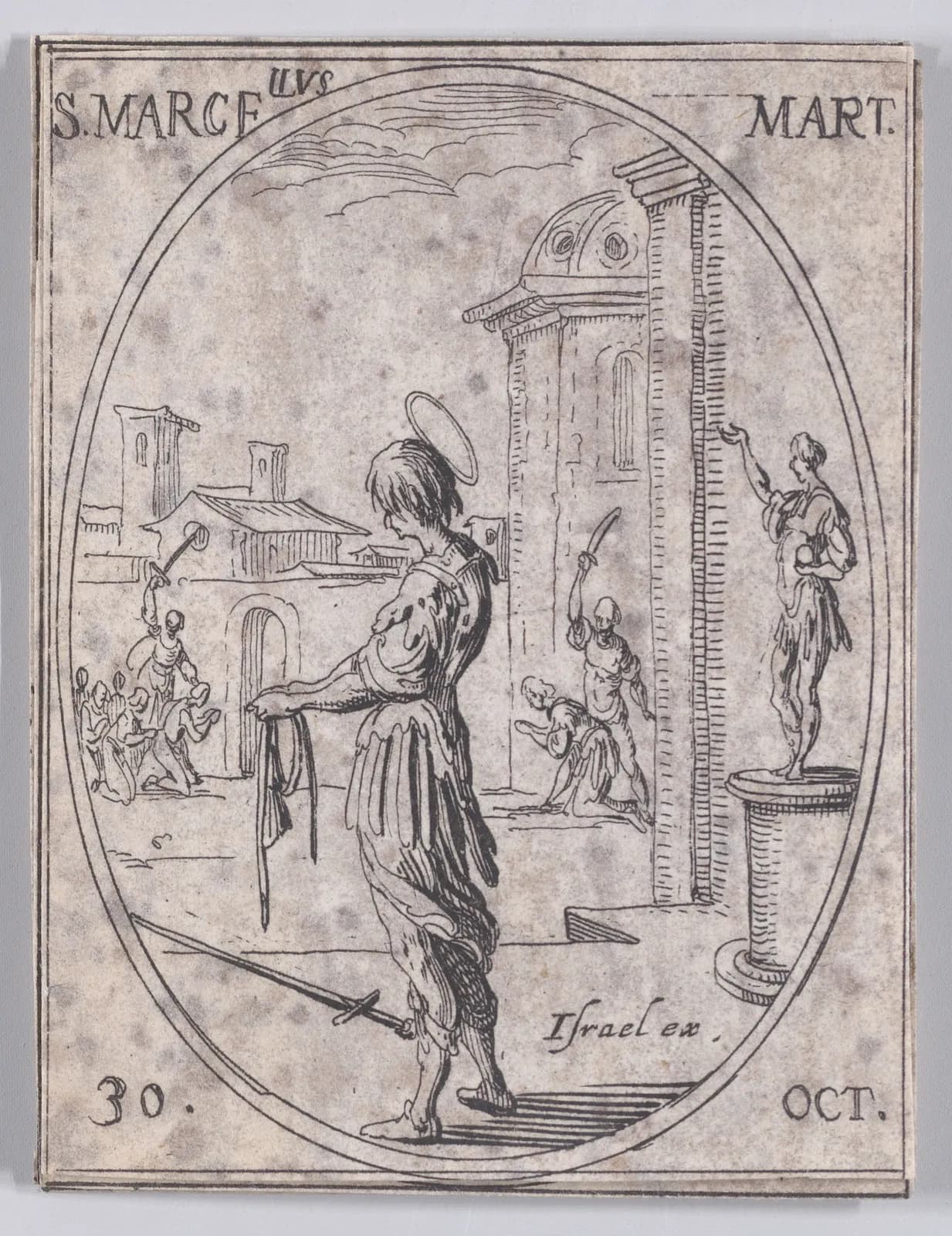
Saint Marcellus the Centurion was a Roman officer who, at a parade for the emperor's birthday in 298, took off his belt, threw down his arms in front of the standards and said he could no longer keep the military oath because he served Christ alone. 23 He was tried, sent to Tangier on the North African coast, and beheaded there on October 30. 12 Unlike many early martyrs, he is known chiefly from the record of his trial, and the Norwegian bishops' saints database calls those Acts very reliable. 1
A soldier with a career
Tradition gives him a background. He was born around the middle of the third century, at Arzas in what is now Galicia, a pagan who went into the army hoping to make his fortune and earn Roman citizenship on his discharge. 14 He rose to centurion of the first rank in the legion of Trajan. 1 Catholic Culture says that he married a young woman named Nona, that he heard the preaching of a holy bishop of León, and that he was converted with his whole family. 4
Butler, writing in the eighteenth century from the Acts, begins later, with the event that made him a saint, and calls him simply "a Christian centurion or captain in the legion of Trajan." 2 Where that legion was is unclear. Butler says it was "then posted in Spain." 2 katolsk.no puts his unit at Tingis, modern Tangier, in the province of Mauretania Tingitana. 1 Catholic Culture leaves it open: "Mauritania or Spain." 4
The birthday of the emperor
The emperor was Maximian, Diocletian's colleague in the West, and his birthday in 298 was kept, in Butler's words, "with extraordinary feasting and solemnity." 21 "Pompous sacrifices to the Roman gods made a considerable part of this solemnity." 2 katolsk.no gives the date as July 21. 1
In front of the assembled troops, Marcellus "cast away his military belt at the head of his company, declaring aloud that he was a soldier of Jesus Christ, the eternal King." 2 He also threw down his weapons and his vine staff, the mark of a centurion's rank. 21 The Roman Martyrology, as the Italian bishops print it, says he threw his belt, his arms and his very life before the standards, professing that he was a Christian and could no longer properly obey the military oath but only Jesus Christ. 3
His fellow soldiers saw treason and blasphemy in it. 1 They reported him, and he was put in prison until the festival was over. 2
Two hearings
Catholic.net describes the trial in two stages: first in Spain before the governor Fortunatus, on July 28, 298, and then at Tangier before Aurelius Agricolanus on October 30. 6 Butler names the first judge Anastasius Fortunatus, prefect of the legion, and the second Aurelian Agricolaus. 2
Before Fortunatus, Marcellus did not deny anything. Butler gives his answer: "When you celebrated the emperor's festival on the 12th before the calends of August (the day on which Maximian had been declared Caesar), I said aloud that I was a Christian, and could serve no other than Jesus Christ, the Son of God." 2 Fortunatus replied that he could not overlook it and had to report it to the emperors. 21 Catholic.net preserves the letter in which he sent the case on, describing a centurion who, as if he had lost his mind, took off his belt of his own accord and threw down his sword and staff in front of the troops. 6
At Tangier, the deputy prefect Agricolanus heard the case on October 30, with a court stenographer named Cassian taking the record. 1 Marcellus admitted what he had done and explained that it was not fitting for a Christian, who fights for Christ his Lord, to fight for the armies of this world. 1 Butler says the sentence was death "for desertion and impiety, as he called his action." 2 As he was led out, according to katolsk.no, Marcellus said: Agricolanus, may God reward you. 1 He was beheaded the same day. 12
Cassian, the stenographer
Catholic Culture says that Cassian, "the secretary or notary of the court, refused to record the sentence pronounced against the martyr, because of its injustice," and was beheaded in his turn on December 3. 4 katolsk.no's page on Cassian tells it the same way: he threw down his stylus and tablets, declared himself a Christian and was imprisoned. 5
It also adds a caution. Cassian's part may be a later addition to the authentic Acts of Marcellus, though there clearly was a martyr named Cassian at Tangier who was venerated as early as the fourth century and is named by the poet Prudentius. 51 The Roman Martyrology keeps him on December 3, at Tangier. 7 katolsk.no adds that Pius XII named him patron of stenographers in 1952. 5
From Tangier to León
His body is said to have remained incorrupt at Tangier until 1471, when the city was taken by King Afonso V of Portugal, who found a grave inscribed with his name. 1 After negotiations, the relics reached León on Holy Saturday, March 29, 1493, brought there by Ferdinand the Catholic. 1 katolsk.no says they are kept in a shrine in the Benedictine monastery in León. 1 Butler says they are "kept in a rich shrine in the chief parish church in that city, of which he is the titular saint." 2 Catholic Culture names the Church of San Marcelo, dating from the tenth century, and says the Plaza de San Marcelo is named for him. 4
A Leonese tradition goes further. It gives Marcellus and Nona twelve sons, all martyrs, among them Claudius, Lupercus and Victorius of León, Facundus and Primitivus of Sahagún, Emeterius and Celidonius of Calahorra, and Servandus and Germanus of Cádiz. 14 katolsk.no judges this to be a legend that attached a number of known martyrs of the same period to Marcellus, and notes that the oldest versions of the documents make no reference to León at all. 1 The Roman Martyrology enters Claudius, Lupercus and Victorius on the same day as Marcellus without calling them his sons. 3
What is Saint Marcellus the patron saint of?
Catholic Culture lists Saint Marcellus as the patron of conscientious objectors and of the city and province of León in Spain. 4 None of the sources read here calls him a patron of soldiers. In León his day is kept as a solemnity of the city, and Butler calls him the titular saint of its chief parish church. 12
Saint Marcellus's feast day
Saint Marcellus's feast day is October 30, the day of his death, and the current Roman Martyrology enters his passion at Tangier on that date. 13 katolsk.no notes that it is an obligatory memorial in North Africa and an optional one in the Mozarabic rite. 1 In León he is kept on October 29, as a solemnity in the city and an obligatory memorial in the diocese. 1 Cassian has his own day, December 3. 57
Praying with Saint Marcellus
The sources weigh his reasons differently. The Martyrology puts the weight on the oath and the sacrifices: on a day when the army honored the emperor with offerings to the gods, he could no longer properly keep his oath, because he owed obedience to Christ. 3 In katolsk.no's account of the trial he goes further, telling the judge that it was not fitting for a Christian, who fights for Christ, to fight for the armies of this world. 1 Both readings have been drawn from him since.
The record is plain, almost bureaucratic, which is what makes it worth reading. A soldier makes a scene at a parade. An officer writes a letter saying the man seems to have gone mad. A deputy prefect asks whether the facts are correct, hears that they are, and passes sentence. 612 Nobody in it is a monster. Marcellus blesses the judge who condemned him. 1
Catholic Culture now lists him as a patron of conscientious objectors. 4 That is a reading the trial allows, not one it forces. What it shows for certain is a man who had served faithfully and was willing to stop, publicly and at once, the moment serving meant giving to someone else what belonged to God. 23
Saint Marcellus the Centurion, pray for us.
Sources
- 1."Den hellige Marcellus centurionen av Tanger (d. 298)," Den katolske kirke (katolsk.no), Catholic Diocese of Oslo (in Norwegian).
- 2.Alban Butler, "St. Marcellus the Centurion, Martyr," The Lives of the Fathers, Martyrs and Other Principal Saints, Vol. 3, EWTN Library.
- 3.Roman Martyrology, entry for October 30, "San Marcello, centurione," as printed in "Santo del giorno," Conferenza Episcopale Italiana (in Italian).
- 4."October 30," Liturgical Year calendar, Catholic Culture (Trinity Communications), with the entry for Saint Marcellus.
- 5."Den hellige Kassian av Tanger (d. 298)," Den katolske kirke (katolsk.no), Catholic Diocese of Oslo (in Norwegian).
- 6."Marcelo de Tánger, Santo," with the Roman Martyrology entry for October 30, Catholic.net (in Spanish).
- 7.Roman Martyrology, entry for December 3, "San Cassiano, martire," as printed in "Santo del giorno," Conferenza Episcopale Italiana (in Italian).
Saints to turn to next
Others in this collection who are turned to for some of the same things.