Saints Marcellinus and Peter
Martyred in Rome in 304
- Relics
- Taken by Einhard to Seligenstadt, Germany, in the ninth century 5
Saints Marcellinus and Peter were a Roman priest and an exorcist, beheaded in 304 in the persecution of Diocletian and named ever since in the Roman Canon of the Mass. 134 Their executioners took them into a wood to kill them so that no one would find the place, Vatican News says, but their executioner later told the story to Damasus, who as pope put it into verse on their tomb. 13 Their feast is June 2. 12
Rome in 304
Vatican News sets the scene in the year 304, when the persecution ordered by the Emperor Diocletian was at its height. 1 It calls it the last great culling of Christians before Constantine's Edict of Milan gave them legal standing. 1 The second of Diocletian's four edicts against the Christians ordered the arrest of bishops, priests and deacons, and Marcellinus, a priest, was one of those taken. 1 He would not renounce the faith. 1
In prison he met Peter, an exorcist. 1 Vatican News glosses the office: an exorcist, it says, was less a fighter of demons than someone whose duties included those of a modern-day usher or warden. 1 Together, it says, they proclaimed Christ crucified and risen, and many prisoners asked to be baptized. 1
The story in the passio
The later account of their martyrdom is longer and more colorful, and Vatican News warns that "there are many legends in their hagiography," some of them miracles, such as the healing of their jailer's daughter. 1 Catholic Culture reprints that story as Dom Prosper Guéranger told it in The Liturgical Year. 2
In Guéranger's telling, Peter was jailed by a judge named Serenus and freed Paulina, the daughter of the jailer Artemius, from an evil spirit. 2 Artemius, his wife, his household and the neighbors who came running to see were all converted, and Peter brought them to Marcellinus, who baptized them. 2 Serenus summoned the two, threatened them, had Marcellinus beaten and shut him up naked in a cell strewn with broken glass, without food or light, and confined Peter apart from him. 2 When neither weakened, both were beheaded. 2
Catholic Culture's own summary at the head of the same page calls the first of them an exorcist and the second a priest, reversing them; every other source consulted, including the Guéranger excerpt below it, makes Marcellinus the priest and Peter the exorcist. 1234
What Damasus heard
Here, Vatican News says, the story becomes more certain, "thanks to Pope St. Damasus, who tells it a few decades after the fact." 1 Franciscan Media says Damasus wrote their epitaph from the account of the executioner himself. 3
As Vatican News retells it, the two were tortured and taken into a wood called the Black Forest, made to dig their own graves, and beheaded. 1 Killing them in the forest was meant as a final insult, a way to hide the place of execution forever. 1 "That calculation was mistaken." 1
Adrian Fortescue, writing on the Canon of the Mass for the Catholic Encyclopedia, calls Peter "a Roman exorcist martyred at Silva Candida," which he places in the Diocese of Porto near Rome. 4 Vatican News explains the name: after Lucilla moved the martyrs' remains, the Black Wood, Selva Nera, came to be called the White Wood, Selva Candida. 1
Lucilla and the two laurels
A Roman matron named Lucilla soon learned where they had died, according to Vatican News, found the bodies and moved them to the cemetery called ad duas lauros, at the two laurels, perhaps from two trees that grew there. 1 Vatican News places it on the Via Casilina, though it heads its page "martyrs on the via Labicana," and the Catholic Encyclopedia lists the catacomb of Saints Peter and Marcellinus on the Via Labicana. 16
Catholic Culture and Franciscan Media both say their cult mattered enough that Constantine built a basilica over their burial place once peace had come to the Church. 23 Damasus composed a poem for the new tomb and fixed it there; when the Goths destroyed it, Vatican News says, Pope Vigilius set it up again and put the two martyrs' names in the Canon of the Mass. 1 Their memory, it says, proved "too great to be erased by anonymous burial in unmarked tombs covered by overgrowth," and the Roman churches and the catacombs, still open today, keep it. 1
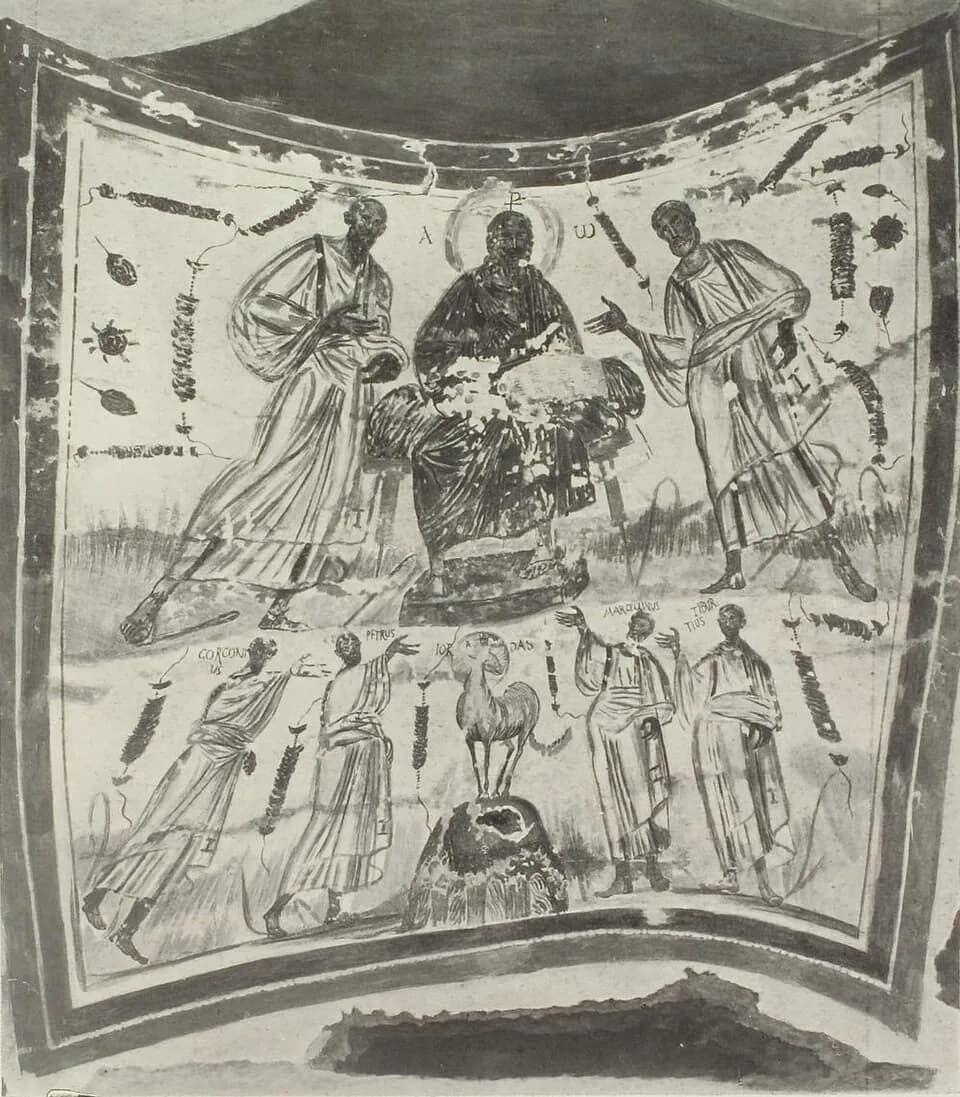
The catacomb was among those excavated in the half-century before 1908, and the encyclopedia's article on the Roman catacombs describes how, once burials there stopped, the graves of the martyrs were painted with pictures of the saints grouped around Christ. 6 The fresco reproduced on this page comes from their catacomb.
In the Roman Canon
Their names are in the first Eucharistic Prayer, the Roman Canon. 23 Fortescue explains where: in the prayer that begins "Nobis quoque peccatoribus," after John the Baptist come seven men and seven women, all of them martyrs, and the Peter in that list is the Roman exorcist, kept with Marcellinus on 2 June. 4 Franciscan Media notes that the Church honors them with a feast and a place in the Eucharistic Prayer even though so little about them is documented. 3
Seligenstadt
Vatican News says there followed "a series of more-or-less licit translations" of their relics. 1 One of them took them across the Alps. 5 Einhard, the historian and trusted adviser of Charlemagne, withdrew from court in 830 to Mühlheim on the Main, an estate granted him as early as 815 as a mark of imperial favor; he brought the relics of Saints Marcellinus and Peter there and renamed the place Seligenstadt. 5 Between 831 and 834 he founded a Benedictine abbey on the site, where he lived out his life as abbot and died in 840. 5
What are Saints Marcellinus and Peter the patron saints of?
Saints Marcellinus and Peter's feast day
Saints Marcellinus and Peter are remembered on June 2. 123 Fortescue gave the same date for their feast in 1908, and Catholic Culture prints it as their optional memorial in the current calendar. 24 Vatican News lists them that day as "Sts. Marcellinus, priest, and Peter, exorcist, martyrs on the via Labicana." 1
Catholic Culture notes that they are in the Roman Martyrology, which began as a list of those who shed their blood for Christ in the early persecutions, and that the local churches kept each martyr's "birthday" into heaven, the day of the final victory, as the feast. 2 The same day also carries the commemoration of Saint Erasmus, a bishop martyred at about the same time, according to Catholic Culture. 2
Praying with Saints Marcellinus and Peter
They were killed where nobody was supposed to find them, and buried in graves they had been made to dig. 1 Vatican News calls it an effort "to obscure forever their place of execution." 1 Within a few decades a pope had written their names on a tomb in verse, and by the sixth century, Vatican News says, their names were in the Canon of the Mass. 14
The memory survived through two unlikely witnesses. 13 By Franciscan Media's account Damasus learned what happened from the executioner, and by Vatican News's it was a Roman matron, Lucilla, who went looking for the bodies and found them. 13
Neither of them was a bishop, and nothing they wrote or said survives. 12 Vatican News's calendar for the day describes them as two of the innumerable saints who gave heroic witness in the Church's infancy, "when neither torture nor death could give them cause to turn their backs on Christ." 7
Saints Marcellinus and Peter, pray for us.
Sources
- 1."Sts. Marcellinus, priest, and Peter, exorcist, martyrs on the via Labicana," Saint of the Day, June 2, Vatican News.
- 2."Optional Memorial of Sts. Marcellinus and Peter, Martyrs - June 02, 2026," Liturgical Year, Catholic Culture, with an excerpt from Prosper Guéranger, The Liturgical Year.
- 3."Saints Marcellinus and Peter," Saint of the Day, June 2, Franciscan Media.
- 4.Adrian Fortescue, "Canon of the Mass," The Catholic Encyclopedia, vol. 3 (New York: Robert Appleton Company, 1908).
- 5.P. Schlager, "Einhard," The Catholic Encyclopedia, vol. 5 (New York: Robert Appleton Company, 1909).
- 6.A. de Waal, "Roman Catacombs," The Catholic Encyclopedia, vol. 3 (New York: Robert Appleton Company, 1908).
- 7."Saint of the Day: 2 June," Vatican News.
Saints to turn to next
Others in this collection who are turned to for some of the same things.
- Saint CyprianBirth unknown - September 14, 258CourageConversionSuffering and illness
- Saint EustaceMartyred at Rome, in 118 by tradition; other accounts give 140 or 188ConversionCourageSuffering and illness
- Saint Gregory the Illuminatorc. 257 - c. 337 (both dates uncertain)ConversionSuffering and illnessCourage
- Saint John Paul IIMay 18, 1920 - April 2, 2005CourageSuffering and illnessConversion