Saint Mamas
Died c. 275
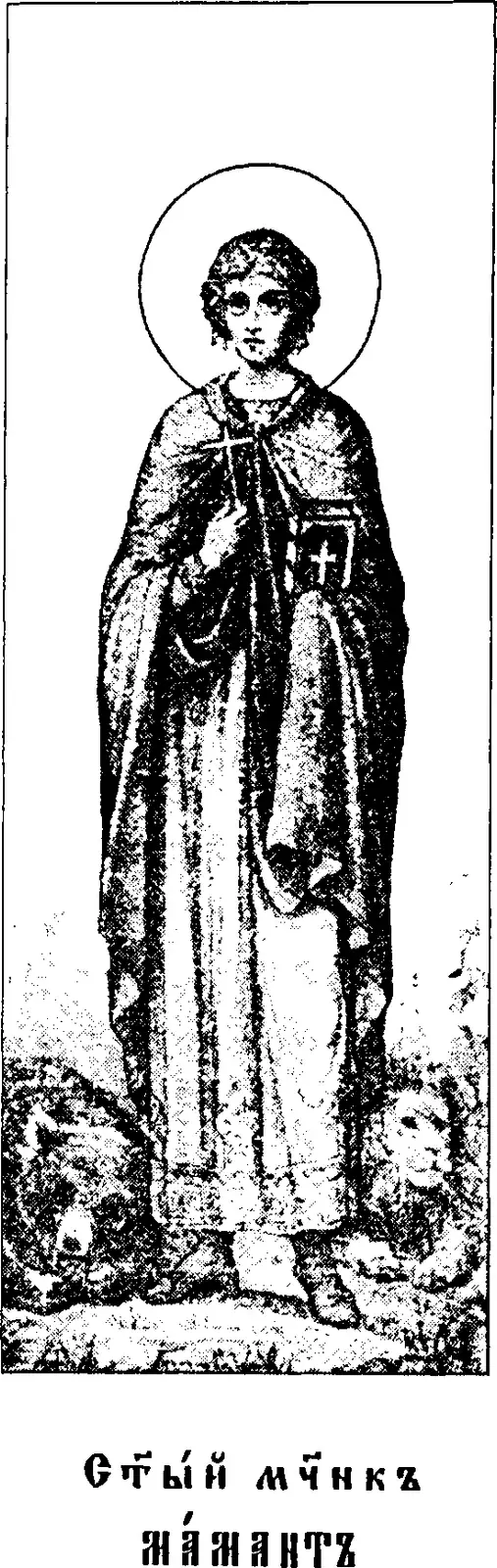
- Known for
- The church in his honor that the young Julian, later the Apostate, could not get to stand 13
- Invoked for
- Broken bones and nursing infants, by tradition, according to Catholic.net 6
Saint Mamas was a shepherd of Caesarea in Cappadocia, in what is now Turkey, martyred under the emperor Aurelian about the year 275. 15 Saint Basil and Saint Gregory Nazianzen both preached his praises, and in the following century the boy who would become Julian the Apostate tried to build a church at his tomb and, the historian Sozomen says, could not make the walls stand. 13 His feast is August 17. 25
A shepherd of Cappadocia
Alban Butler says he took the life of Mamas from the sermons that Saint Basil and Saint Gregory Nazianzen preached in his honor, and that he made "no use" of the later Greek Acts of his martyrdom. 1 What those two bishops of Cappadocia handed down is short. Mamas, Butler writes, "was a poor shepherd's boy at Cæsarea in Cappadocia, who, seeking from his infancy the kingdom of God with his whole heart, distinguished himself by his extraordinary fervour in the divine service." 1
The current Roman Martyrology adds a picture of how he lived: a very humble shepherd who lived alone in the forests of the mountains, with the greatest frugality, and who suffered martyrdom under the emperor Aurelian for professing his faith in Christ. 5 The Byzantine hymns for his day make the same comparison the shepherd invites, calling him a new Abel, who "presided over his grazing flocks" and offered himself to Christ as Abel offered a lamb. 4
The 1897 English edition of the Roman Martyrology notes that "he has been highly praised by the holy fathers Basil and Gregory Nazianzen." 2 Butler ranks him among those the Greeks call the Great Martyrs. 1
Under Aurelian
Butler sets the scene in the reign of Aurelian, a soldier emperor chosen by the army in 270. 1 Aurelian defeated Zenobia of Palmyra, who had favored the Christians in the East, and on his return to Rome he published, Butler says, "most bloody edicts against them in 275," only to be killed by a conspiracy in Thrace in April of the same year. 1 The persecution was short, but Butler notes that "the calendars testify that many suffered in it," and that among them "none is more famous than St. Mamas." 1
Mamas was arrested "about the year 274 or 275," Butler writes, and "suffered the most cruel torments with a holy joy, and attained in his youth a glorious crown of martyrdom." 1 The Byzantine Catholic Menaion dates his death to 274 and says that he was killed by a pagan priest after many forms of torture. 4
Two other tellings
Beyond those bare facts the sources part ways, and this page gives each its own voice. The Menaion of the Archeparchy of Pittsburgh tells a fuller story. Mamas was born in Paphlagonia to Christian parents who had been imprisoned for the name of Christ. His father died, then his mother, and the baby was found beside their bodies and rescued by a pious widow. 4 He did not speak until he was five, and his first word was "mama," from which, the Menaion says, his name comes. 4 At fifteen he was brought before Aurelian and told to blaspheme Christ, and answered, "I shall not deny my God and King Jesus Christ, either in my heart or with my lips." 4
The older Roman Martyrology knew a version of the same family. On August 31 it commemorates at Caesarea the saints Theodotus, Rufina and Ammia: "The first two were the parents of the martyr St. Mamas, whom Rufina brought forth in prison, and whom Ammia brought up." 2 Catholic.net gives the same names and adds that Ammia died when Mamas was fifteen and left him her property. 6
The 1897 Martyrology's entry for August 17 does not make him young at all. It says that Mamas, "from childhood to old age, endured a long martyrdom," and ended it in the reign of Aurelian under the governor Alexander. 2 Butler, working from Basil and Gregory, says he died in his youth. 1 Neither is reconciled here.
Catholic.net, writing in Spanish, reports the arena story explicitly as legend: that the lions he was thrown to grew tame, that he was then killed with a trident and died in a cave near the theater, and in another version that the lions devoured him. 6 It judges that the traditional date of his martyrdom under Aurelian, though not fully confirmed, can be considered plausible. 6
The church that would not stand
The best-attested story about Mamas happened in the next century, and he is not in it except as the saint of a building. Butler mentions it from Sozomen and Gregory: Julian, the future emperor who would abandon the faith, and his brother Gallus were raised near Caesarea and amused themselves as boys "in building churches to the martyrs, particularly one to St. Mamas; but that while Gallus's part advanced, that of Julian fell down again every day." 1
Sozomen tells it at length. The two orphaned princes were kept at Macellum, an imperial estate near Mount Argeus not far from Caesarea, and brought up as Christians; they were enrolled among the clergy, read the Scriptures to the people and honored the tombs of the martyrs. 3 "It is said that they undertook to deposit the tomb of St. Mammas the martyr in a large edifice, and to divide the labor between themselves." 3
Gallus's half went up quickly. Of Julian's, Sozomen writes, part fell into ruin, part was thrown up out of the ground, and part could not be held upright on its foundation "but was hurled backward as if some resistant and strong force from beneath were pushing against it." 3 He says the story would be incredible were it not for the testimony of many still living who had it from eyewitnesses, and that the people drew no conclusion from it until Julian's later apostasy made its meaning plain. 3
His cult
Catholic.net traces his cult from Caesarea into the West. The chief center of his veneration in Europe, it says, is the cathedral of Langres in France, which is dedicated to him, and pilgrims on the road to Santiago carried his devotion into Spain, where shrines and a district of León bear his name. 6 It reports that his head is kept in the church of Saint Mary Magdalene in Zaragoza. 6
In the East the kontakion of his day asks him to lead his people like a flock: "O holy Mammas, with the staff God gave to you, lead your people as a flock to life-giving pastures." 4
What is Saint Mamas the patron saint of?
Saint Mamas's feast day
Saint Mamas's feast day is August 17. The current Roman Martyrology, as the Italian bishops print it, enters him on that day at Caesarea in Cappadocia. 5 Butler and the 1897 English Martyrology place him on August 17 as well. 12
The Byzantine calendar, followed by the Eastern Catholic Churches, keeps him on September 2. 4
Praying with Saint Mamas
Almost nothing is known about Mamas for certain. The bishops who preached about him remembered a shepherd, poor, devoted from childhood, who died for Christ under Aurelian. 1 The Martyrology remembers a man who lived alone in the mountain forests and ate very little. 5
The rest grew up around that core: the prison birth, the widow, the first word, the lions. 246 The sources carry those stories honestly as what was told, and Catholic.net calls the arena story legend outright. 6
His one reply to the emperor, in the Menaion, is that he would not deny Christ "either in my heart or with my lips." 4 It asks for both.
The church at Macellum is a strange footnote. Two boys built a shrine to a shepherd martyr, and one of them later tried to undo the faith of the empire. 13 Sozomen tells it as a sign that was understood only afterward. 3
Saint Mamas, pray for us.
Sources
- 1.Alban Butler, "St. Mamas, M.," August 17, in The Lives of the Fathers, Martyrs, and Other Principal Saints, Vol. VIII (London: J. Murphy, 1812), pp. 200-202, Internet Archive.
- 2.The Roman Martyrology, August 17 and August 31 (Baltimore: John Murphy & Co., 1897).
- 3.Sozomen, Ecclesiastical History, Book V, chapter 2, trans. Chester D. Hartranft, Nicene and Post-Nicene Fathers, Second Series, Vol. 2 (1890), New Advent.
- 4."Menaion - September 2," Metropolitan Cantor Institute, Byzantine Catholic Archeparchy of Pittsburgh.
- 5.Roman Martyrology, entry for August 17, Santo del giorno, Conferenza Episcopale Italiana (in Italian).
- 6."Mamés o Mamante o Mameto, Santo," Catholic.net (in Spanish).
Saints to turn to next
Others in this collection who are turned to for some of the same things.