Saint Malo
c. 520 - seventh century
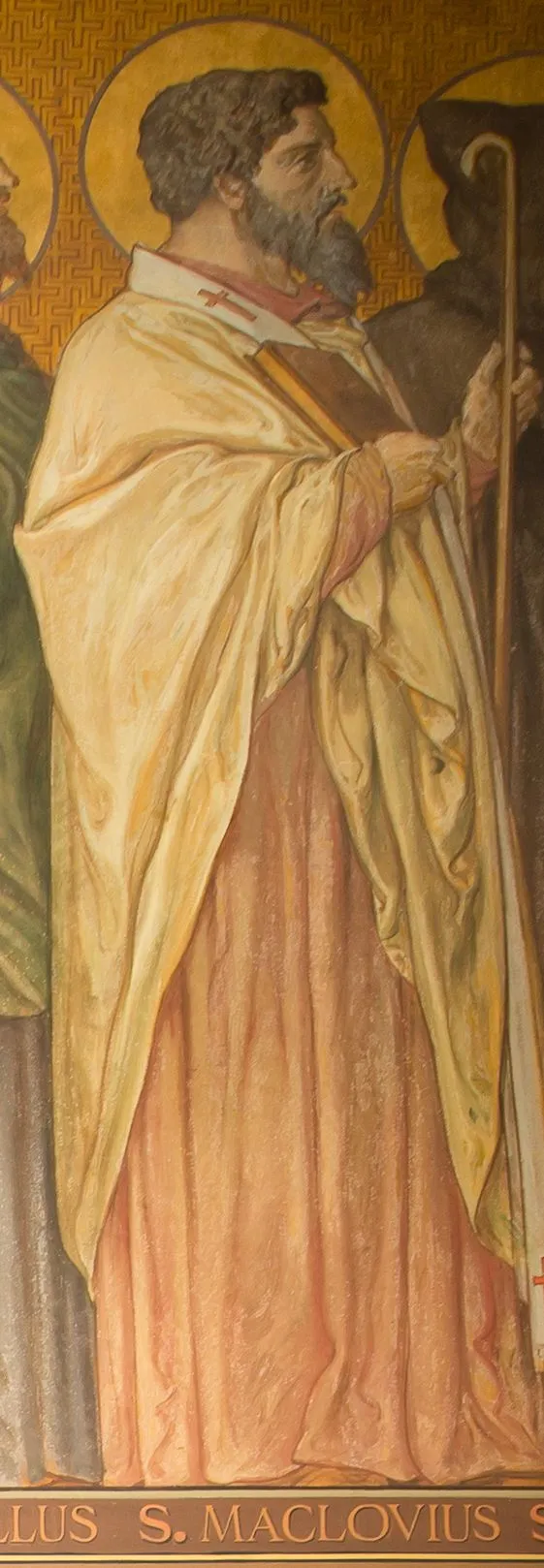
- Patron saint of
- The town of Saint-Malo 1
Saint Malo was a Welsh monk who crossed to Brittany in the sixth century, became bishop of Aleth near the mouth of the Rance, and gave his name to the port of Saint-Malo that grew up beside it. 12 He was also, by every account, a difficult man to keep: he made enemies as readily as friends, was driven out of his diocese, and died in exile near Saintes in southwestern France. 123 The Roman Martyrology says no more than that he is held to have been born in Wales and to have died in the territory of Saintes. 3
A monk of Llancarfan
His name comes in many forms: Malo, Maclou, Maclovius, Machutus. 13 The Norwegian bishops' saints database regards Machutus as a mistaken form, while the Roman Martyrology, as the Italian bishops print it, enters him as Maclovius or Machutus. 13
Vatican News says he studied in Wales at the monastic school of Llancarfan, founded by Saint Cadoc, and stayed there as a monk. 2 katolsk.no gives his birth as about 520, near Llancarfan according to tradition, to a noble family, and makes him a cousin of Saint Samson and Saint Magloire. 1 It adds that the stories of his early life in Gwent may really belong to another saint, Machudd of Anglesey. 1
The best-known story of his youth puts him in the company of Saint Brendan. katolsk.no reports that he was said to be Brendan's favorite disciple and to have sailed with him for seven years in search of the Isle of the Blessed, celebrating Easter on the back of a whale, and it states plainly that his part in Brendan's voyage is purely legendary. 1
Aaron's island and Aleth
Vatican News says that, once he had become a bishop, Malo left Glamorgan with some companions, put to sea, and stopped at the island of the hermit Aaron, who advised the Welsh monks to go to Aleth, a city in the old lands of the Coriosolites. 2 katolsk.no tells it differently: in one version he was chosen bishop before he left and declined, and he became one of Aaron's disciples on the island of Cézembre at the mouth of the Rance, succeeding him as abbot after Aaron's death. 1
From there he preached to the people of Aleth on the mainland. 1 katolsk.no explains that the island on which the city of Saint-Malo began was called Saint-Aaron until about 1150, when Jean de la Grille renamed it for Malo, and that old Aleth is now the district of Saint-Servan. 1
His preaching took him as far as Corseul, near Dinan. 1 In katolsk.no's account, he was chosen bishop of Aleth only after the rightful Breton king, Judual, was restored around 560, and he was probably not the first bishop there, though his reputation was such that the diocese later took his name. 1 The Martyrology calls him simply bishop of Aleth. 3
A bishop who made enemies
He was a hard missionary to like. katolsk.no describes a puritanical man who often found himself shaking the dust from his feet after making enemies as well as friends in a district, and who sang the psalms aloud as he rode from place to place. 1 He did what he could to protect his people from the violence of their lords. 1
One episode shows what that could cost. katolsk.no tells how a royal official named Redwal, seizing power, murdered the sons of King Judhael, and how one of the boys took refuge in Aleth while Malo was away; despite the bishop's pleas, Redwal killed the child in front of him. 1 The new king, Haeloc, persecuted Malo and his monks for years afterward, though katolsk.no says the two were reconciled in the end. 1
In the end the opposition was too strong. Vatican News says disputes led him to abandon his flock and resign his see. 2 katolsk.no says that when the chief who protected him died, Malo took ship with thirty-three monks, solemnly condemned his opponents, and sailed down the coast to Saintonge, where Bishop Leontius of Saintes befriended him. 1
Exile and death in Saintonge
After some years a deputation came from Aleth to ask him back. katolsk.no says the town had been struck by a severe drought that people blamed on their treatment of their bishop; Vatican News says Aleth was devastated by plague and famine. 12 Here the versions divide. Some say he died near Saintes before he could go; others that he went back, that rain fell as he arrived, and that he returned to Saintonge and died there. 12
katolsk.no gives his death as November 15, probably about 640, while noting that many sources say 621 and others give dates from 565 to 630. 1 Vatican News gives November 16, 649. 2 He was buried in Saintonge, and Leontius paid for his funeral and built a chapel over the grave. 1
katolsk.no is blunt about the sources for all of this. At least four medieval lives exist, the best known by a deacon named Bili in the late ninth century, but they are of little value; some scholars think two different men, a Machutus of Saintonge and a Maclovius of Aleth, have been merged into one. 1
The wren on his cloak
One story from a later life has lasted better than the rest. katolsk.no gives Sigebert of Gembloux's account of Malo pruning vines with his brothers. He took off his cloak and laid it aside, and when he came back for it, a wren had laid an egg in it. He left the cloak where it was until the egg hatched and the bird had taken its young away, and, the story says, no rain fell on the cloak all that time. 1
The relics
Vatican News says the Christians of Aleth managed to recover some of his relics, and that during the Norman invasions they were kept near Paris, at Saint-Jacques du Haut-Pas. 2 katolsk.no gives the longer story told by the Breton hagiographer Albert Le Grand, of a young nobleman of Aleth who carried the bones home from Saintonge in the late ninth century, and follows them to Paris in 975, to the abbey of Saint-Magloire, and to Saint-Victor, where they were lost when the abbey was suppressed in 1791. 1 What remained at Saint-Jacques du Haut-Pas went in 1954 to the abbey of Boquen in Brittany. 1
His cult reached well beyond Brittany. katolsk.no notes his feast in the calendars of Sarum, York and Hereford. 1 Vatican News points to the church of Saint Malo at Bully in the diocese of Arras, and to the cathedral of Pontoise, which is dedicated to him. 2
What is Saint Malo the patron saint of?
katolsk.no names Saint Malo as the patron saint of the town of Saint-Malo, which grew from an island renamed for him in the twelfth century. 1 He is counted among the seven founding saints of Brittany, with Samson, Brieuc, Tudwal, Pol Aurelian, Patern and Corentin. 1 No other patronage appears in the sources consulted. 12
Saint Malo's feast day
Praying with Saint Malo
Malo is not an easy saint to make gentle. The sources remember a stern preacher who made enemies, who left districts shaking the dust from his feet, and who in the end sailed away from his own diocese condemning the people who had driven him out. 12
They also remember him unable to save a child who had come to his town for sanctuary, and forced to watch him killed. 1 Nothing in the story turns that into a lesson, and it should not be made into one here.
What follows is a long exile, a town that sent for him when it was suffering, and a bishop who went. 12 Alongside the hard man the tradition kept another picture too: a monk in a vineyard who would not move his own cloak until a wren had finished with it. 1
Saint Malo, pray for us.
Sources
- 1."Den hellige Malo av Aleth (~520-~640)," Den katolske kirke (katolsk.no), Catholic Diocese of Oslo (in Norwegian).
- 2."Saint Malo," Saint of the Day for November 15, Vatican News.
- 3.Roman Martyrology, entry for November 15, "San Maclovio o Macúto," as printed in "Santo del giorno," Conferenza Episcopale Italiana (in Italian).
Saints to turn to next
Others in this collection who are turned to for some of the same things.