Saint Lupus of Sens
573 - September 1, 623
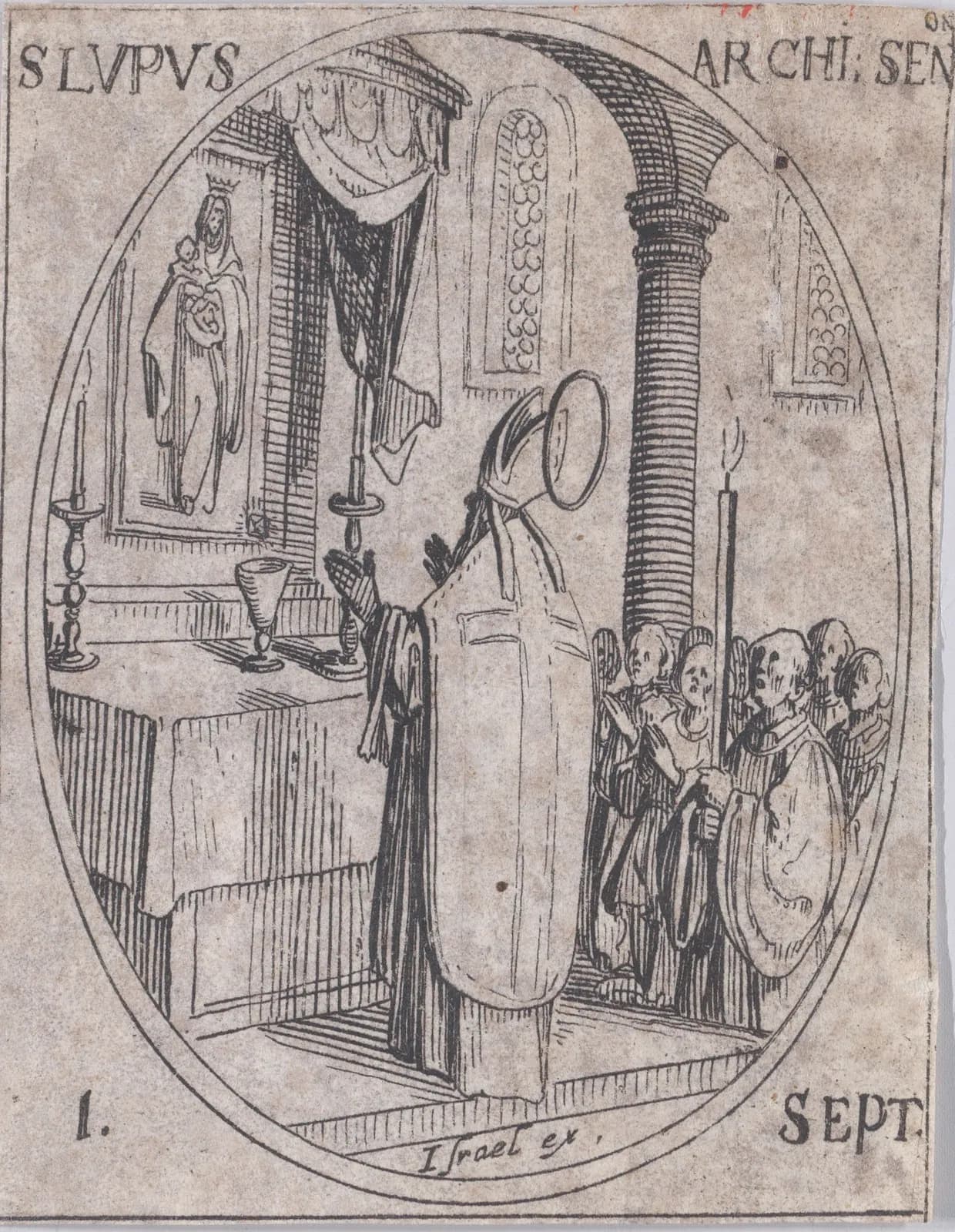
Saint Lupus, called Loup or Leu in French, was bishop of Sens from 609 to 623, in the years when Clotaire II made himself sole king of the Franks. 13 He took the losing side, was slandered to the winner and sent into exile, and spent the exile converting the pagans of the countryside where he had been left. 13 The king recalled him and asked his pardon, and Butler says the bishop never showed the least resentment. 13
A bishop from a family of bishops
Lupus was born at Orléans in 573. 1 The Norwegian bishops' saints database (katolsk.no) says his father, Betto, was a nobleman of Orléans related to the Burgundian royal house and is honored as blessed, and his mother, Agia, as a saint. 1 His mother's brother was Saint Aunacharius, bishop of Auxerre, and another uncle was bishop of Orléans, so that, as katolsk.no puts it, a career in the Church came naturally. 1 Georges Goyau, in the 1912 Catholic Encyclopedia, lists Aunacharius among the bishops of Auxerre as "uncle of St. Lupus, Archbishop of Sens." 4
Alban Butler, in his Lives of the Saints, says he was brought up "like another Samuel" among the clergy of Orléans, his native city. 3 He liked to visit the tombs of the martyrs, fasted hard, and was so generous to anyone in need that his charity, in Butler's words, "on any other occasion would have been esteemed profusion." 3 katolsk.no adds that he became a monk at Lérins, the island monastery off Cannes, before he was made bishop. 1
In 609 he succeeded Saint Artemius as bishop of Sens. 13 katolsk.no says he was a good archbishop, a humble man of prayer who carried out his duties with great zeal, and that he attended the Council of Paris in 614. 1 Goyau gives him a part in the cult of the city's own martyr, Saint Columba: it was Bishop Loup, he writes, "who translated the relics of St. Columba to the monastery church." 4
On the wrong side
The trouble was political. 13 In 613 King Theuderic II of Burgundy died, and Lupus supported the claim of Theuderic's son Sigebert II to succeed him; Butler says he did so "to the utmost of his power." 13 Sigebert died the same year, and Clotaire II of Neustria took Burgundy and became sole king of the Franks. 1 katolsk.no says Lupus rebuked Clotaire for annexing it. 1
Clotaire sent Farulf to manage his affairs in Burgundy. 13 katolsk.no tells that when Farulf marched on Sens, Lupus had the church bells rung, and the noise frightened him and his men away. 1 What turned Farulf into an enemy, in both accounts, was money: Lupus would not buy his own safety from Farulf, and Butler says the official was "exasperated against the saint because he did not bring him presents." 13 Farulf accused him falsely to the king. 13
He had help from inside Sens. Medegisil, abbot of Saint-Rémi just outside the city, wanted the bishopric for himself and joined in the slander. 13 He did not get it. katolsk.no says the people of Sens killed him in his own church for his treachery; Butler does not mention his end. 13
The Martyrology gives a different reason for the exile. It says Lupus suffered banishment for having boldly declared before a local notable that the people must be led by their priest and must obey God rather than princes. 2
Exile and recall
Clotaire believed the accusers and banished the bishop. 13 Butler says the king gave orders to Landegesil, a pagan officer, to take him to Ausene, a village in the Vimeu; katolsk.no places it near Blangy-sur-Bresle. 13 Finding temples there where the people still worshiped the old gods, Butler writes, Lupus took it that God had sent him to convert them, and set about it at once. 3
The two accounts agree that the turning point was a healing. 13 katolsk.no says that after Lupus restored a blind man's sight, even the governor and some of the soldiers were converted. 1 In Butler the man converted is Landegesil himself, "the duke or governor," whom Lupus baptized along with several others in the Frankish armies who were still pagans. 3
Meanwhile Sens wanted him back. Saint Winebald, abbot of the monastery of Saint Lupus at Troyes, and the people of the city appealed to the king. 13 Butler says Clotaire, who was then near Rouen, saw how he had been deceived, sent for Lupus, "prostrated himself at his feet to ask him forgiveness," had him eat at his table, and sent him home loaded with gifts. 3 katolsk.no says Lupus bore no grudge and went on governing his diocese as if nothing had happened. 1 Butler says he "sought no other revenge than by conferring the greatest benefits on his calumniators." 3
Death and legend
Lupus died in 623. 13 katolsk.no says it was reportedly at Brienon-sur-Armançon, where a spring still bears his name; Butler gives "the manor of Brinon, which still belongs to his church," and the date September 1. 13 He was buried, as he had asked, in the church of Saint Columba at Sens; Butler says it was "out of humility, under the water-conduit pipe." 13 The church was renamed for Columba and Lupus together, a monastery grew up around it, and in 853 his relics were moved to a new basilica. 1
How much of his story can be trusted is an open question. Butler says his Life was "written soon after his death." 3 katolsk.no says that the earliest Latin Life, once dated to the eighth century, is now thought to be of the ninth and is regarded as unreliable. 1 His cult, though, is old: katolsk.no notes that he is named in the complete manuscripts of the martyrology attributed to Jerome and in Wandelbert's martyrology of about 850, and Butler that he is in the martyrologies of Ado and Usuard. 13 Places such as Saint-Loup-de-Naud and Saint-Leu-d'Esserent are named for him. 1
Two treasures at Sens are tied to him by legend. katolsk.no says the cathedral treasury keeps his episcopal ring, one of the many rings in the old stories that were lost in water and found again inside a fish, and with it a gem said to have fallen miraculously into his chalice while he was saying Mass at Ordon, now Saint-Loup-d'Ordon. 1
What is Saint Lupus of Sens the patron saint of?
None of the sources consulted names a patronage for Saint Lupus of Sens. katolsk.no notes that his cult was at one time widespread and popular in France, and that several places there are named for him. 1
Saint Lupus of Sens's feast day
Praying with Saint Lupus
Lupus backed a claimant who died within the year, and paid for it. 13 He would not buy off the official sent to watch him, and one of his own abbots helped to bring him down. 13
Exile put him among people who still worshiped the old gods, and he preached the Gospel to them. 13 Butler sees in it a man who believed "he was sent by God for their conversion." 3
When the king knelt to him, he went home and, as katolsk.no tells it, carried on as though nothing had happened. 1 Butler sees "the highest mark of true heroism and sincere virtue" in the "evenness of temper with which he bore his disgrace." 3 The Martyrology remembers something sharper: a bishop who told a powerful man to his face that God is obeyed before princes. 2
Saint Lupus of Sens, pray for us.
Sources
- 1."Den hellige Lupus av Sens (573-623)," Den katolske kirke (katolsk.no), Catholic Diocese of Oslo (in Norwegian).
- 2.Roman Martyrology, entry for September 1, "San Lupo, vescovo," as printed in "Santo del giorno," Conferenza Episcopale Italiana (in Italian).
- 3.Alban Butler, "St. Lupus, or Leu, Archbishop of Sens, C.," The Lives of the Fathers, Martyrs, and Other Principal Saints, Vol. 9, September 1 (Derby: Richardson and Son, 1842), via the Internet Archive.
- 4.Georges Goyau, "Sens," The Catholic Encyclopedia, Vol. 13 (New York: Robert Appleton Company, 1912).
Saints to turn to next
Others in this collection who are turned to for some of the same things.