Saint Lucy
c. 283 - 303 or 304
- Patron saint of
- The blind and eye disorders; the 1911 Catholic Encyclopedia lists "Clare and Lucy (the eyes)" 23
- Why the eyes
- Franciscan Media's account is that the paintings came first and the legends grew to explain them 4
- Historical record
- The 1910 Catholic Encyclopedia says the story "cannot unfortunately be accepted without criticism" 1
- Early veneration
- One of the few women named in the canon of the Mass, with her own prayers in Gregory's Sacramentary 1
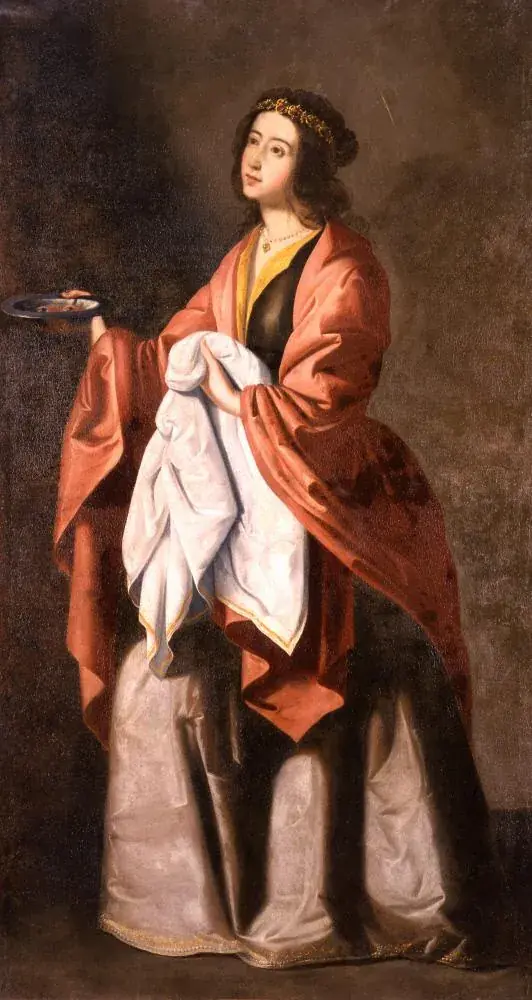
Saint Lucy was killed at Syracuse in Sicily during the persecution of Diocletian, denounced by the man she had refused to marry. Her own encyclopedia will defend the place and the date and very little else. She is invoked for eyesight and by the blind, and the most careful account of how that started runs backwards from what most people assume: the paintings of her holding two eyes on a dish came first, and the story about how she lost them grew up afterward to explain the picture. 4
The story that came down
Lucy was born about 283 to rich and noble parents. Her father, of Roman origin, died early, leaving her dependent on her mother, Eutychia, whose name suggests Greek stock. 1 She had consecrated her virginity to God and hoped to spend what she owned on the poor. Her mother was not so single-minded about the money.
The opening came through an illness. Eutychia had suffered a hemorrhage for several years, and the relics of the virgin-martyr Agatha at Catania, fifty miles away, were drawing pilgrims and reports of cures. Mother and daughter went. Eutychia was cured, and Lucy used the moment to win permission to give away a great part of her wealth. 1
That largess is what killed her. The young man she had been unwillingly betrothed to watched the inheritance go out the door and denounced her to Paschasius, the Governor of Sicily. The year was 303, in the persecution of Diocletian. She was sentenced to be taken to a brothel, "but in the strength of God she stood immovable, so that they could not drag her away to the place of shame." Wood was heaped around her and set alight, and she survived that too. "Finally, she met her death by the sword." 1 Franciscan Media compresses the whole of it into one sentence: "The single fact survives that a disappointed suitor accused Saint Lucy of being a Christian, and she was executed in Syracuse, Sicily, in the year 304." 2
What the encyclopedia will not vouch for
The 1910 article prints that story and then examines it. "This beautiful story cannot unfortunately be accepted without criticism. The details may be only a repetition of similar accounts of a virgin martyr's life and death." Lucy is said to have foretold the end of the persecution and the deaths of the emperors, and the article notes that the prophecy "was not realized." It adds, drily, that "Paschasius, also, is a strange name for a pagan to bear." The account traces back to Acts that probably belong to the fifth century, two hundred years after the fact. 1
What survives the examination is small and firm: "the place and time of her death can hardly be questioned." 1 Everything between the pilgrimage and the sword is told rather than known. The two sources also part company on the year, 303 against 304, which is the kind of gap nobody can close now. 12
Franciscan Media opens its own account by warning readers that the older books give a long paragraph of traditions and the newer ones a long paragraph explaining that the traditions have little basis in history. 2 Both sources, a century apart, decline to pretend otherwise.
Why eyesight?
The article about her life never mentions her eyes at all. 1 The answer is in a different article of the same encyclopedia: "Patron Saints," written by Henry Parkinson in 1911, which runs through the patrons invoked in illness - "Agatha (diseases of the breast), Apollonia (toothache), Blaise (sore throat), Clare and Lucy (the eyes)." 3 So the patronage is recorded where the biography is silent about it, and it was already old in 1911.
Parkinson also gives the general mechanism, which is more candid than most modern accounts. Patrons of this kind "were chosen on account of some real correspondence between the patron and the object of patronage, or by reason of some play on words, or as a matter of individual piety." 3 He does not say which of the three produced Lucy, and different times and places, he adds, could land on different patrons for the same thing. 3
The most specific account comes from Greg Friedman, OFM, writing for Franciscan Media, and it runs opposite to the order most people assume. "She is depicted in art holding her eyes on a plate, and so legends developed that her eyes were gouged out by her torturers. Perhaps her name, which means 'light,' helped those stories to grow, until Lucy became, in the tradition of the church, the patron of those who are blind." 4 The painting comes first in that sentence. The story arrives to explain the painting, and the wordplay Parkinson listed as one of the three routes is doing some of the work - hedged, in Friedman's own "perhaps."
What none of this establishes is the event. No source used on this page says that anyone took her eyes: the encyclopedia's account of her death goes from the brothel to the fire to the sword and stops. 1 So the patronage is explained here and the gouging is not narrated, which is the same distinction the sources themselves keep.
How old the devotion is
Whatever cannot be shown about her life, the veneration is early and unusually well attested. "There can be no doubt of the great veneration that was shown to St. Lucy by the early church." She is one of the few women whose names occur in the canon of the Mass as Gregory the Great had it, and there are prayers and antiphons for her in his Sacramentary and Antiphonary. She is commemorated in the ancient Roman Martyrology. 1
The first writer to use her Acts for a full account of her life and death is Saint Aldhelm, who died in 709, and who told it twice - once in prose in his treatise on virginity and again in verse. Bede then put the story into his Martyrology. 1 By the eighth century, in other words, an English abbot was writing poems about a Sicilian girl who had died four hundred years earlier.
Where her body went
The relics traveled. A monk of Gembloux writing in the eleventh century has her body lying undisturbed in Sicily for four hundred years, going to Corfinium when the Duke of Spoleto took the island, and moved again to Metz by the Emperor Otho I in 972. 1
After that the encyclopedia gives up on it: "The subsequent history of the relics is not clear." The French found some at Constantinople when the city fell in 1204 and the Doge secured them for Venice; in 1513 the Venetians presented her head to Louis XII, who deposited it at Bourges - though another account brings the head there from Rome instead. 1
What is Saint Lucy the patron saint of?
Saint Lucy is the patron saint of the blind and of eye disorders, and Franciscan Media calls her the patroness of eyesight. 2 The 1911 Catholic Encyclopedia lists her alongside Clare of Assisi as a patron invoked in diseases of the eyes. 3
The tradition is not a museum piece. On her feast in December 2014 Pope Francis received the National Council of the Italian Union of Blind and Sight-Impaired Persons, whose president had, in Francis's words, "referred to St Lucy as the patroness of those without sight." The pope remarked that this was unexpected, since the association is not a religious one, and that they had asked for the meeting to fall on that day anyway - "confirming that this tradition retains a certain significance for you." 5
Saint Lucy's feast day
The feast of Saint Lucy is December 13, "celebrated by Latins and Greeks alike" - a shared date that was already old when the encyclopedia noted it. 1 Franciscan Media keeps her on the same day. 2 It falls in the middle of Advent, which is why she turns up in the middle of everyone else's Christmas preparations.
Praying with Saint Lucy
The honest summary of Lucy is that a young woman in Sicily was informed on by someone close to her, over money, and was killed for being a Christian. 12 The rest is a fifth-century account doing what such accounts do. That is a thinner biography than most saints get, and it is still a real death.
What the denunciation says about her is worth sitting with. She was betrayed by the man she had been promised to, and the trigger was the money she gave away. Generosity made an enemy of somebody who had been counting on it. People who have given away something they were expected to keep - time, a house, an inheritance, a career - tend to recognize the shape of that.
Speaking to a room of blind and sight-impaired people on her feast, Francis offered her as an example and not as a cure, and named three things. Courage: "She was a young defenceless woman, however she faced torture and a violent death with great courage" - and the courage he asked of them was not to withdraw or settle into being a victim. That she was not alone, but belonged to a community, which he turned on the association in front of him: "An association is not the sum of individuals, it is much more." And that "life is made to be given," read through her name, since a person is "full of light" to the extent that he or she is a gift to others. 5 That last is the wordplay the encyclopedia listed as one of the ways a patronage gets made 3, being used to say something true.
She is not remembered for having changed the outcome. The prophecy attributed to her failed, the persecution ran on, and the encyclopedia points that out as one of the reasons to doubt the account. 1 What is left is a name kept at Mass for sixteen hundred years, and prayers in a Sacramentary written three centuries after she died. 1 For a great many of the people who ask her for something, that is closer to their own situation than a rescue story would be.
Saint Lucy, pray for us.
Sources
- 1.James Bridge, "St. Lucy," The Catholic Encyclopedia, Vol. 9 (New York: Robert Appleton Company, 1910).
- 2."Saint Lucy," Saint of the Day, Franciscan Media.
- 3.Henry Parkinson, "Patron Saints," The Catholic Encyclopedia, Vol. 11 (New York: Robert Appleton Company, 1911).
- 4.Greg Friedman, OFM, "Advent with the Saints: Lucy," Minute Meditations, Franciscan Media.
- 5.Pope Francis, Address to the National Council of the Italian Union of Blind and Sight-Impaired Persons on the occasion of the Feast of Saint Lucy, 13 December 2014.
Saints to turn to next
Others in this collection who are turned to for some of the same things.