Saint Symphorian of Autun
c. 165 - c. 178 or 180
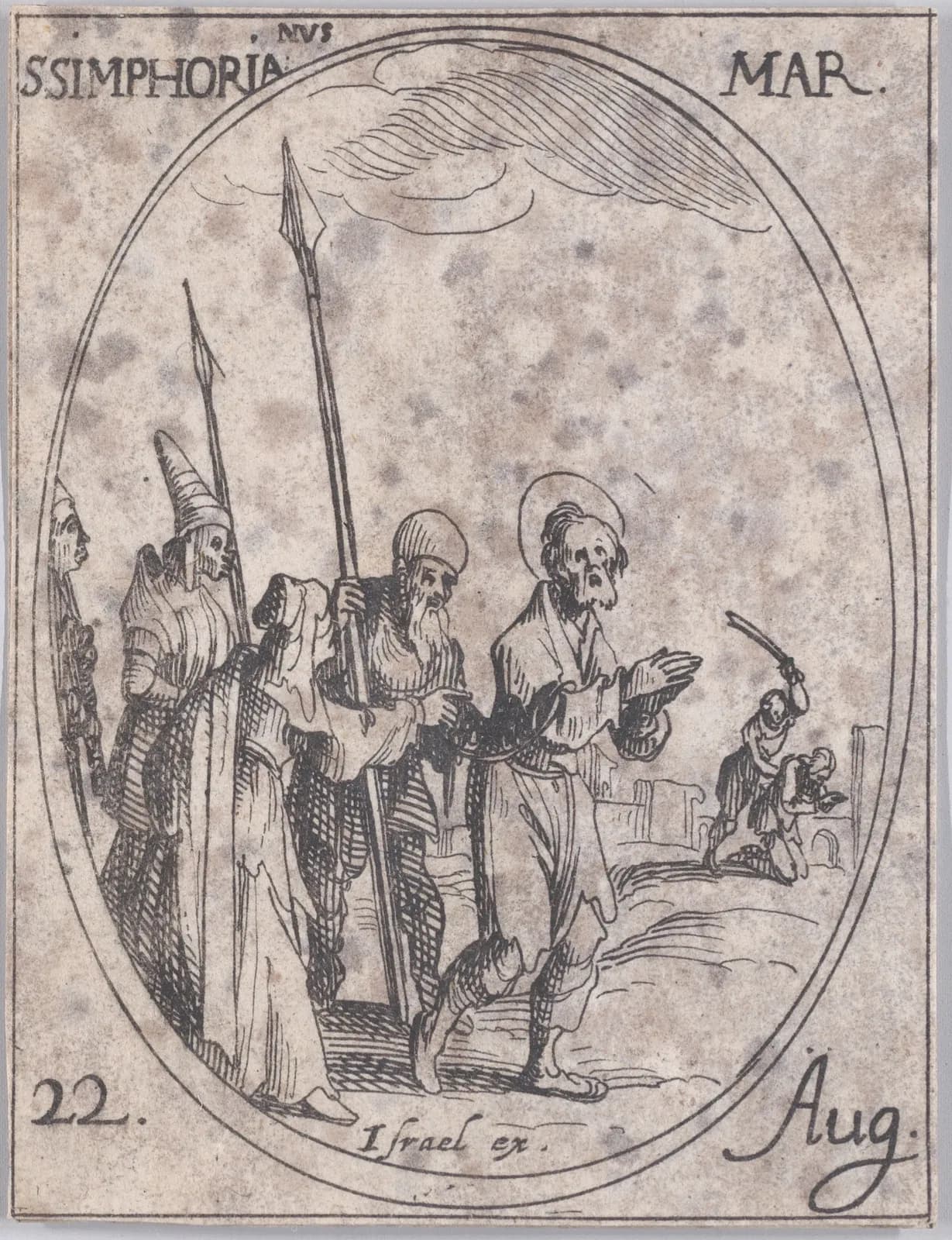
- Born
- About 165, at Autun in Burgundy, says katolsk.no 2
- Died
- Beheaded at Autun, August 22, 178, says the 1912 Catholic Encyclopedia 1; about 180, says katolsk.no 2; in the second or third century, says Catholic Culture 4
Saint Symphorian was a young Christian of Autun, in Roman Gaul, who was beheaded for his faith in the second century. 12 As he was led out of the city to die, his mother called down to him from the wall not to fear, because his life was not being taken away but changed for a better one. 23 His veneration spread early through the kingdom of the Franks, and he is the patron saint of Autun. 14
Autun in the second century
Autun was a Roman city in what is now Burgundy, and Christianity reached it early. 25 Georges Goyau and Thomas Shahan, writing on the diocese in the 1907 Catholic Encyclopedia, point to the Greek inscription of Pectorius, found in an Autun cemetery in 1839 and dated to the third century, as early evidence of the faith there. 5 katolsk.no, the saints database of the Catholic Diocese of Oslo, says Symphorian was born about 165 into one of the few Christian families in the city. 2
What is told of his life comes from his Passion, and the sources weigh it differently. 124 Gabriel Meier, in the 1912 Catholic Encyclopedia, calls it "a legend of the early fifth century." 1 katolsk.no says the traditions from that time are historical, but that because he became one of the most popular saints in France his story has been mixed with legend. 2 Catholic Culture says, "His Acts appear to be genuine." 4
Goyau and Shahan add that local versions of the Passion were later woven into a legendary cycle, dating from about the first half of the sixth century, in which Polycarp and Irenaeus send three missionaries, Benignus, Andochius and Thyrsus, toward Autun. 5
The festival of Cybele
According to the legend as katolsk.no retells it, Symphorian was the son of a senator named Faustus and his wife Augusta, well educated and brought up as a Christian. 2 Autun was a center of the cult of Cybele, the mother of the gods, and once a year her image was drawn through the streets on a cart. 2
Symphorian happened to be in the crowd when it passed. 2 Everyone else knelt; he stayed on his feet, and when the people pressed him he refused to worship the goddess. 2 He was taken before the governor, Heraclius, who was attending the ceremony. 2
The governor ordered him to honor Cybele as the mother of all the gods, and Symphorian answered that he worshiped the one true God. 2 Learning that the young man came from a leading family, Heraclius gave him another chance. 2 He had the emperor's edict read out, had him scourged when he held firm, and then tried to win him over by offering him a post in the army. 2 When none of this moved him, he sentenced Symphorian to be beheaded with the sword. 2
His mother on the wall
The scene the Church remembers is the walk to execution. 13 Meier says simply that his mother "encouraged him on his way to execution." 1 The Roman Martyrology gives her words: as he was led to his death, she called to him from the city wall by name, told him to keep the living God in mind, and said that on this day his life was not being taken from him but changed into something better. 3
katolsk.no gives a longer form of the same words, in which she tells him to lift his eyes to the one who reigns in heaven, and prints the Latin of the last line, "Vita non tollitur sed mutatur." 2 Catholic Culture lists the scene as his symbol: a young man led to martyrdom while his mother encourages him. 4
He was beheaded outside the walls. 12 Meier dates his death August 22, 178, under Marcus Aurelius. 1 katolsk.no says he was about fifteen and died about 180, under Marcus Aurelius or Commodus. 2 Catholic Culture says only that he died "while still a young man in the second or third century." 4 katolsk.no adds that the Christians buried him secretly in a cave near a spring not far from the city. 2
The shrine at Autun
His grave became a center of devotion. 12 Meier says that Bishop Euphronius of Autun, who died in 490, built "a handsome church over his grave, connected with a monastery." 1 The monastery belonged to the Congregation of Sainte-Geneviève from 1656 until it was suppressed in 1791. 12 katolsk.no adds that the old church, fallen into ruin, was pulled down in 1086. 2
One of its abbots became famous. Andrew MacErlean, in the encyclopedia's article on Saint Germain of Paris, says Germain was born near Autun about 496, ordained by Bishop Agrippinus, and made abbot of Saint-Symphorien. 6 His charity there was so great that his monks, afraid he would give everything away, rebelled. 6 He was made bishop of Paris in 555. 6 Meier says he dedicated a chapel to Symphorian in Paris, and MacErlean that Germain himself was first buried in Saint Symphorian's chapel in the church of Saint Vincent, the church later called Saint-Germain-des-Prés. 16
Meier says his veneration spread early through the Frankish kingdom and was especially popular at Tours, where Gregory of Tours tells of a miracle worked by the saint. 1 Catholic Culture calls him "one of the great saints of Gaul" and says several churches were built in his honor. 4 katolsk.no says his cult spread particularly in Provence, that he was kept from the sixth century and generally from the eighth, and that the village and church of Veryan in Cornwall take their name from him. 2
He is also known from art. katolsk.no says he is shown as a cleric with a book and palm, or as a knight in armor, and that the best-known image of him is Jean-Auguste-Dominique Ingres's 1834 painting of his martyrdom in Autun's cathedral of Saint-Lazare. 2
What is Saint Symphorian the patron saint of?
Saint Symphorian's feast day
Saint Symphorian's feast day is August 22. 124 The current Roman Martyrology enters him on that day at Autun, in Lugdunensian Gaul, and gives his mother's words from the wall. 3 He shares the day with Saint Timothy, a Roman martyr, and Meier treats the two in a single article; Catholic Culture notes that they were unrelated, lived in different places and died at different times. 14
katolsk.no adds that his feast was removed from the General Roman Calendar in the revision of 1969 and left to local and particular calendars, and that he is commemorated with Saint Timothy of Rome and Saint Hippolytus of Porto. 2 August 22 is now the memorial of the Queenship of Mary, and Catholic Culture lists Symphorian among the day's other commemorations. 4
Praying with Saint Symphorian
The story of Symphorian turns on one refusal. In the legend he does not seek out the procession or attack it; he simply does not kneel when everyone else does. 2 Asked to, he says whom he worships. 2
His judge tried a beating and then a career, and neither moved him. 2 He was young, by every account, and had a life in front of him. 124
The Church keeps his mother's words more than his own. 3 Watching her son led out to die, she did not ask him to save himself. She told him to remember the living God and that his life was being changed, not ended. 23
Saint Symphorian of Autun, pray for us.
Sources
- 1.Gabriel Meier, "Sts. Timotheus and Symphorian," The Catholic Encyclopedia, Vol. 14 (New York: Robert Appleton Company, 1912).
- 2."Den hellige Symforian av Autun (~165-~180)," Den katolske kirke (katolsk.no), Catholic Diocese of Oslo (in Norwegian).
- 3.Roman Martyrology, entry for August 22, "San Sinforiano, martire," as printed in "Santo del giorno," Conferenza Episcopale Italiana (in Italian).
- 4."August 22: Memorial of the Queenship of the Blessed Virgin Mary," Liturgical Year, Catholic Culture (Trinity Communications).
- 5.Georges Goyau and Thomas Shahan, "Autun," The Catholic Encyclopedia, Vol. 2 (New York: Robert Appleton Company, 1907).
- 6.Andrew MacErlean, "St. Germain," The Catholic Encyclopedia, Vol. 6 (New York: Robert Appleton Company, 1909).
Saints to turn to next
Others in this collection who are turned to for some of the same things.
- Saint Raymond Nonnatus1200 or 1204 - August 31, 1240CourageSuffering and illnessMarriage and family
- Saint EustaceMartyred at Rome, in 118 by tradition; other accounts give 140 or 188CourageMarriage and familySuffering and illness
- Saint Gianna Beretta MollaOctober 4, 1922 - April 28, 1962Marriage and familyCourageSuffering and illness
- Saint Margaret Clitherowc. 1556 - March 25, 1586CourageMarriage and familySuffering and illness