Saint Margaret Clitherow
c. 1556 - March 25, 1586
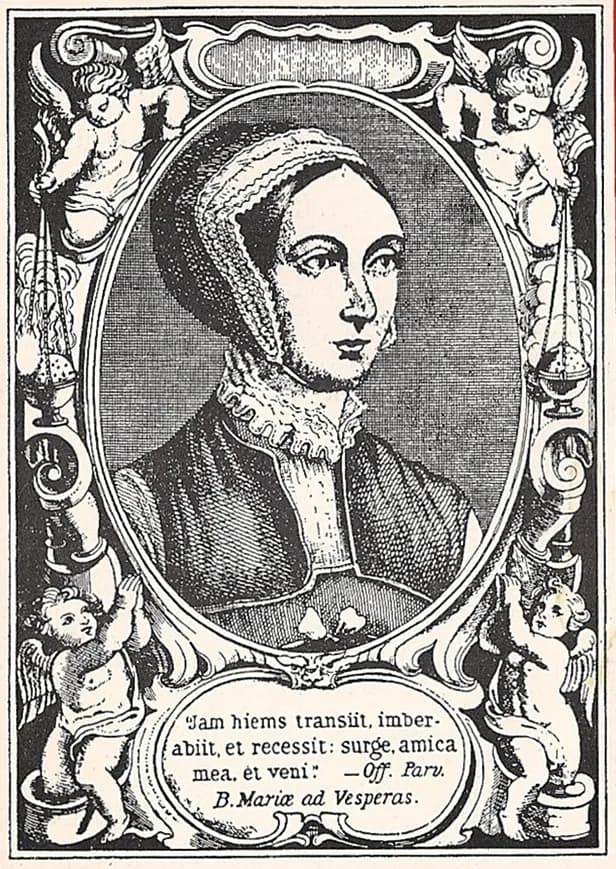
- Married
- John Clitherow, a butcher, on July 8, 1571, at St. Martin's church, Coney Street 1
- Arrested
- March 10, 1586 1
- Beatified
- 1929, by Pope Pius XI 2
- Feast day
- With the Forty Martyrs, May 4 in England and October 25 in Wales; also commemorated in England on August 30 2
Saint Margaret Clitherow was a butcher's wife in Elizabethan York who hid priests in her home, was arrested for it, and refused to plead at her trial so that her children and household would not be made to testify. 12 The penalty for refusing was to be crushed to death, and on March 25, 1586, she was. 12 The 1908 Catholic Encyclopedia calls her "the Pearl of York," and Paul VI canonized her in 1970 among the Forty Martyrs of England and Wales. 12
A York household
She was born Margaret Middleton, in York, in about 1556; the York Oratory and the Grahame Park parish give the year as 1556 without qualification. 123 Her father, Thomas Middleton, was a wax-chandler and served as Sheriff of York in 1564 and 1565. 1 She was raised a Protestant. 3
On July 8, 1571, at St. Martin's church in Coney Street, she married John Clitherow, a well-off butcher who served as one of the city's chamberlains. 1 She was about fifteen. 3 They lived in the Shambles, the butchers' street, which the encyclopedia in 1908 called "still unaltered." 1 Her husband stayed in the Established Church all his life, though he had a brother who was a priest. 1 The Grahame Park parish calls the marriage a happy one and says John was sympathetic to her faith. 3
Conversion, and the priests in the house
About three years after the wedding, in 1574, she became a Catholic. 123 At the time, as the York Oratory puts it, it was treason to be a Catholic priest in England or to shelter one. 2 She did both things that were forbidden: she kept priests and she had Mass said. 1
The encyclopedia says she kept two rooms for the purpose, one next to her house and another elsewhere in the city, where priests were hidden and Mass was "continually celebrated through the thick of the persecution." 1 The York Oratory says Mass was said above the family's shop, and adds that she ran a small school to teach the faith to children. 2 She was imprisoned again and again, the encyclopedia says "sometimes for two years at a time," and the parish adds that her husband was heavily fined for what she did. 13
Some of the priests she knew were executed. The encyclopedia says that she wanted the same death "above all things," and that she made secret pilgrimages by night to the gallows at York Tyburn to pray beneath it for that grace. 1
Arrest and the refusal to plead
The house was raided in 1586. 23 The parish says the priest got away, but that a frightened boy staying with the family told the searchers what they wanted to know, and that vestments and altar bread were found. 3 She was arrested on March 10 and arraigned on March 14 before the judges at the York assizes, charged with harboring priests and hearing Mass. 1
She refused to plead, and the sources give different reasons. The encyclopedia says it was because the only witnesses against her would have been "her own little children and servants, whom she could not bear to involve in the guilt of her death." 1 The York Oratory says she did not want to expose her family, friends or the children of her school to giving evidence, in which they "may have betrayed others or denied their faith in public." 2 The Grahame Park parish quotes a member of the Knights of St Columba who believes she was protecting her husband. 3
The law for a prisoner who would not plead was the peine forte et dure: to be pressed to death. 1 "God be thanked, I am not worthy of so good a death as this," she said. 1 The parish quotes her words to a friend after the sentence: "I feel the weakness of my flesh which is troubled at this news, but my spirit rejoices greatly. For the love of God, pray for me." 3
Lady Day, 1586
The sentence was carried out on March 25, 1586, Lady Day, the feast of the Annunciation. 12 The York Oratory says it was also Good Friday; the encyclopedia says it was Good Friday "according to New Style," a qualification the Oratory does not make. 12 The encyclopedia says she was probably pregnant. 1 She had spent the night before in "an agony of fear," it records, but in the morning she was "calm, joyous, and smiling." 1 She walked barefoot to the tollbooth on Ouse Bridge, having sent her shoes and stockings to her daughter Anne as a sign that Anne should follow her. 1
Asked once more to confess her crimes, she answered: "No, no, Mr. Sheriff, I die for the love of my Lord Jesu." 1 She was laid on the ground with a sharp stone under her back and her arms stretched out and tied in the form of a cross, and a door was laid on her and weighted until she died. 1 It took about fifteen minutes. 13 Her last words were "Jesu! Jesu! Jesu! have mercy on me!" 13
Her family, her hand and her shrine
Her sons Henry and William became priests, and Anne became a nun at St. Ursula's in Louvain. 1 The York Oratory says Henry trained abroad and came back to work on the English mission. 2
Where her body lies is unknown. 1 The parish says it was likely buried in secret to keep it from being venerated, and that about six weeks later, by tradition, it was taken up, a hand removed, and the body reburied with reverence somewhere hidden. 3 The encyclopedia placed her right hand at St. Mary's Convent, York; the York Oratory and the parish say the hand is venerated at the Bar Convent. 123
There is a shrine to her in the Shambles where Mass is said every Saturday. 2 The parish notes that the street was renumbered in the eighteenth century and her real house was probably the one opposite. 3 Her confessor, John Mush, wrote her life, which survives in two versions. 1 Pius XI beatified her in 1929, and Paul VI canonized her on October 25, 1970. 23
What is Saint Margaret Clitherow the patron saint of?
None of the sources used for this page names a patronage for Saint Margaret Clitherow, so this page does not list one. 123 The York Oratory calls her "one of the best known and loved of the English Martyrs." 2 John Paul II, preaching in York in 1982, named her among the "holy women" who "inspire women today to take their rightful place in the life of the Church," and said that for many people, "as for Margaret Clitheroe," God's call "comes in and through marriage and family life." 4
Saint Margaret Clitherow's feast day
Praying with Saint Margaret Clitherow
John Paul II brought her up at a Mass for families, which is worth noticing. 4 She was a wife and a mother of young children, running a household in a busy street, and the risks she took were taken from inside that life. 12
Her refusal to plead was, on every reading the sources give, a decision about other people: the children who would have been made to testify, the servants and pupils, perhaps her husband. 123 She took the worst death the law offered to keep them out of it.
She was not fearless. The encyclopedia says she spent her last night in an agony of fear, and she told a friend that her flesh was troubled. 13 By morning she was smiling. 1 Both are part of the record, and neither cancels the other.
There is no comfortable lesson in how she died. What the sources leave is a woman who kept faith with God and with the people in her house at the same time, and who would not trade one for the other.
Saint Margaret Clitherow, pray for us.
Sources
- 1.Bede Camm, "St. Margaret Clitherow," The Catholic Encyclopedia, Vol. 4 (New York: Robert Appleton Company, 1908).
- 2."Who is St Margaret Clitherow?" The York Oratory.
- 3."St Margaret Clitherow," Roman Catholic Parish of Grahame Park, Diocese of Westminster.
- 4.Pope John Paul II, Homily at the Mass for Families, York, May 31, 1982.
Saints to turn to next
Others in this collection who are turned to for some of the same things.
- Saint EustaceMartyred at Rome, in 118 by tradition; other accounts give 140 or 188CourageMarriage and familySuffering and illness
- Saint Gianna Beretta MollaOctober 4, 1922 - April 28, 1962Marriage and familyCourageSuffering and illness
- Saints Perpetua and FelicityMartyred at Carthage, March 7, 203CourageSuffering and illnessMarriage and family
- Saint Raymond Nonnatus1200 or 1204 - August 31, 1240CourageSuffering and illnessMarriage and family