Saint Raymond Nonnatus
1200 or 1204 - August 31, 1240
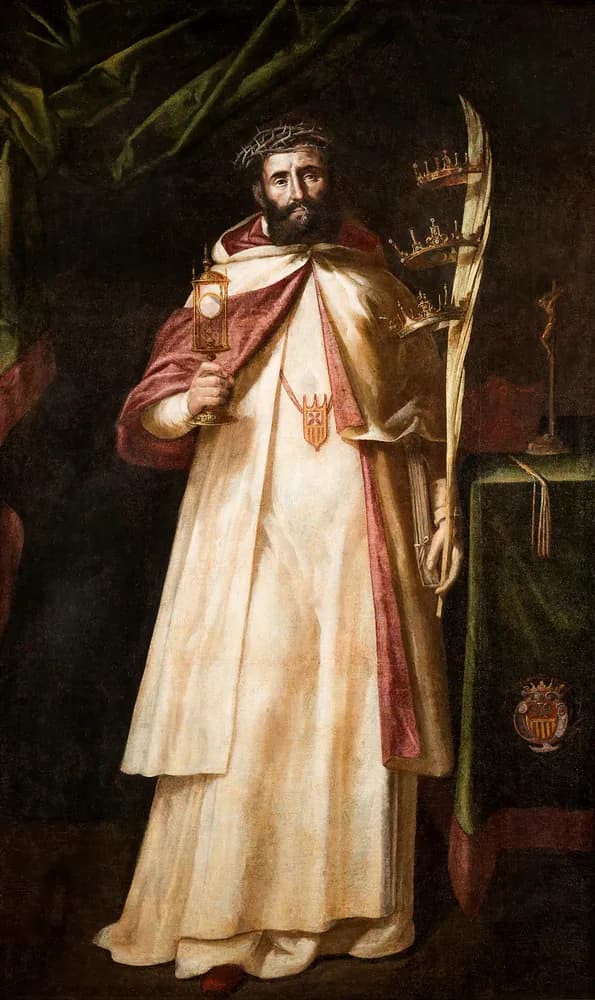
- Born
- Portello, in the diocese of Urgel, Catalonia; 1200 or 1204 by the 1911 Catholic Encyclopedia, c. 1204 by the New Catholic Encyclopedia 12
Saint Raymond Nonnatus was a thirteenth-century Catalan friar of the Mercedarians, the order founded to buy back Christians held captive in North Africa, who is remembered for giving himself as a hostage at Algiers when the ransom money ran out. 12 His surname means "not born": his mother died before he was delivered. 12 He is invoked by women in labor and by people falsely accused, and he is commemorated on August 31. 123
What can be known
The honest place to begin is with a warning from the New Catholic Encyclopedia: "In the absence of reliable contemporary sources, it is impossible to establish the events in his career." 2 What it will say is that he is "generally credited with noteworthy activity in ransoming Christian captives in Moorish North Africa and in Spain," and that his zeal became a model for the work of his order. 2
The older accounts say a great deal more, and the story below is theirs. Francis Mershman wrote the Catholic Encyclopedia article in 1911, drawing on Butler and the Bollandists, and it is the fuller of the two encyclopedia entries. 1 Where a later writer adds something, the page says who.
Not born
Mershman places his birth in 1200 or 1204 at Portello, in the diocese of Urgel in Catalonia; the New Catholic Encyclopedia gives about 1204. 12 Both explain the name the same way. He "was taken from the womb of his mother after her death," Mershman writes, "hence his name." 1 The New Catholic Encyclopedia speaks of his "reputed birth by Caesarean section." 2
Stephen Beale, writing for Catholic Culture, points out that the operation was rare enough in the early 1200s to earn a child a name for it, and adds that the loss of his mother gave him a lasting devotion to Mary. 5 Bentley's calendar, excerpted by Catholic Culture, makes the same connection between the name and the delivery. 3
His family was "noble but poor," and he showed piety and talent early. 1 His father set him to tend a farm. 1 Later the father relented and let him join the Mercedarians at Barcelona, where he received the habit from the founder, Peter Nolasco. 1 Catholic Culture's own note names Raymond of Penyafort alongside Nolasco as the order's founders. 3
The ransomer
The Mercedarians existed for one purpose, which Bentley describes as "ransoming Christians captured by the Moors." 3 Raymond did well enough in the life that he was "soon considered worthy to succeed his master in the office of ransomer," in Mershman's words; Bentley says he took the office when Nolasco retired from it. 13
He was sent to Algiers and freed many captives. 1 Then the money ran out. Mershman puts it in one line: "When money failed he gave himself as a hostage." 1 Bentley spells out the choice. He could have gone home, but that would have meant leaving several captives behind, so he gave himself up in exchange for their liberty. 3 Catholic Culture's note adds a reason: he did it to keep from apostasy those whose faith was wavering. 3
Beale dates this mission to 1236, though neither encyclopedia gives a year. 5
The padlock
As a hostage he went on teaching the faith and made converts, which, Mershman says, embittered the authorities. 1 He was subjected to indignities and cruelty, made to run the gauntlet, and finally sentenced to impalement. 1 What saved him was money. "The hope of a greater sum of money as ransom caused the governor to commute the sentence into imprisonment." 1 Bentley tells it the same way, and adds that he was whipped through the streets, partly to discourage anyone tempted to learn the faith from him. 3
Then comes the detail every image of him keeps. "To prevent him from preaching for Christ, his lips were pierced with a red-hot iron and closed with a padlock." 1 Beale adds that the lock was opened every three days so that he could be fed, and passes on a story from the Catechism in Examples of the guards finding Raymond rapt in prayer over the Psalms with his mouth still locked. 5
Bentley adds a caution of his own: "Reports of his tortures probably exaggerated the cruelty of his Moorish captors." 3 After eight months, by Bentley's account, Peter Nolasco arrived with the ransom. 3 Raymond wanted to stay behind to keep preaching, and Nolasco forbade it. 3
Cardinal, and Cardona
Mershman says that after he reached Spain in 1239 Gregory IX made him a cardinal, and Bentley says the same. 13 The New Catholic Encyclopedia is more careful: "The claim that Raymond was created cardinal by Gregory IX is historically uncertain." 2 Vatican News, which lists him on August 31, still styles him "Cardinal, Mercedarian." 4
The pope called him to Rome the following year. 1 He got only as far as Cardona, about six miles from Barcelona by Mershman's reckoning, and died there on August 31, 1240. 1 The New Catholic Encyclopedia gives the same place and says "probably" of the date. 2 Bentley puts his age at thirty-six. 3 His body was taken to the chapel of St. Nicholas near the farm he had once worked. 1
In 1657 Alexander VII placed his name in the Roman Martyrology. 12
How he is pictured
Mershman describes the standard image: Raymond "in the habit of his order surrounded by ransomed slaves, with a padlock on his lips." 1 Catholic Culture lists more, among them a crown of thorns, three or four crowns, and a Mercedarian with a cardinal's red hat. 3 The painting at the top of this page has several of them: the white habit with the order's shield, the crown of thorns, a palm hung with three crowns, and a monstrance in his hand.
What is Saint Raymond Nonnatus the patron saint of?
Saint Raymond Nonnatus is invoked by women in labor and by people falsely accused, according to both Mershman and the New Catholic Encyclopedia, which words the second as "the innocent charged with crime." 12 The first follows from his birth. Neither source explains the second, though a man imprisoned for preaching is not a hard link to draw.
Catholic Culture gives a longer list: expectant mothers, pregnant women, childbirth, midwives and obstetricians, babies, newborns and children, the falsely accused, Mercedarian novices, protection against fever, and domestic animals, with two places, Baltoa in the Dominican Republic and San Ramon in Costa Rica. 3 Mershman also notes that the appendix to the Roman Ritual gave a blessing of water in his honor, for use by the sick, and another of candles. 1
Saint Raymond Nonnatus's feast day
Saint Raymond Nonnatus's feast is August 31, the day of his death, as Mershman and the New Catholic Encyclopedia both print it. 12 Catholic Culture lists him that day as a commemoration in the Roman Martyrology, and Vatican News includes him on its August 31 calendar. 34 Beale calls it his feast day "in the traditional calendar." 5
Praying with Saint Raymond Nonnatus
The center of his story is a trade. A man came to Algiers with money to buy people back, the money was gone before the people were, and he put himself in the place of the ones who were left. 13 Bentley notes that he could have gone home instead. 3 Most of what is told of him afterward follows from that one decision.
The padlock is the image everyone remembers, and it is worth seeing what it was for. It was put there to stop him talking about Christ. 1 The accounts Beale relies on remember him praying behind it. 5 A man with his mouth locked had not been silenced in the way his captors meant.
He is also a saint whose life is partly hidden. The New Catholic Encyclopedia will not vouch for most of it, and even his red hat is called uncertain. 2 What the sources agree on is small: a ransomer of captives, a hostage, a death on the road at Cardona. 12 Devotion to him has lasted on less than a full biography.
His name comes from a death. His mother did not live to see him born, and the women who pray to him are mostly praying about births: their own, or a child's. 123 He is a saint for people waiting on something they cannot control, and who would like someone to have stood in the gap before them.
Saint Raymond Nonnatus, pray for us.
Sources
- 1.Francis Mershman, "St. Raymond Nonnatus," The Catholic Encyclopedia, Vol. 12 (New York: Robert Appleton Company, 1911).
- 2."Raymond Nonnatus, St.," New Catholic Encyclopedia, via Encyclopedia.com.
- 3.Catholic Culture, Liturgical Year, August 31, 2026, with an excerpt from James Bentley, A Calendar of Saints.
- 4.Vatican News, Saint of the Day, August 31.
- 5.Stephen Beale, "Padlocked Lips Couldn't Keep This Saint from Prayer," Catholic Culture library.
Saints to turn to next
Others in this collection who are turned to for some of the same things.
- Saint Gianna Beretta MollaOctober 4, 1922 - April 28, 1962Marriage and familyCourageSuffering and illness
- Saint EustaceMartyred at Rome, in 118 by tradition; other accounts give 140 or 188CourageMarriage and familySuffering and illness
- Saint Margaret Clitherowc. 1556 - March 25, 1586CourageMarriage and familySuffering and illness
- Saints Perpetua and FelicityMartyred at Carthage, March 7, 203CourageSuffering and illnessMarriage and family