Saints Perpetua and Felicity
Martyred at Carthage, March 7, 203
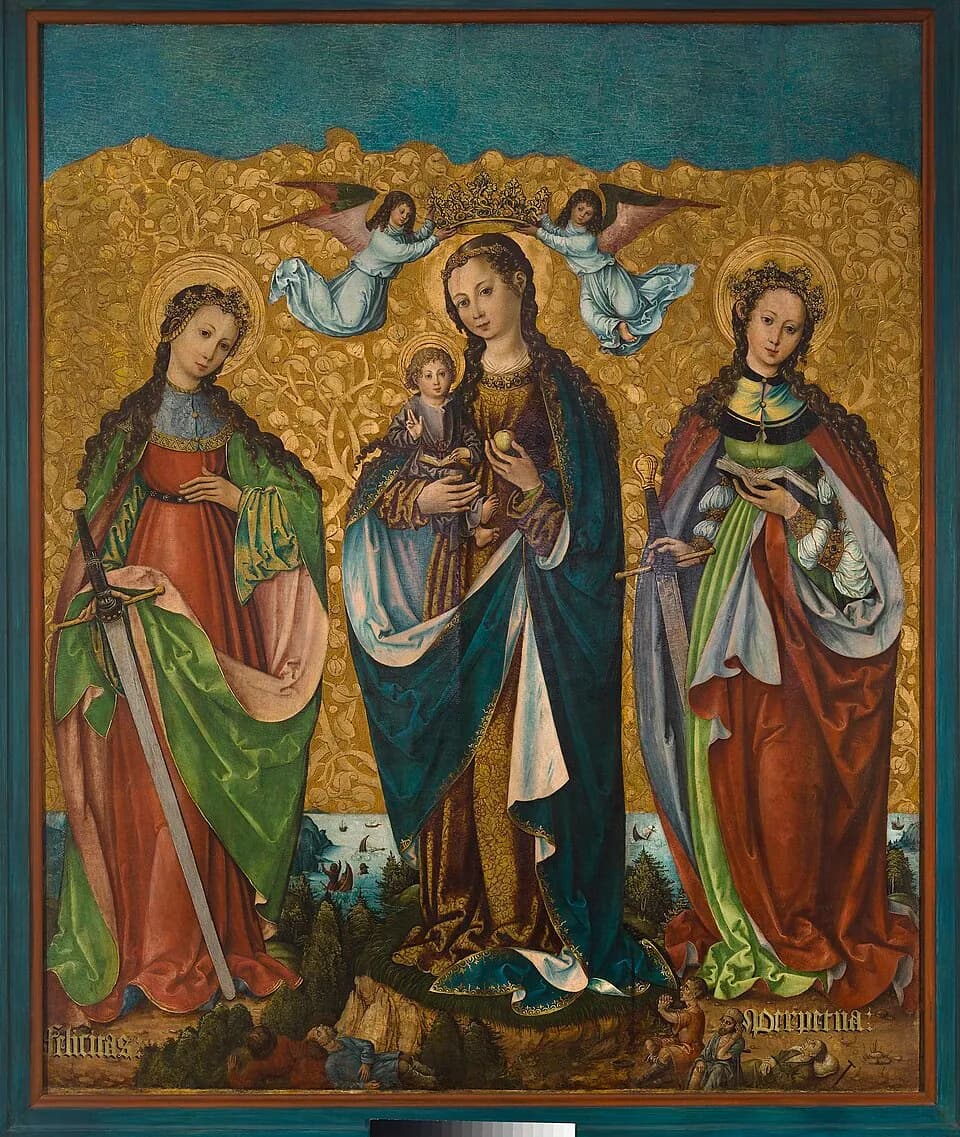
- Patron saint of
- Franciscan Media lists Perpetua as patron of widows and of mothers of deceased sons 3
- Who they were
- Vibia Perpetua, about twenty-two, a young mother "respectably born, liberally educated"; Felicity, a slave, eight months pregnant when arrested 12
- Buried
- At Carthage; a basilica, the Basilica Majorum, was later built over the tomb 2
Saints Perpetua and Felicity died in the amphitheater at Carthage on March 7, 203: a young noblewoman still nursing her son, and a slave who had given birth in prison days before. 12 And one of them wrote down what happened. Perpetua's account of her arrest, her father, her child and her visions survives in her own words, and the Catholic Encyclopedia calls the whole record "one of the most affecting accounts of the glorious warfare of Christian martyrdom in ancient times." 2
Five catechumens in Carthage
Kirsch, writing in the Catholic Encyclopedia, sets the scene in one sentence: by a rescript of Septimius Severus "all imperial subjects were forbidden under severe penalties to become Christians." 2 In consequence, a group of catechumens at Carthage was seized. The Passion names them: "Revocatus and his fellow-servant Felicitas, Saturninus and Secundulus," and among them "Vivia Perpetua, respectably born, liberally educated, a married matron, having a father and mother and two brothers, one of whom, like herself, was a catechumen, and a son an infant at the breast. She herself was about twenty-two years of age." 1
Saturus was not taken with them. Perpetua says he "had subsequently delivered himself up freely on our account, not having been present at the time that we were taken prisoners." 1 The page of the Vatican City State Governorate describes him as their catechist. 5 Her father, Kirsch notes, was a pagan. 2
Then the narrator steps aside: "From this point onward she shall herself narrate the whole course of her martyrdom, as she left it described by her own hand and with her own mind." 1
A pitcher, a father and a baby
Her account opens with her father pressing her to give up the faith. "'Father,' said I, 'do you see, let us say, this vessel lying here to be a little pitcher, or something else?' And he said, 'I see it to be so.' And I replied to him, 'Can it be called by any other name than what it is?' And he said, 'No.' 'Neither can I call myself anything else than what I am, a Christian.'" 1
She was baptized within a few days, and soon afterward they were taken into the dungeon. "I was very much afraid, because I had never felt such darkness." 1 Her son troubled her most. When two deacons bribed their way to a few better hours, she nursed him, "now enfeebled with hunger." 1 When she was allowed to keep him with her, everything changed: "the dungeon became to me as it were a palace, so that I preferred being there to being elsewhere." 1
Her father came back as the hearing approached, and Perpetua records his words at length. "Have pity my daughter, on my grey hairs... Have regard to your son, who will not be able to live after you." 1 He kissed her hands and "with tears he called me not Daughter, but Lady." 1 "I grieved over the grey hairs of my father, that he alone of all my family would not rejoice over my passion." 1
At the hearing before the procurator Hilarianus he appeared again, holding her child. He told her to sacrifice for the emperors. "And I replied, 'I will not do so.' Hilarianus said, 'Are you a Christian?' And I replied, 'I am a Christian.'" 1 Her father was ordered thrown down and beaten with rods, and she wrote that it hurt her "as if I myself had been beaten." 1 All of them were condemned to the beasts. Afterward her father refused to give the baby back. 1
The visions
Perpetua recorded four visions. In the first she saw "a golden ladder of marvellous height, reaching up even to heaven," with a dragon crouched beneath it. 1 She trod on its head, climbed into a garden where a white-haired shepherd fed her, and woke "still tasting a sweetness which I cannot describe," and understood that she would die. 1
Two of the visions concern her brother Dinocrates, who had died at seven of a disease that disfigured his face. 1 She saw him thirsty and unable to reach a pool, prayed for him daily, and later saw him drinking and going off "to play joyously, after the manner of children." 1 Kirsch adds that he "had died a pagan." 2
The last came the night before the games. She was led into the arena and, instead of beasts, faced "a certain Egyptian, horrible in appearance." 1 Kirsch's summary makes him an Ethiopian. 2 She beat him, and woke knowing "that I was not to fight with beasts, but against the devil." 1 Then her own record stops: "what passed at the exhibition itself let who will write." 1
Felicity
Felicity's part is told by the narrator. She was eight months pregnant, and Roman law did not allow a pregnant woman to be put to death in public, so she feared she would be held back and die later, apart from her companions. 12 Three days before the games her companions prayed together, and her labor began at once. 1 Kirsch puts the birth two days before the games. 2
When a servant mocked her pain and asked what she would do before the beasts, she answered: "Now it is I that suffer what I suffer; but then there will be another in me, who will suffer for me, because I also am about to suffer for Him." 1 She gave birth to a girl, "which a certain sister brought up as her daughter." 1
March 7, 203
The narrator, an eyewitness whom Kirsch declines to identify ("That Tertullian is the author of these Acts is an unproved assertion"), describes the day. 12 Perpetua walked out "with placid look... casting down the luster of her eyes from the gaze of all," and Felicity came rejoicing that she had safely given birth. 1
The two women were stripped, wrapped in nets and sent in against a wild cow. Perpetua was thrown, pulled her torn tunic back over herself, and tied up her hair. "And when she saw Felicitas crushed, she approached and gave her her hand, and lifted her up. And both of them stood together." 1 Her last recorded words were to the Christians standing near her: "Stand fast in the faith, and love one another, all of you, and be not offended at my sufferings." 1
The martyrs gave one another the kiss of peace and were put to the sword. 12 Perpetua was pierced between the ribs and cried out, "and she herself placed the wavering right hand of the youthful gladiator to her throat." 1 Franciscan Media says simply that the two women "were beheaded"; the Vatican City State page says "their throats were cut." 35 Franciscan Media also names Secundulus among those sent to the games, though the Passion says he had already died in prison. 13
They were buried at Carthage, where the Basilica Majorum was later built over the tomb. 2 Kirsch adds that the claim they were Montanists "lacks proof". 2
What are Saints Perpetua and Felicity the patron saints of?
Franciscan Media lists Perpetua as the patron saint of widows and of mothers of deceased sons. 3 It names no patronage for Felicity, and neither the encyclopedia nor the Vatican pages assign either woman one. 245
The Vatican City State page calls the pair "two mothers united in their witness to Christ unto sacrificing their lives." 5 Perpetua left a son; Felicity left a newborn daughter to be raised by another woman. 1
Saints Perpetua and Felicity's feast day
The feast of Saints Perpetua and Felicity is March 7, the day they died. 234 Vatican News lists "Sts. Perpetua and Felicitas, Martyrs" on that day, and the Vatican City State keeps them there as well. 45
The date is old. Kirsch writes that "under 7 March the names of Felicitas and Perpetua are entered in the Philocalian calendar, i.e. the calendar of martyrs venerated publicly in the fourth century at Rome," and that in 1909 the feast was "still celebrated on 7 March." 2 The Vatican City State page says their dies natalis was recorded in the Depositio martyrum, "the ancient calendar of the Roman Church." 5
Older missals give a different day. According to Catholic Culture, in the 1962 Missal they are kept on March 6, and March 7 in that Missal is the feast of Saint Thomas Aquinas, who is now kept on January 28. 67
Praying with Saints Perpetua and Felicity
Perpetua's account is written by someone who knew she was going to die and still recorded what she was afraid of. The darkness frightened her. Her baby's hunger frightened her more, and when her father kept him from her she wrote that the child no longer wanted the breast and her own body stopped troubling her, "lest I should be tormented by care for my babe and by the pain of my breasts at once." 1 Nothing in the account pretends that the cost was small.
Her father is the hardest part of the story, and she does not write him as a villain. He threatened her, begged her, called her "Lady", and was beaten in front of her, and what she records is mostly grief for him. 1 The account leaves that tension unresolved.
Felicity's single sentence carries a different weight. She did not claim she would feel nothing. She said that in the arena "there will be another in me, who will suffer for me, because I also am about to suffer for Him." 1 She said it in labor, to a man who was mocking her.
And then there is the moment in the arena when the noblewoman went to the slave who had been knocked down and lifted her up, and "both of them stood together." 1 The Church has kept their names side by side for more than sixteen centuries, the free woman and the slave. 25
Saints Perpetua and Felicity, pray for us.
Sources
- 1."The Passion of the Holy Martyrs Perpetua and Felicity," trans. R.E. Wallis, Ante-Nicene Fathers, Vol. 3, ed. Alexander Roberts, James Donaldson and A. Cleveland Coxe (Buffalo, NY: Christian Literature Publishing Co., 1885); revised and edited for New Advent by Kevin Knight.
- 2.Johann Peter Kirsch, "Sts. Felicitas and Perpetua," The Catholic Encyclopedia, Vol. 6 (New York: Robert Appleton Company, 1909).
- 3."Saints Perpetua and Felicity," Saint of the Day, Franciscan Media.
- 4.Saint of the Day, 7 March, Vatican News (Dicastery for Communication).
- 5."7 March: Saints Perpetua and Felicity, martyrs," Saint of the Day, Governorate of Vatican City State.
- 6.Liturgical Year calendar, March 6, 2014, Catholic Culture (Trinity Communications).
- 7.Liturgical Year calendar, "Optional Memorial of Sts. Perpetua and Felicity, martyrs," March 7, 2020, Catholic Culture (Trinity Communications).
Saints to turn to next
Others in this collection who are turned to for some of the same things.
- Saint Gianna Beretta MollaOctober 4, 1922 - April 28, 1962Marriage and familyParentingCourageSuffering and illness
- Saint Joachima de Vedruna1783 - 1854Marriage and familySuffering and illnessParenting
- Saint Agathac. 230 - c. 251CourageSuffering and illness
- Saint AgnesDied in the third or early fourth centuryCourageSuffering and illness