Saint Louis Bertrand
January 1, 1526 - October 9, 1581
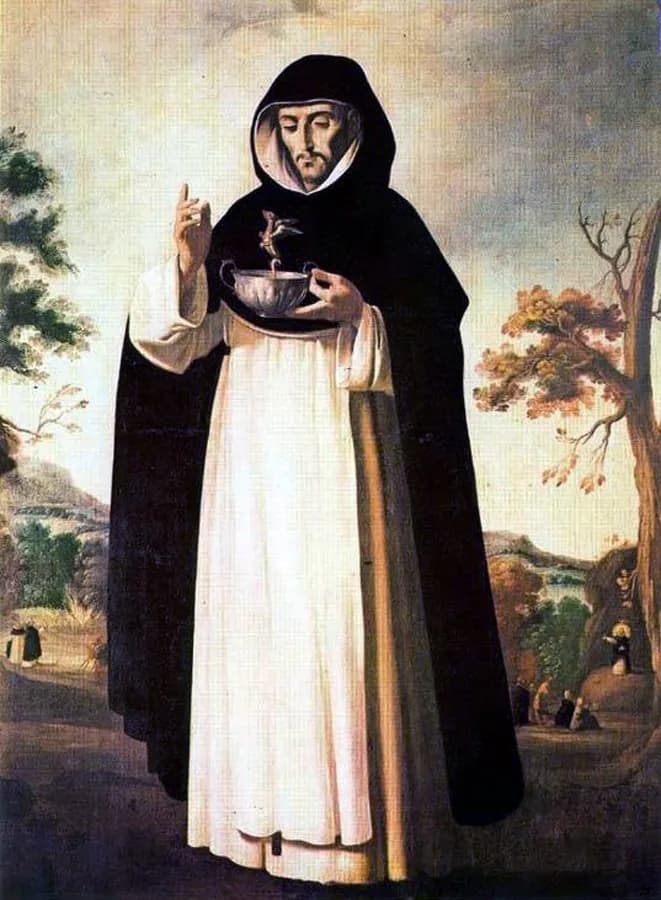
Saint Louis Bertrand was a Spanish Dominican from Valencia who trained novices for most of his life and spent seven years, from 1562, as a missionary in what is now Colombia and Panama, earning the title Apostle of South America. 12 His own order says he defended the native peoples "from their oppressors, acting courageously against the conquistadores-encomenderos." 2 He died in Valencia on October 9, 1581, and his feast is kept on that day. 234
A Valencian family
He was born in Valencia on January 1, 1526, to Juan Bertrand and Juana Angela Exarch, and through his father he was related to Saint Vincent Ferrer, whom O'Connor calls the great wonder-worker of the Dominican Order. 14 O'Connor, who wrote the Catholic Encyclopedia article in 1910, notes that his boyhood showed none of the signs "that frequently forecast heroic sanctity." 1
He wanted to be a Dominican early, and his father did not want him to be one. 1 The Order of Preachers tells the story in more detail. At sixteen he left home against his father's wishes, meaning to go to Santiago, and was brought back. 2 He was then refused entry to the Order, and went secretly to the friars' chapter to listen to its admonitions. 2 On August 26, 1544, he finally received the habit at the convent of St. Dominic in Valencia, with his parents still opposed. 12 Butler, excerpted by Catholic Culture, says he was professed in 1545 "after severe trials." 4
Novice master
O'Connor gives a frank portrait. He was "grave and apparently without any sense of humour," yet gentle and sweet-natured, and well liked by those around him. 1 He could not claim great intellectual gifts, O'Connor says, but he studied hard and filled his mind with the Summa. 1 He was ordained in 1547 by the Archbishop of Valencia, Saint Thomas of Villanova. 13
His superiors made him master of novices, an office he held at different times for a total of thirty years, according to O'Connor. 1 Butler says he was given it at twenty-five; the New Catholic Encyclopedia says his first term in Valencia ran from 1553 to 1555. 34 His own order calls him a "model for the novices entrusted to him for formation." 2
Plague and preaching
When plague struck Valencia in 1557, he went out to the sick. 13 O'Connor writes that he nursed them "with the tenderness and devotion of a mother," and that he prepared the dead for burial and buried them with his own hands. 1
Afterward he began to preach, and the crowds outgrew the buildings. "The cathedral and most capacious churches were placed at his disposal, but proved wholly inadequate to accommodate the multitude," O'Connor writes, so he took to the public squares. 13 O'Connor thinks his fame as a preacher is probably what brought him to the attention of Saint Teresa of Avila, who asked his counsel about the reform of her order. 1
Seven years in New Granada
He had long wanted to go to the missions in the New World, partly, O'Connor says, in hope of martyrdom. 1 He sailed in 1562 and landed at Cartagena. 1 The Order of Preachers says he obtained leave to go "to the farthest regions of America, now called Colombia." 2
O'Connor follows him from Cartagena to Panama, then to Tubera on the coast, to Cipacoa and Paluato, to the province of Santa Marta, among the Caribs, at Teneriffe and Mompax, and to several islands of the West Indies. 1 The New Catholic Encyclopedia names his missions as Turbará, Palauto and Turbaco, and then Tenerife and Tamalameque in the diocese of Santa Marta. 3 O'Connor gives large numbers of converts: some 6,000 in Panama, 10,000 at Tubera by Touron's count, and 15,000 in Santa Marta. 1 At Tubera, he adds, the baptismal registers survive in the saint's own handwriting, and the converts there had been instructed before they were baptized. 1
All three accounts say people understood him in their own languages. The bull of canonization, as O'Connor reports it, says he "was miraculously endowed with the gift of tongues." 1 Butler says that while preaching in Spanish he was understood in various languages, and the Order says the native peoples "marvelously understood him as he spoke their own language." 24 O'Connor also records that a native priest among the Caribs gave him poison and that it did not kill him. 1 Catholic Culture notes that he is shown holding a chalice with a serpent in it for that reason. 4
Against the encomenderos
The Order of Preachers is the source that says most about how he treated the people he served. He "labored tirelessly for the Indigenous peoples," it says, and "defended them from their oppressors, acting courageously against the conquistadores-encomenderos, encouraged by Bartolomé de Las Casas." 2 The New Catholic Encyclopedia speaks of "his love and concern for the native peoples." 3
Butler says that after seven years he returned to Spain "to plead the cause of the oppressed Indians," and was not allowed to go back to them. 4 O'Connor says he came home under obedience, and the New Catholic Encyclopedia says he was recalled just as he had been named prior of Santa Fe. 13 The Order dates his return to 1569. 2
His last years
He had eleven years left, and they were full of offices. 1 The New Catholic Encyclopedia says he became prior of the convent of San Onofre and later returned to Valencia as master of novices and prior. 3 O'Connor says government officials consulted him more than once on affairs of state. 1 The Order says he devoted himself to "the renewal of Christian and religious life," and that fear of the Lord was the mark of his holiness. 2
Butler writes that in 1580 he was carried from the pulpit of Valencia Cathedral to the bed he never left, and that he died on the day he had foretold, October 9, 1581. 4 Clement X canonized him in 1671, on April 12 by the Order's date. 123 His body did not survive. The Order records that it was burned in 1936, during the Spanish Civil War. 2
What is Saint Louis Bertrand the patron saint of?
Saint Louis Bertrand is the patron of Colombia. The New Catholic Encyclopedia says he was named patron of the New Kingdom of Granada, now Colombia, in 1690, and Catholic Culture says the declaration was Alexander VIII's. 34 Catholic Culture also lists him as patron of Caribbean vicariates and of Dominican novices, which fits the thirty years he spent training them. 14
Saint Louis Bertrand's feast day
Praying with Saint Louis Bertrand
Most of his working life went to novices. 1 Thirty years of forming young friars is unglamorous, and O'Connor is honest that he brought no special brilliance to it, only diligence and a reputation for holiness. 1 The order that remembers him as an "ideal" Friar Preacher remembers him first as a teacher of beginners. 2
He had to fight to get in. At sixteen he ran away, was fetched home, was turned down by the friars, and listened at their chapter in secret until they took him. 2 Anyone whose vocation has met a closed door can find company in that.
The American years are told in big numbers, and the numbers are the least of it. 1 What his own order chose to record in its liturgical book is that he defended the people he baptized from the men who were exploiting them. 2 The Gospel he preached in New Granada came with an argument about how its hearers were being treated.
And he went where he was sent, both ways. He went to the Americas because he asked to, and came home under obedience; Butler says he was not allowed to return. 134
Saint Louis Bertrand, pray for us.
Sources
- 1.John Bonaventure O'Connor, "St. Louis Bertrand," The Catholic Encyclopedia, Vol. 9 (New York: Robert Appleton Company, 1910).
- 2."S. Ludovici Bertrán," Saints of the Order, Order of Preachers, from the Proprium Officiorum Ordinis Praedicatorum (Rome, 1982).
- 3."Bertrand, Louis, St.," New Catholic Encyclopedia, via Encyclopedia.com.
- 4.Catholic Culture, Liturgical Year, October 9, 2026, with an excerpt from Alban Butler, Lives of the Saints (Benziger Bros., 1894).
Saints to turn to next
Others in this collection who are turned to for some of the same things.
- Saint Augustine of CanterburyBirth unknown - 604 or 605CourageWork and vocationDiscernment
- Saint Corbinianc. 680 - c. 730Work and vocationCourageDiscernment
- Saint FabianBirth unknown - January 20, 250CourageDiscernmentWork and vocation
- Saint Fidelis of Sigmaringen1577 - April 24, 1622CourageWork and vocationDiscernment