Saint Corbinian
c. 680 - c. 730
- Patron saint of
- The Archdiocese of Munich and Freising and the city of Freising 2
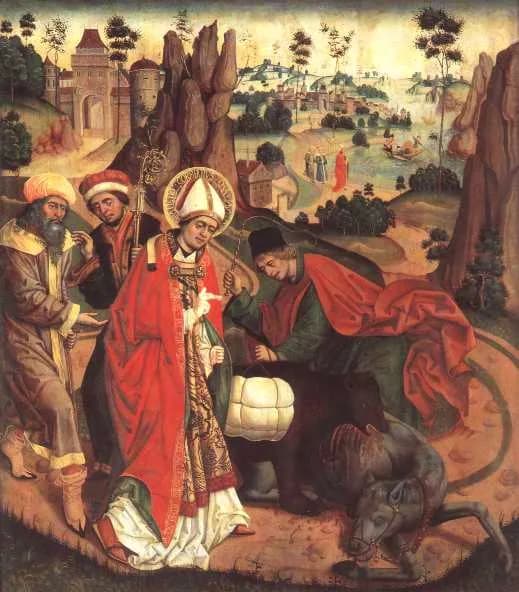
Saint Corbinian was a hermit from France who was made a bishop in Rome against his own inclination and settled at Freising in Bavaria, where the Church of Freising traces its beginning to him. 126 He is the saint with the bear: by an old tradition he made the animal that killed his horse carry his baggage to Rome, and Benedict XVI put that bear in his papal coat of arms. 34 The Roman Martyrology keeps him on September 8, and his own archdiocese on November 20. 25
A hermit in France
The Catholic Encyclopedia says he was born about 680 "at Chatres near Melun, France," and admits that it knows nothing of his youth. 1 His father, Waldekiso, died before he was born, and after the death of his mother, Corbiniana, "he lived as a hermit at the church of Saint-Germain at Chatres." 1 The note on Benedict XVI's coat of arms gives the same year and place. 4 The Archdiocese of Munich and Freising says he was born about 680 at Arpajon, in what is now the Diocese of Évry. 2
The archdiocese's account of those years is fuller. He stayed awake whole nights in prayer, and by day gave hospitality to the poor and to pilgrims passing through the country. Later he withdrew more and more, gave up his property, and had his servants supply only what he needed. 2 His reputation spread anyway. People came to ask his advice, nobles brought gifts and asked for his prayers, and he watched with alarm as the silence he needed disappeared. 2
Rome, twice
So he went to Rome, to put his worries before the pope and place himself under the protection of Saint Peter. 2 There he was ordained and consecrated a bishop. The archdiocese says he took the office with a heavy heart and soon went home to Gaul. 2 The encyclopedia says he was "given the pallium, and sent to preach, which he did with great success in the vicinity of his former home." 1
He went a second time, according to the encyclopedia "with the intention of resigning," and the pope "would not listen to his request." 1 The dates are uncertain. The encyclopedia gives 716 or 709 for the first journey and 723 or 716 for the second, and admits that they "are somewhat confused." 1 The archdiocese puts the first about 710 and the second about 714. 2
The second journey took him through Bavaria, where the duke would gladly have kept him as bishop. 2 On the way back, the encyclopedia says, he came to Mais in Tyrol, "where he was induced by messengers of Duke Grimoald to go to Bavaria, and settle at Freising." 1 It adds that the people of Freising seem to take 724 as the year he arrived, since they kept the tenth centenary of the diocese in 1724 and the eleventh in 1824. 1
The bear
The story everyone knows about Corbinian belongs to one of those journeys over the Alps, and the sources that tell it call it a tradition. 47 The encyclopedia does not tell it at all; it notes only "emblem, a bear." 1
Benedict XVI, who had been Archbishop of Munich and Freising, told it in Munich on September 9, 2006: "From my childhood I was very much taken with the story that a bear had attacked and killed the horse on the saint was riding across the Alps. Corbinian severely scolded the bear and he punished him by loading him down with all his baggage and making him carry it all the way to Rome." 3 Only in Rome, he went on, was the bear allowed to go free. 3
The bear with its pack is in the arms of the city of Freising, and Joseph Ratzinger put it in his own arms when he became archbishop in 1977 and kept it as pope. 24 The Vatican's explanation of the papal arms offers what it calls an easy interpretation: "the bear tamed by God's grace is the Bishop of Freising himself; the pack saddle is the burden of his Episcopate." 4
Freising and Duke Grimoald
At Freising he began mission work across Bavaria and founded a church dedicated to Saint Stephen, the beginning of what became the abbey of Weihenstephan. 2 The encyclopedia's article on the archdiocese says that on a mountain near Freising he "erected a Benedictine monastery and a school." 6 The Roman Martyrology says of him simply that, ordained a bishop and sent to preach the Gospel in Bavaria, he gathered abundant fruit. 5
His relations with Duke Grimoald were good until he reproached the duke for his marriage. 2 The encyclopedia calls the marriage incestuous. 1 The archdiocese's short life speaks of a marriage to a blood relative, while a caption elsewhere in the same booklet names the wife as Pilitrud, the widow of Grimoald's brother, and says such a marriage was invalid in church law; Catholic Culture's account, which calls her Biltrudis, agrees. 27 Corbinian refused to appear at court while the couple stayed together. After forty days, the booklet says, both came before him, confessed their fault and were absolved. 2
It did not last. The encyclopedia speaks of Grimoald's "apparent repentance, and subsequent relapse," and says that Corbinian left Freising. 1 The archdiocese says he fled the duchess's plans for revenge and went to Kuens near Meran, in South Tyrol, to a monastery he had founded some years earlier on his way back from Rome. 2 Catholic Culture says plainly that she "plotted to have Corbinian killed." 7
Return, death and the journey of his body
After Grimoald's death his successor, whom the archdiocese calls Hugibert and the encyclopedia Huebert, brought Corbinian back to Freising, where he was received with enthusiasm. 12 He died not long afterward. The encyclopedia and the Vatican's note give September 8, 730; the archdiocese says probably about 728. 124
The accounts of his burial differ as well. The encyclopedia says his body "was buried at Freising, then transferred to Mais, and in 769 brought back to Freising by Bishop Arbeo, who also wrote his life." 1 The archdiocese says he was buried at Kuens at his own wish, and that Arbeo had the body brought to Freising in 765. 2 The article on the archdiocese says Arbeo laid the remains in a tomb he had built in the church of Our Lady between 765 and 768. 6 The shrine with his relics is in Freising Cathedral. 26
Was he the first bishop of Freising? The Vatican's note calls him that. 4 The encyclopedia's article on the archdiocese says the Church of Freising "dates back to St. Corbinian," but that when Saint Boniface set up four Bavarian dioceses in 738, it was Corbinian's brother Erembert who "was chosen first Bishop of Freising." 6
What is Saint Corbinian the patron saint of?
Saint Corbinian's feast day
Saint Corbinian has two feast days. The Roman Martyrology commemorates him on September 8, and the Catholic Encyclopedia gives the same day, the date it assigns to his death. 15 The encyclopedia lists a second feast, of the translation of his relics, on November 20, and that is the day the Archdiocese of Munich and Freising keeps as his feast, in memory of the return of his body to Freising. 12 Each year around November 20 the archdiocese holds a week of pilgrimage to his shrine on the cathedral hill. 2
Praying with Saint Corbinian
Corbinian wanted quiet and kept being given work. He became a hermit and people found him. He went to Rome for protection and came back a bishop; he went again to resign and was refused. 12 The encyclopedia, which is not sentimental about him, calls him "a man of zeal, and of strong feeling, not to say temper." 1
Benedict XVI read his own life through that pattern. In 1977 he had to decide whether to leave the university for the see of Munich and Freising, and he remembered the bear, together with Saint Augustine's reading of a line in Psalm 73 about standing before God like a beast of burden. 3 Augustine "had chosen the life of a scholar and God had called him to become a 'beast of burden'," Benedict said, and had come to see that the beast of burden works very close to the farmer, under his direction. 3
"I have found in Saint Corbinian's bear a constant encouragement to carry out my ministry with confidence and joy," he told the crowd in Munich. 3 Then he added the difference between himself and the animal: "Saint Corbinian's bear was set free in Rome. In my case, the Lord decided otherwise." 3
The quarrel with Grimoald shows the temper put to use. He would not come to court while the duke's marriage stood, and when the reconciliation failed he lost his home over it for a time. 12 He came back when he was asked. 12
Saint Corbinian, pray for us.
Sources
- 1.Francis Mershman, "St. Corbinian," The Catholic Encyclopedia, vol. 4 (New York: Robert Appleton Company, 1908).
- 2."Korbinian von Freising - Patron des Erzbistums München und Freising," in Korbinianswoche 2017 (program booklet), Erzdiözese München und Freising, 2017 (in German).
- 3.Benedict XVI, Greeting before the Mariensäule, Munich, September 9, 2006.
- 4.Andrea Cordero Lanza di Montezemolo, "Coat of Arms of His Holiness Benedict XVI," The Holy See.
- 5.Roman Martyrology, entry for September 8, "San Corbiniano, vescovo," as printed in "Santo del giorno," Conferenza Episcopale Italiana (in Italian).
- 6.Joseph Lins, "Munich-Freising," The Catholic Encyclopedia, vol. 10 (New York: Robert Appleton Company, 1911).
- 7."St. Corbinian," Liturgical Year, September 8, Catholic Culture (excerpted from the 2009 Saints Calendar, Tan Books).
Saints to turn to next
Others in this collection who are turned to for some of the same things.
- Saint Augustine of CanterburyBirth unknown - 604 or 605CourageWork and vocationDiscernment
- Saint FabianBirth unknown - January 20, 250CourageDiscernmentWork and vocation
- Saint Fidelis of Sigmaringen1577 - April 24, 1622CourageWork and vocationDiscernment
- Saint Gregory VIIAbout 1020 - May 25, 1085CourageWork and vocationDiscernment