Saint Lidwina of Schiedam
1380 - April 14, 1433
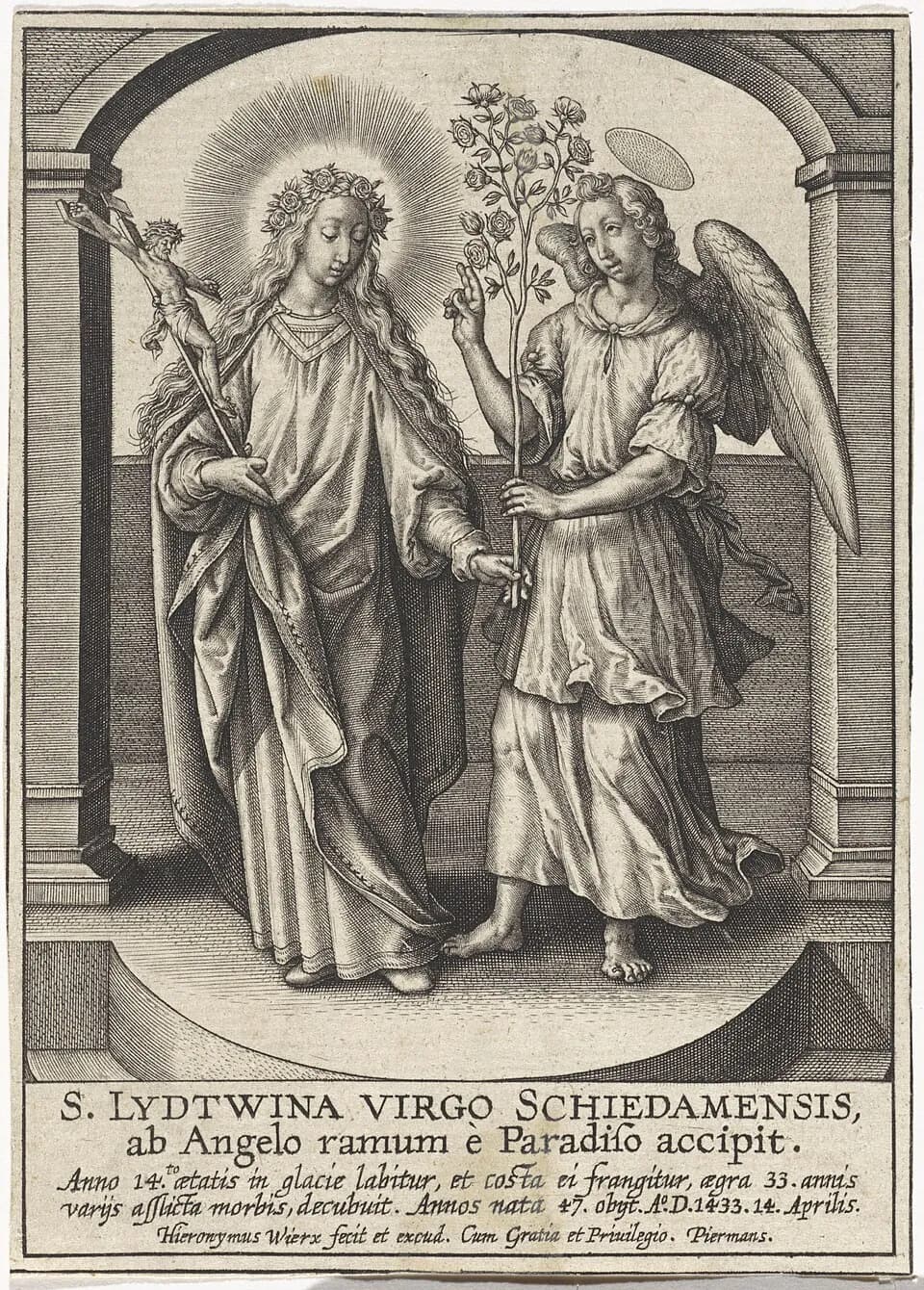
Saint Lidwina of Schiedam was a Dutch girl who broke a rib skating at fifteen and spent the remaining thirty-eight years of her life in bed, in pain that no doctor of her day could treat. 12 She died on April 14, 1433, and pilgrims were at her grave within the year. 13 The Roman Martyrology keeps her on April 14, the Dutch church on June 14, and her own town calls her the patroness of the sick. 36
A girl from Schiedam
Schiedam stands near the mouth of the Meuse in Holland, and Lidwina was born there in 1380. 12 The 1910 Catholic Encyclopedia gives the day as April 18. 1 The basilica in Schiedam that bears her name says Palm Sunday, March 18, and adds that her mother went into labor in the church of St. John during the reading of the Passion. 3 The encyclopedia of the Dutch Catholic broadcaster says only between 1380 and 1386. 5 In Schiedam she is called Liduina. 3
Her parents were Peter and Petronella. 13 The encyclopedia says Peter came of a noble family and that both he and Petronella were poor. 1 The basilica knows him as Peter Janszoon, a night watchman. 3 Lidwina was the fifth of nine children and the only daughter. 35
Butler says that from the age of seven she had a marked devotion to the Blessed Virgin and would stop at the church to say a Hail Mary before the statue there when her mother sent her on errands. 2 At twelve, according to Butler, she made a vow of virginity. 2 The basilica says she was a good-looking girl, young men began asking to marry her when she was twelve, and her father thought it a fine idea. She did not, and she prayed that no young man would want her. 3
The fall on the ice
In the winter of 1395 she went skating with her friends. 1 Butler says she was "amusing herself with skating with her companions, according to the custom of that country." 2 The basilica dates it to February 2, the feast of Candlemas. 3 One of the friends, by the encyclopedia's account, caused her to fall, and she came down on the ice hard enough to break a rib on her right side. 1 The Dutch encyclopedia puts the accident a year or two later and says it was her hip. 5
"This was the beginning of her martyrdom," the Catholic Encyclopedia says, and then: "No medical skill availed to cure her." 1 An abscess formed at the break and would not heal. 3 Gangrene set in and spread. 1 Butler lists what followed with clinical frankness: an ulcer in the lungs, three open sores, dropsy that lasted nineteen years, and for the last seven years a body she could not move at all except for her head and her left arm. 2 The encyclopedia says only that "she was one sore from head to foot." 1
She was sick for thirty-eight years. 23 For the last thirty of them, Butler says, she never left her bed, and the basilica counts thirty-three years in which she did not once touch the ground. 23
Learning to bear it
None of the sources pretends she took this well at first. For the first three or four years, Butler writes, "she was obliged to use violence, and to make continual efforts" to keep herself patient. 2 The basilica says she resisted. 3 What changed things was her confessor, a priest named Jan Pot. He taught her to meditate on the Passion of Christ, and she divided it into seven parts to match the seven hours of the Church's daily prayer. 235
After that the tone of the accounts shifts. She asked that her pain be increased along with her patience, and she offered it for the conversion of sinners and for the souls of the dead. 23 The Roman Martyrology remembers her for precisely this, as a woman who bore the infirmities of her body all her life for the conversion of sinners and the freeing of souls, trusting in God alone. 6
People came. They brought alms, and whatever went beyond what she needed she gave to the poor, though her own family was hard up. 23 They also came for advice and for her prayers. 5 Not everyone was impressed. Some, the encyclopedia says, "looked on her with suspicion, as being under the influence of the evil spirit." 1
The pastor and the host
Eating grew harder every year. In the first half of her illness she managed a slice of apple or a bit of bread now and then; in the last nineteen years, the basilica says, she took nothing but Holy Communion. 34 That left her dependent on the parish clergy, and Titus Brandsma, in his articles on her, describes how badly it went. 4
The pastor, Andries, did not believe a word of it. On a feast of the Nativity of Mary he agreed to bring her Communion and brought an unconsecrated host instead, to see whether she would notice. 14 She could not keep it down. Brandsma gives her answer: "I can digest the body of the Lord, but I cannot eat ordinary bread without having to vomit it out immediately." 4 Andries left angry, gave her nothing, and kept other priests away from the house. She went three months without the sacrament. 4
On December 18 she saw a cross at the foot of her bed bearing Christ in the form of a child, and then a host marked with the five wounds, which others in the room saw too. 34 The basilica dates this to 1412. 3 The pastor called it the work of the devil, and the people of Schiedam were angry enough that the bishop of Utrecht had the matter investigated. 4 The inquiry came down on her side. Andries brought her Communion every two weeks from then until he died. 4
The rose bush
In her visions she had been shown a rose bush and told, in the encyclopedia's words, "When this shall be in bloom, your suffering will be at an end." 1 In the spring of 1433 she said, "I see the rose-bush in full bloom!" 1
On Easter morning she saw Christ coming to anoint her. 1 She died two days later, on Easter Tuesday, April 14, 1433, at fifty-three. 2 She had asked that her body not be laid in the earth, since she had not set foot on the ground for more than thirty years, and so the coffin was set on beams inside a brick tomb in the churchyard of St. John's. 3 Pilgrims arrived at once, and in 1434 a chapel was built over the grave. 13
Her life was written by the Franciscan Joannes Brugman and by Thomas a Kempis, the author of The Imitation of Christ. 15
Relics and recognition
Then came the Reformation, when the veneration of saints was forbidden. 3 Butler says the chapel over her grave was demolished. 2 In 1615 her relics were taken secretly to Brussels for safety. 135 They came back to Schiedam on June 14, 1871. 5
Butler's Lives, still in its 1864 edition, noted that she "was never beatified," 2 That changed on March 14, 1890, when Leo XIII confirmed the veneration that had been paid to her for centuries. 13 The Dutch Catholic encyclopedia is careful about what the decree means: strictly, it gives her the standing of a blessed who may be venerated as a saint. 5 The Roman Martyrology calls her a saint without qualification. 6
What is Saint Lidwina the patron saint of?
Saint Lidwina is the patron saint of the sick. The basilica at Schiedam says so, and so does the Diocese of Rotterdam, where a deacon leading a parish pilgrimage to her church explained it simply: she struggled with her illness, and people in trouble came to her for prayer and support. 37 She is also the patroness of the city of Schiedam and of the basilica that holds her relics. 3
And she is the patron saint of ice skaters. Thomas Craughwell, writing in St. Anthony Messenger, uses her as an example of patronage working backward, the way Sebastian became the patron of archers: she "took a nasty fall on the ice that left her a lifelong invalid," and skaters adopted her. 8
Saint Lidwina's feast day
Saint Lidwina's feast day is April 14, the day she died. Butler's Lives gives it under that date, and the Roman Martyrology enters her there, at Schiedam. 26
In the Netherlands she is now kept on June 14. April 14 falls so often in Holy Week or the Easter octave, when no saint can be commemorated, that in 1974 the feast was moved to the anniversary of the return of her relics. 35
Praying with Saint Lidwina
Her life has almost no events in it. A girl falls, and then for thirty-eight years the same room. 23 What the sources record instead is a slow change in how she lay there, and they are honest that it was slow: years of forcing herself to be patient before patience came. 2
She was not cured. The meditation Jan Pot taught her did not take the pain away; the basilica's account says only that it made the pain bearable. 3 Butler says her bitterness turned to consolation, and in the same paragraph that she still had spells of spiritual dryness. 2
Brandsma thought the usual picture of her, the patient sufferer, stopped a step short. The patience had a source, and he located it in the Eucharist she fought so hard to receive: "There lies the secret of Lidwina's patience." 4 He also noticed that the hardest thing she bore was being disbelieved by her own priest, and that she did not denounce him. 4
A woman who could move one arm kept a purse for the poor, and the town came to her bedside with its troubles. 235 The deacon from the Diocese of Rotterdam put it in the language of the works of mercy: comforting the afflicted is something she certainly did. 7
Saint Lidwina of Schiedam, pray for us.
Sources
- 1.Petrus Henricus Albers, "St. Lidwina," The Catholic Encyclopedia, Vol. 9 (New York: Robert Appleton Company, 1910).
- 2.Alban Butler, "B. Lidwina, Commonly Called Lydwid, V.," The Lives of the Fathers, Martyrs and Other Principal Saints, Vol. IV (D. & J. Sadlier, 1864), as published by EWTN.
- 3."Liduina," Basiliek van de H. Liduina en Onze Lieve Vrouw Rozenkrans, Schiedam, Parochie De Goede Herder (in Dutch).
- 4.Titus Brandsma, "Fragments articles Saint Liduina of Schiedam," from the series "De H. Liduina van Schiedam," translated by Susan Verkerk-Wheatley and Anne-Marie Bos, Writings of Titus Brandsma, Titus Brandsma Institute, Nijmegen.
- 5."Lidwina van Schiedam," Katholieke encyclopedie, KRO-NCRV Katholiek (in Dutch).
- 6.Roman Martyrology, entry for April 14, "Santa Liduina, vergine," as printed in "Santo del giorno," Conferenza Episcopale Italiana (in Italian).
- 7."Parochies pelgrimeren naar de heilige deur in Schiedam," Bisdom Rotterdam, 2016 (in Dutch).
- 8.Thomas J. Craughwell, "Patron Saints for Modern Challenges," St. Anthony Messenger, Franciscan Media.
Saints to turn to next
Others in this collection who are turned to for some of the same things.
- Saint Catherine de' RicciApril 23, 1522 - February 2, 1590PrayerSuffering and illness
- Saint Catherine of Genoa1447 - September 15, 1510Suffering and illnessPrayer
- Saint Charles of Mount ArgusDecember 11, 1821 - January 5, 1893Suffering and illnessPrayer
- Saint FiacreLate sixth century - August 18, c. 670Suffering and illnessPrayer