Saint Fiacre
Late sixth century - August 18, c. 670
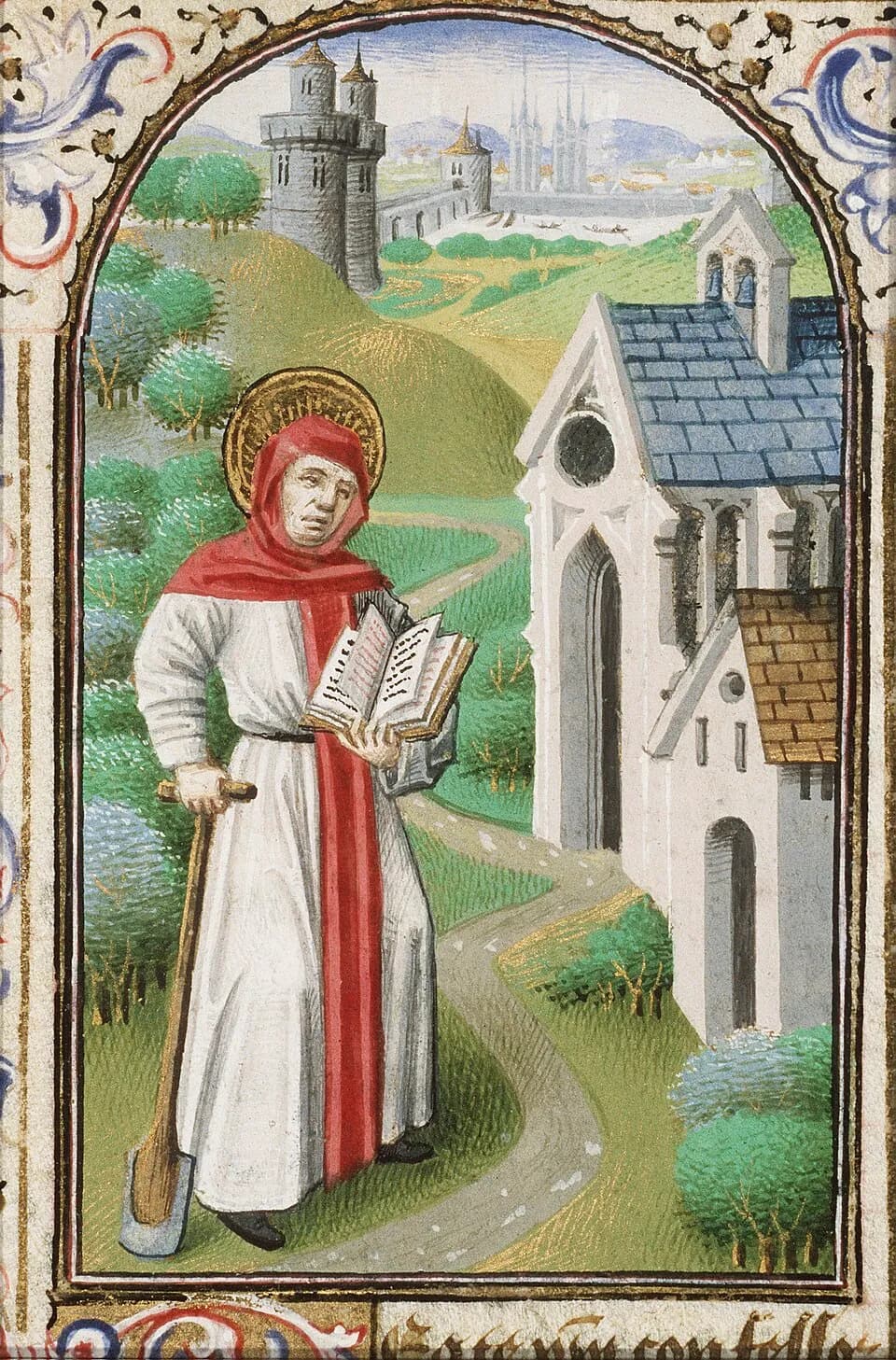
- Patron saint of
- Gardeners 1256; the cab drivers of Paris 2 and taxi drivers 5; people with hemorrhoids 26 and venereal disease 256; Catholic Culture adds the sick, fevers, blindness, harvests and a long list of trades 2
- Born
- In Ireland, about the end of the sixth century according to the 1909 Catholic Encyclopedia and Catholic Ireland 15; in the seventh century according to U.S. Catholic 6
- Died
- August 18, 670, according to the 1909 Catholic Encyclopedia 1; about 670 according to Franciscan Media and Catholic Ireland 45
- Buried
- In the church at Breuil, with the relics moved to the cathedral at Meaux in 1568 1; Franciscan Media places his tomb in Meaux's cathedral 4
- Emblems
- A spade, a shovel, an open book, a basket of vegetables 2
Saint Fiacre was an Irish priest and hermit who crossed to France in 628, was given a patch of forest at Breuil near Meaux by its bishop, and lived there in prayer and the labor of a garden until his death around 670. 1 He is the patron saint of gardeners, and the Paris cab called a fiacre takes its name from him, by way of an inn that hung his picture over its door. 12 The best-known story about him, of land marked out with the point of his staff, is reported by the 1909 Catholic Encyclopedia as a legend, and is told here as one. 1
An Irish hermit
Cornelius Mulcahy, writing in the Catholic Encyclopedia, says Fiacre was born in Ireland about the end of the sixth century and was ordained a priest before he withdrew to a hermitage on the banks of the River Nore. 1 The townland of Kilfiachra, or Kilfera, in County Kilkenny still preserved the memory of it in his day. 1 Patrick Duffy of Catholic Ireland places it, with a "possibly," near St. Fiachra's Well at Cill Fiachra, near Bennetsbridge, and notes that Fiacre does not appear in the earlier Irish calendars. 5
The sources agree on what drove him out of Ireland. Disciples gathered, and he wanted more solitude than they allowed him. 1 Duffy says he had been raised in a monastery and learned herbal medicine there, and that crowds came for his holiness and his cures. 5 Franciscan Media's Brian O'Neel adds two details no other source used here repeats: that Fiacre was the son of an Irish king, and that he was educated by a Saint Conan. 4
Breuil, near Meaux
He arrived at Meaux in 628. 1 The bishop there was Saint Faro, who received him generously, and the encyclopedia gives a reason: Faro and his father's house had been blessed by the Irish missionary Columbanus, and he was well disposed to an Irish monk because of it. 1 U.S. Catholic tells the same story of a bishop remembering Columbanus kindly. 6
Faro gave Fiacre a site out of his own family land, at a place called Brogillum or Breuil, surrounded by forest. 1 There Fiacre built an oratory in honor of the Blessed Virgin Mary, a hospice where he took in strangers, and a separate cell where he lived alone. 1 Mulcahy describes "a life of great mortification, in prayer, fast, vigil, and the manual labour of the garden." 1 Disciples came, as they had in Ireland, and in time they formed a monastery around him. 1
The visitors were not only would-be monks. Catholic Culture, quoting John Delaney's Dictionary of Saints, says he was known for his charity to the poor and was consulted by many for his spiritual wisdom. 2 U.S. Catholic says the poor especially sought him out, and that he grew food for the crowds and herbs to treat the sick. 6 Catholic Ireland says the settlement grew into the village of Saint-Fiacre, in what is now the Seine-et-Marne department. 5
The legend of the staff, and the woman at the door
The encyclopedia introduces the story with the words "There is a legend," and then tells it briefly. 1 Faro allowed Fiacre as much land as he could enclose in one day with a furrow. Fiacre turned up the earth with the point of his crosier. "An officious woman" hurried to tell the bishop that he was being tricked, but when Faro came to the wood he saw that the wonder-worker was a man of God and asked for his blessing. From then on, the legend says, Fiacre kept women out of the precincts of his monastery, on pain of severe bodily infirmity. 1
Other sources tell it differently. Catholic Ireland and U.S. Catholic keep the staff and leave out the woman: Faro offered as much land as Fiacre could turn up or plow in a day, and he used his staff instead of a plow. 56 Franciscan Media gives the fullest version, naming the woman Becnaude and adding that Fiacre, lost in thought, sat on a granite rock that softened like wax and kept his imprint, which Faro took as a sign. 4
On the exclusion of women, Mulcahy does not leave it to the legend. "In reality," he writes, it was common practice in the Irish foundations, and U.S. Catholic likewise says Fiacre "followed the custom of Irish monks" in barring women from his hermitage and chapel. 16 Franciscan Media does not soften it, and asks openly how someone who stereotyped women could be a saint. 4
The healer and his shrine
His reputation for miracles spread widely, and the encyclopedia says he cured by the laying on of hands: blindness, polyps and fevers are mentioned, and especially a tumor or fistula that came to be called "le fic de S. Fiacre." 1 He was buried in the church at Breuil, and cures at his tomb soon testified to his holiness. 1 Franciscan Media instead places the tomb in the cathedral at Meaux. 4 The encyclopedia records that his relics were in fact taken to the cathedral at Meaux in 1568, to keep them safe from the Calvinists. 1
Before that, in 1234, the bishop of Meaux placed his remains in a shrine and enclosed his arm in a separate reliquary. 1 Part of his body went to the Grand Duke of Tuscany in 1617, and part of his vertebrae to Cardinal Richelieu in 1637. 1 A fifteenth-century mystery play celebrated his life, many churches in France were dedicated to him, and the encyclopedia names Saint John of Matha, Louis XIII and Anne of Austria among his most famous clients. 1 U.S. Catholic adds that the queen, coming on foot to give thanks, prayed outside the chapel door with the other pilgrims rather than go in. 6
Why a Paris cab is called a fiacre
The encyclopedia says the French cab takes its name from him. 1 In the middle of the seventeenth century, the Hôtel de St-Fiacre on the Rue St-Martin in Paris was the first to let coaches out for hire. Its sign showed the saint, and the coaches came to be called by his name. 1 Catholic Culture dates the first of them to 1640 and says they were chiefly hired there to take pilgrims on the first stage of the journey to his shrine. 3
What is Saint Fiacre the patron saint of?
The encyclopedia, Catholic Culture, Catholic Ireland and U.S. Catholic all name him the patron saint of gardeners. 1256 Franciscan Media calls him simply a "Worker of the Land." 4 Catholic Culture adds the cab drivers of Paris, and Catholic Ireland taxi drivers, both following from the name of the coaches. 25 Because of the healings attributed to him, he is also invoked for illnesses: Catholic Culture's list includes the sick, fevers, blindness, hemorrhoids and venereal disease, and U.S. Catholic and Catholic Ireland name some of the same. 256 Catholic Culture's list goes on into harvests and a long run of trades, among them potters, tile makers and trellis makers. 2
Saint Fiacre's feast day
His feast is August 30. 12 The encyclopedia says plainly that "his feast is kept on the 30th of August," and Catholic Culture lists him on that day as a commemoration in the Roman Martyrology. 12 Catholic Ireland and U.S. Catholic give the same date. 56
Franciscan Media's article gives a memorial on August 18 instead, which is the day the encyclopedia gives for his death. 14 On Catholic Culture's calendar he appears among the day's other commemorations, marked as from the Roman Martyrology, rather than as a memorial of the day. 2
Praying with Saint Fiacre
Fiacre left Ireland because people would not leave him alone, and in France the same thing happened again. 15 His answer, in the encyclopedia's account, was to build three things side by side: an oratory, a hospice for strangers, and a cell for himself. 1 Franciscan Media says that when people found him again he took it as God's will. 4 The record shows a man who kept his cell and also kept the hospice open.
The work that made him a patron was ordinary. He fasted and kept vigils, and he dug a garden. 1 U.S. Catholic says the garden fed the people who came and supplied the herbs he used for the sick. 6 For gardeners who ask his prayers, that is the life on record: manual labor done within a life of prayer, with the produce going to whoever turned up. 16
The story people remember best is the one the sources trust least. The encyclopedia calls the staff and the furrow a legend, and each source tells it a little differently. 1456 The exclusion of women that follows it is not softened by any of them; Mulcahy explains it as an ordinary rule of Irish monasteries, and Franciscan Media admits it is hard to understand and does not explain it away. 14
Most of what is recorded about him concerns the sick, during his life and long after it. People came to Breuil with fevers, tumors and blindness, the shrine was still a place of pilgrimage for bodily ailments in 1909, and a queen of France came on foot to give thanks. 16 Praying to him for the sick puts a person among those pilgrims.
Saint Fiacre, pray for us.
Sources
- 1.Cornelius Mulcahy, "St. Fiacre," The Catholic Encyclopedia, Vol. 6 (New York: Robert Appleton Company, 1909).
- 2."August 30" (St. Fiacre, Hermit, Roman Martyrology), Liturgical Year calendar, Catholic Culture, Trinity Communications, excerpting John J. Delaney, Dictionary of Saints.
- 3."August 30: St. Fiacre," Catholic Activity, Catholic Culture, Trinity Communications, from Demetria Taylor, The Cook's Blessings (Random House, 1965).
- 4.Brian O'Neel, "Saint Who? Fiacre," Franciscan Spirit, Franciscan Media, May 19, 2020.
- 5.Patrick Duffy, "St Fiacre (7th century) patron of gardeners and taxi-drivers," Saint of the Day, Catholicireland.net, August 30, 2012.
- 6.Catherine O'Connell-Cahill, "St. Fiacre," Saint Calendar, U.S. Catholic, Claretian Publications.
Saints to turn to next
Others in this collection who are turned to for some of the same things.
- Saint Alphonsus Rodriguez1532 or 1533 - October 1617PrayerWork and vocationSuffering and illness
- Saint André BessetteAugust 9, 1845 - January 6, 1937PrayerSuffering and illnessWork and vocation
- Saint Veronica Giuliani1660 - July 9, 1727Suffering and illnessPrayerWork and vocation
- Saint Walburgac. 710 - February 25, 777 or 779Work and vocationSuffering and illnessPrayer