Saint Walburga
c. 710 - February 25, 777 or 779
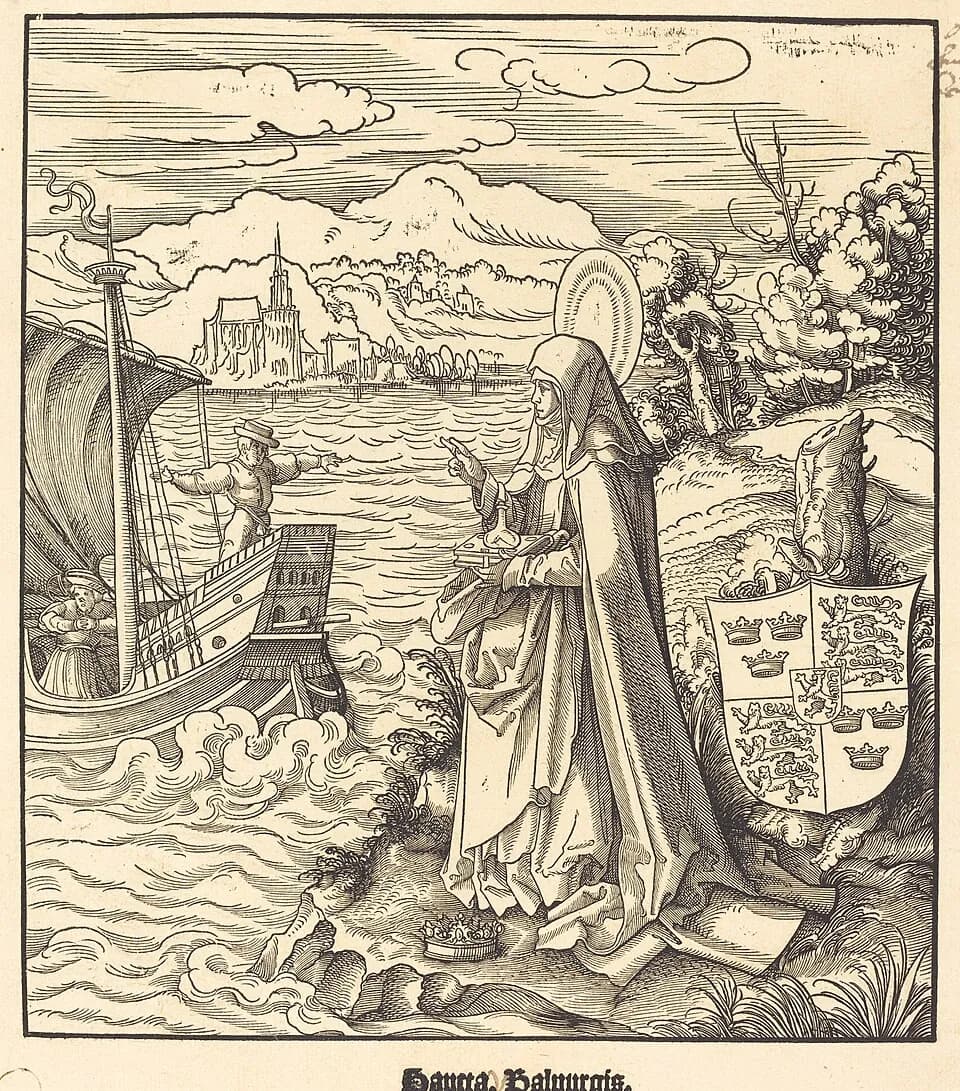
- Patron saint of
- Sailors, and those caught in storms 12; farmers and harvests 2; invoked against hydrophobia and rabies 12. Patroness of Eichstätt and its diocese 123, and of Antwerp, Oudenarde, Furnes, Groningen and Zutphen, among other places 12
- Feast day
- February 25 2, or February 26 in a leap year in the Benedictine Breviary 1. In 1912 the Roman Martyrology commemorated her on May 1 1
- Died
- February 25 at Heidenheim: 777 according to the 1912 Catholic Encyclopedia 1; 777 or 779 according to Catholic Culture and the Abbey of St. Walburga 24; 788 or 790 according to the Abtei St. Walburg 3
- Family
- Daughter of Saint Richard; sister of Saints Willibald and Winibald; niece of Saint Boniface through her mother, Winna, according to Casanova 1
Saint Walburga was an English nun from a family of saints who crossed to Germany in the eighth century at Saint Boniface's call and died abbess of Heidenheim, in Bavaria. 13 Her brothers were Saints Willibald and Winibald, and the 1912 Catholic Encyclopedia makes Boniface her uncle. 1 She is best known for what happened after her death: since 893, her bones at Eichstätt have been found wet with a clear liquid that Catholics call Saint Walburga's oil and use in praying for the sick. 134 Walpurgis Night carries her name because May 1 is one of the dates given for the translation of her relics. 2
A family of saints from Wessex
She was born around 710. 13 Gertrude Casanova, writing in the 1912 encyclopedia, places her birth in Devonshire; the Benedictine nuns at Eichstätt, who keep her shrine, say Wessex and describe the family as noble Anglo-Saxons. 13 According to Casanova her father was Saint Richard, "one of the under-kings of the West Saxons," and her mother was Winna, a sister of Saint Boniface. 1 The Abbey of St. Walburga in Colorado, more cautiously, calls Boniface her relative. 4
When Walburga was eleven, Richard set out on pilgrimage to the Holy Land with her two brothers, Willibald and Winibald, and left her with the abbess of Wimborne. 12 News of his death at Lucca reached her about a year later. 1 The Eichstätt abbey says only that she was educated in an Anglo-Saxon monastery, "perhaps Wimborne." 3
She stayed twenty-six years, first in the school and then as a member of the community, and Casanova says she was "trained in solid learning." 12 Casanova credits her with a life of Winibald and a Latin account of Willibald's travels in Palestine, and writes that "she is thus looked upon by many as the first female author of England and Germany." 1 Catholic Culture repeats the claim. 2
The crossing to Germany
Boniface was by then founding monasteries across Germany, and Casanova calls him "the first missionary to call women to his aid." 1 In 748, answering his appeal, Abbess Tetta of Wimborne sent Saint Lioba, Walburga and a number of other nuns across the sea. 1
The voyage gave her the first of her stories. A storm came up; Walburga knelt on the deck and prayed, and the sea went calm. 12 Casanova says the sailors told everyone what they had seen when they landed, so that she was received in Germany "with joy and veneration." 1 A tradition of the church at Antwerp, Casanova adds, holds that she stopped there on the way. 1
At Mainz she was met by Boniface and by Willibald. 1 She lived for a time at Bischofsheim under Lioba's rule before being sent on to Heidenheim. 12
Abbess of Heidenheim
Heidenheim was Winibald's house, and the sources describe her coming there in different ways. Casanova has her appointed abbess of the nuns while Winibald governed the monks nearby, and taking charge of the monks' monastery as well after he died. 1 The Eichstätt abbey dates her abbacy from Wunibald's death in 761, and says the monastery became a double house of monks and nuns under her, on the Anglo-Saxon model. 3 The Colorado abbey says Wunibald founded it as a double monastery; Catholic Culture says she did. 24 Casanova, Catholic Culture and the Eichstätt abbey agree that she ended her life ruling both communities. 123
The sources say little about how she governed. Casanova speaks of her "virtue, sweetness, and prudence" and of the many miracles credited to her, and the Colorado nuns say the tenth-century legend of her life tells of her gentleness, humility and charity and of her power to heal the sick through prayer. 14 Casanova adds a line of the historian Ozanam about the Anglo-Saxon nuns of Germany: "Silence and humility have veiled the labours of the nuns from the eyes of the world, but history has assigned them their place at the very beginning of German civilization." 1
On September 23, 776, she was present when Willibald moved Winibald's body to a new tomb, and according to Casanova it was found untouched by time. 12 She fell ill soon afterward and died with Willibald at her side, and he buried her beside their brother. 12 The date was February 25, but the year is disputed. Casanova gives 777, Catholic Culture gives both 777 and 779 on a single page, the Colorado abbey gives "777 or 779," and the Eichstätt abbey gives "either 788 or 790." 1234
Saint Walburga's oil
After Willibald died, Casanova says, devotion to her faded and her tomb was neglected. 1 Around 870, Bishop Otkar of Eichstätt set about restoring the ruined church at Heidenheim, and the workmen damaged her grave. 12 Casanova reports that she then appeared to the bishop one night, "reproaching and threatening him," and that her remains were solemnly carried to Eichstätt and laid in the Church of the Holy Cross, now called St. Walburga's. 1 Casanova dates that translation to September 21; Catholic Culture gives May 1, 870; both abbeys say only that it happened between 870 and 879. 1234
In 893 the shrine was opened to give relics to Liubula, abbess of Monheim, and her bones were found to be wet. 13 Casanova calls it "a precious oil or dew" and says it had flowed ever since, especially from the breast, except while Eichstätt lay under an interdict and after robbers shed blood in the church and badly wounded the bell-ringer. 1 Because of it, Casanova writes, she is reckoned among the Elaephori, the oil-yielding saints. 1 The Eichstätt nuns describe "water-clear drops," say the flow is first documented in 1078 in a chronicle of the bishops, and report that drops still form every winter on the base of her sarcophagus. 3 The Colorado nuns say it is called oil "for want of a more accurate word," that when tested it has the properties of spring water, and that it flows each year from about October 12 to February 25. 4 The nuns of the Abtei St. Walburg collect it and send it out for use in prayer for the sick, and the Colorado abbey writes that "countless numbers experienced healing of body or spirit through her intercession." 4
Relics went to Monheim, Cologne, Antwerp and elsewhere. 13 In 1035 a Benedictine abbey was founded at her grave in Eichstätt, and her relics lie in the high altar of its church. 34
Walpurgis Night
Catholic Culture, quoting CatholicSaints.Info, explains how her name came to be attached to Walpurgisnacht. The night of May 1, the date it gives for the translation of her relics to Eichstätt, coincided with a pagan festival marking the start of summer and "the revels of witches." 2 "Though the saint had no connection with this festival," it says, her name became associated with witchcraft and country superstition because of the date. 2 It suggests, as a possibility only, that the protection of crops ascribed to her, shown by the three ears of corn in her pictures, may have come to her the same way. 2
The 1912 encyclopedia ties May 1 to something else: Walburga is said to have been canonized by Pope Adrian II on that day, though Casanova notes the dates do not fit if it happened under Bishop Erchanbold. 1
What is Saint Walburga the patron saint of?
The 1912 Catholic Encyclopedia calls her patroness of Eichstätt, Oudenarde, Furnes, Antwerp, Groningen, Weilburg and Zutphen, and says she is invoked against hydrophobia, in storms, and by sailors. 1 Catholic Culture gives a longer list: against coughs, dog bites, famine, plague, rabies and storms; boatmen, mariners, sailors and watermen; farmers and harvests; and the dioceses of Eichstätt and of Plymouth in England. 2 The Eichstätt abbey calls her the patroness of both the monastery and the diocese. 3
Saint Walburga's feast day
Her feast is February 25, the day she died. Catholic Culture notes that the Roman Martyrology commemorates her on that date, and Casanova says the Benedictine Breviary assigns her feast to February 25, or the 26th in a leap year. 124
Casanova explains that the moving of her relics produced "a diversity of feasts." 1 In 1912 the Roman Martyrology remembered her on May 1, alongside Saint Asaph, and that was her chief festival in Belgium and Bavaria. 1 The encyclopedia adds that the church at Antwerp, before it adopted the Roman Office, kept her feast four times a year. 1
Praying with Saint Walburga
Most of what can be said of her life fits in a few sentences: a girl left at a convent at eleven while her father and brothers went to the Holy Land, a quarter century in that cloister, then a sea crossing to a country where the Church was still being planted. 1 Her sources keep returning to the people around her. Boniface's appeal brought her over, she lived for a time under Lioba's rule, Winibald was her neighbor at Heidenheim, and Willibald nursed her as she died and buried her. 1
The work itself left little trace. The Ozanam line Casanova quotes is about exactly that, nuns whose labor was veiled by "silence and humility," and the dispute over even the year of her death shows how thin the record is. 13
Her later story has more incident than her life. A grave was forgotten and then disturbed, her relics were carried to Eichstätt, and every winter the nuns there collect the drops that form at her tomb and send them out for prayer with the sick. 134 The nuns in Colorado call it oil only for want of a better word, and what they describe is its use in prayer for the sick. 4
Walpurgis Night gives her name to something she had nothing to do with, as Catholic Culture says plainly. 2 The older devotion is the one in the sources: an abbess invoked by sailors in storms, named patroness by towns from Eichstätt to Zutphen, and still invoked for the sick, with the oil from her grave, by the people who pray for them. 124
Saint Walburga, pray for us.
Sources
- 1.Gertrude Casanova, "St. Walburga," The Catholic Encyclopedia, Vol. 15 (New York: Robert Appleton Company, 1912).
- 2."February 25: St. Walburga, Abbess," Liturgical Year, CatholicCulture.org.
- 3."Saint Walburga: Life and Work of St. Walburga; Veneration of St. Walburga," Benediktinerinnenabtei St. Walburg, Eichstätt.
- 4."St. Walburga: Our Patroness," Abbey of St. Walburga, Virginia Dale, Colorado.
Saints to turn to next
Others in this collection who are turned to for some of the same things.
- Saint Alphonsus Rodriguez1532 or 1533 - October 1617PrayerWork and vocationSuffering and illness
- Saint André BessetteAugust 9, 1845 - January 6, 1937PrayerSuffering and illnessWork and vocation
- Saint FiacreLate sixth century - August 18, c. 670Work and vocationSuffering and illnessPrayer
- Saint Veronica Giuliani1660 - July 9, 1727Suffering and illnessPrayerWork and vocation