Saint Veronica Giuliani
1660 - July 9, 1727
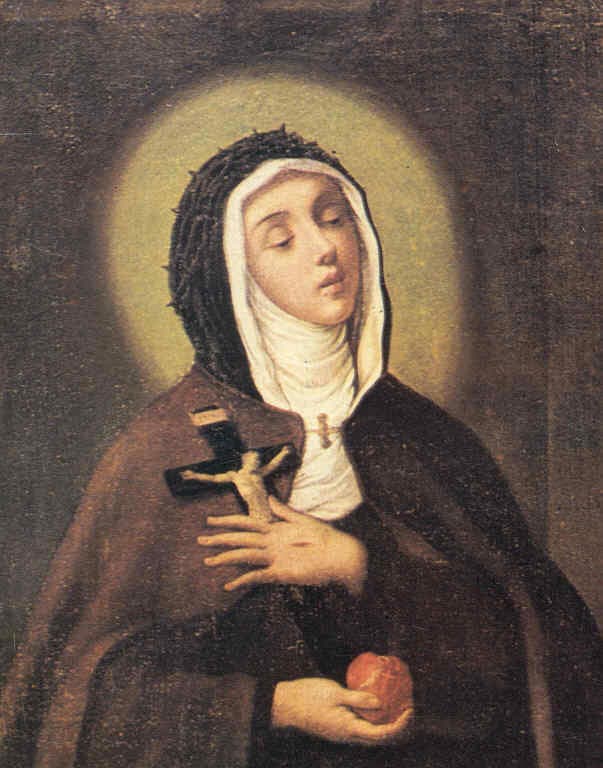
- Born
- Ursula Giuliani at Mercatello in the Duchy of Urbino, 1660 1
- Took the name
- Veronica on entering the Capuchin Poor Clares in 1677, "in memory of the Passion" 1
- Was investigated
- By Rome, lost her office, and was barred from daily Mass while it ran 2
- Would not let
- Her novices read mystical books 1
- As abbess
- Enlarged the convent and had water pipes laid, which it had lacked 1
Saint Veronica Giuliani reported visions from the age of three and received the stigmata at thirty-seven, and Rome responded by investigating her, stripping her of her office and forbidding her to attend Mass except on Sundays. 12 Franciscan Media records what she did about it: "Through all of this Veronica did not become bitter." 2 She was restored, made abbess, and spent the appointment fixing the convent's water supply. 1 She would not let her novices read books about mysticism. 1
A child who was hard to live with
Hess's account of her infancy is the kind of thing a hagiography usually smooths over and he prints it straight. At eighteen months "she uttered her first words to upbraid a shopman who was serving a false measure of oil, saying distinctly: 'Do justice, God sees you.'" 1 From three she was "favoured with Divine communications", set aside part of her food for the poor, and gave her clothes to children who had none. 1
And then the sentence that makes her a person. "When others did not readily join in her religious practices she was inclined to be dictatorial." 1 She was bossy about religion, and the article says so.
She found out about it in a way she did not forget. "In her sixteenth year this imperfection of character was brought home to her in a vision in which she saw her own heart as a heart of steel." 1 Hess adds another admission taken from her own writings: she enjoyed the grander style her family adopted when her father was made superintendent of finance at Piacenza. 1
Franciscan Media supplies the detail about her mother that Hess leaves out: "It is said that when her mother Benedetta was dying she called her five daughters to her bedside and entrusted each of them to one of the five wounds of Jesus. Veronica was entrusted to the wound below Christ's heart." 2 Note the hedge - "it is said" - which this page keeps.
Ill until he agreed
Her father wanted her married and worked at it: he "urged her to marry and procured for her several suitors as soon as she became of marriageable age." 1 Franciscan Media says the same and adds that "she convinced him to allow her to become a nun." 2
Hess describes how the convincing happened, and it is not an argument. "Owing to her father's opposition to her desire to enter a convent, Veronica fell ill and only recovered when he gave his consent." 1
She entered the Capuchin Poor Clares at Città di Castello in 1677 and took the name Veronica "in memory of the Passion." 1 The bishop handed her over with a line the abbess presumably remembered: "I commend this new daughter to your special care, for she will one day be a great saint." 1
It did not feel like that from the inside. Her novitiate "was marked by extraordinary interior trials and temptations to return to the world." 1 Franciscan Media lists the jobs she did in those first years, which are the ordinary jobs: "she worked in the kitchen, infirmary, sacristy, and also served as portress." 2
The investigation
The mystical phenomena escalated over years - a vision of Christ carrying his cross and a permanent pain in her heart, then in 1694 "the impression of the Crown of Thorns, the wounds being visible and the pain permanent." 1 The bishop ordered medical treatment; it "obtained no relief." 1 At thirty-seven, Franciscan Media says, she received the stigmata. 2
And then: "Life was not the same after that." 2
What happened next is only in the modern source, and it is the most important thing on this page. "Church authorities in Rome wanted to test Veronica's authenticity and so conducted an investigation. She lost the office of novice mistress temporarily and was not allowed to attend Mass except on Sundays or holy days." 2
Consider what that means for a woman whose entire spiritual life was built on receiving Communion. The Church did not condemn her; it suspended her, took away her work, and restricted her access to the sacrament while it decided.
Franciscan Media records her response in eight words: "Through all of this Veronica did not become bitter." 2 And the outcome: "the investigation eventually restored her as novice mistress." 2 Hess's 1912 article does not mention any of this. 1
A practical woman of affairs
Hess draws the contrast himself and it is the frame this page uses: "Yet, although she lived in this supernaturally mystical life, she was a practical woman of affairs." 1
She formed novices for decades - thirty-four years by Hess's count, twenty-two by Franciscan Media's, beginning when she was thirty-four - "and guided the novices with great prudence." 12 Then the detail that says more about her judgment than any vision: "It is noticeable that she would not allow them to read mystical books." 1
A woman with visible stigmata and permanent pain kept mystical literature away from the young women in her charge. She had presumably watched what it did to people who went looking for it.
She was elected abbess in 1716, protesting against it, and held the office for eleven years until she died. 12 What she did with it: "enlarged the convent and had a good system of water-pipes laid down, the convent hitherto having been without a proper water supply." 1
Franciscan Media adds what the suffering was for: "She offered her sufferings for the missions." 2 She was canonized by Gregory XVI in 1839. 12
What is Saint Veronica Giuliani the patron saint of?
Saint Veronica Giuliani's feast day
Praying with Saint Veronica Giuliani
She is the saint for being disbelieved by the institution you belong to, and staying in it. Rome investigated her, took her job, and rationed her access to Mass. 2 She was not expelled and she was not vindicated for some time - she was simply suspended while people decided whether she was genuine. Anyone who has been put on hold by an employer, a diocese or a family while a question about them was worked out will recognize the position.
What she did not do is the part worth copying. She did not campaign, and Franciscan Media's sentence is flat and complete: she "did not become bitter." 2 When it was over they gave her the novices back, and later made her abbess.
The most instructive thing about her is what she withheld from other people. She had the stigmata, a crown of thorns that left visible wounds, and permanent pain - and she would not let her novices read mystical books. 1 She was not protecting her own status. She had evidently concluded that reading about ecstasies is bad for the young, and she was the person in the building best placed to know.
And then the water pipes. 1 Given eleven years of authority, a mystic used them to extend the building and get plumbing installed. Whatever was happening to her interiorly, the convent got a water supply out of it.
Saint Veronica Giuliani, pray for us.
Sources
Saints to turn to next
Others in this collection who are turned to for some of the same things.
- Saint Alphonsus Rodriguez1532 or 1533 - October 1617PrayerWork and vocationSuffering and illness
- Saint Anthony Zaccaria1502 - July 5, 1539Work and vocationPrayer
- Saint Benedict of Nursiac. 480 - March 21, 547PrayerWork and vocation
- Saint Bernadette SoubirousJanuary 7, 1844 - April 16, 1879PrayerSuffering and illness