Saint Bernadette Soubirous
January 7, 1844 - April 16, 1879
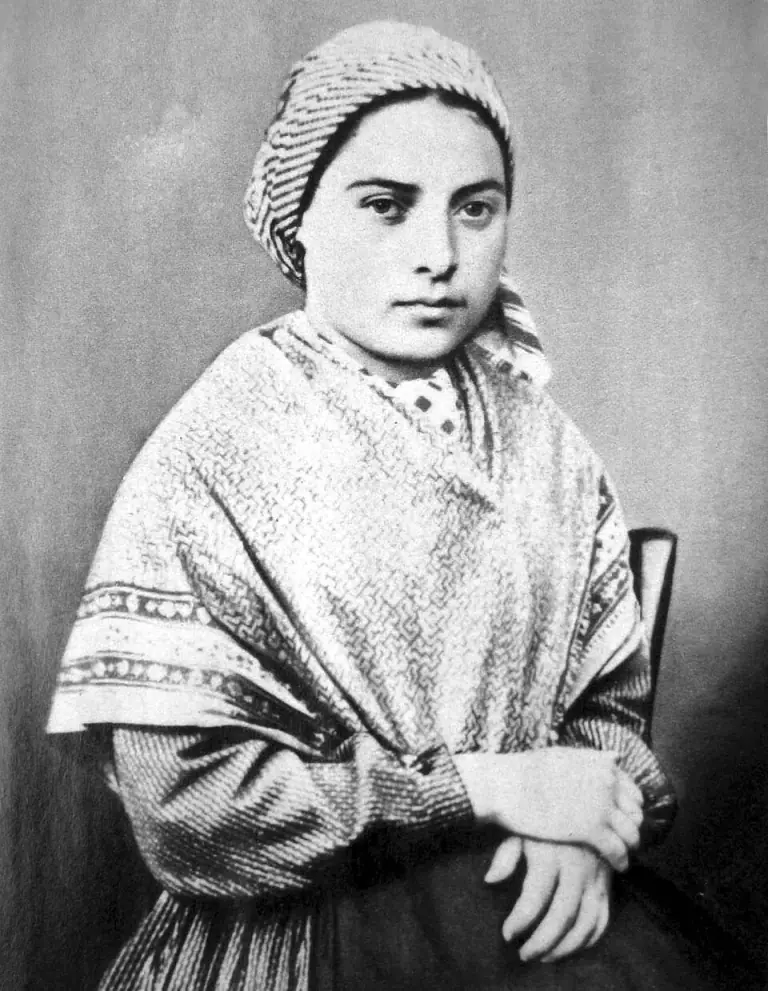
- Feast day
- April 16, the day she died in 1879 2
- Not to be confused with
- Our Lady of Lourdes, kept on February 11 - the date of the first apparition, extended to the whole Church by Pius X in 1907 1
- Born
- Lourdes, January 7, 1844, the first child of a very poor miller 2
- Approved
- In 1862 the bishop declared the faithful "justified in believing the reality of the apparition" 1
- Died
- At Nevers, April 16, 1879, aged thirty-five; canonized in 1933 2
Saint Bernadette Soubirous was fourteen, asthmatic, desperately poor, and known as "a virtuous girl though a dull student who had not even made her first Holy Communion." 2 Between February and July of 1858 she saw something eighteen times in a hollow of rock outside Lourdes that nobody standing beside her could see. 1 "Never has a sanctuary attracted such throngs" as the one that grew there 1 - and she got no relief from it herself. 2
The girl at Massabielle
Bernadette was born at Lourdes on 7 January 1844, the first child of an extremely poor miller; by the time of the apparitions the family was living in the basement of a dilapidated building. She had suffered from asthma from an early age. 2 The encyclopedia, which spells her Soubiroux, introduces her simply as "a poor, fourteen-year-old girl." 1
The first apparition was on 11 February 1858, in the hollow of the rock at Massabielle. There were eighteen in all, the last on 16 July. 12 "Bernadette often fell into an ecstasy," Bertrin writes. "The mysterious vision she saw in the hollow of the rock Massabielle was that of a young and beautiful lady. 'Lovelier than I have ever seen' said the child." 1
The detail Bertrin is careful about is the loneliness of it: "the girl was the only one who saw the vision, although sometimes many stood there with her. Now and then the apparition spoke to the seer who also was the only one who heard the voice." 1 Crowds came and stood next to her and saw a fourteen-year-old kneeling at a rock.
Franciscan Media supplies what she said she saw: a girl of sixteen or seventeen in a white robe with a blue sash, yellow roses on her feet, a large rosary on her right arm. 2
The spring, and the sentence she did not understand
On one occasion the lady told her to drink from a fountain in the grotto "the existence of which was unknown, and of which there was no sign, but which immediately gushed forth." 1 On another she told Bernadette to go to the priests and ask that a chapel be built there and processions made to the grotto. 1 Franciscan Media adds that people were to come to wash in and drink the water of the spring that welled up where she had been told to dig. 2
On 25 March the lady said: "I am the Immaculate Conception." 2 Franciscan Media records the thing that matters about that sentence - "It was only when the words were explained to her that Bernadette came to realize who the Lady was." 2 She carried the phrase to the clergy without knowing what it meant.
They did not believe her at first. "At first the clergy were incredulous," Bertrin writes, and it was four years before the bishop of the diocese declared the faithful "justified in believing the reality of the apparition," in 1862. 1 Franciscan Media makes the same point from the other end: "Few visions have ever undergone the scrutiny that these appearances of the Immaculate Virgin were subject to." 2
What grew there
A basilica was built on the rock of Massabielle by the parish priest, Peyramale. The great national French pilgrimages began in 1873; the basilica was consecrated three years later and the statue solemnly crowned. By 1883 it was already too small, and the Church of the Rosary was begun at its foot and consecrated in 1901. 1
The numbers Bertrin gives for the first fifty years are worth reading slowly. By the end of 1908, 5,297 registered pilgrimages had brought 4,919,000 pilgrims - and individual pilgrims, he says, far outnumber those who come in groups. The railway company estimated the Lourdes station received over a million travelers a year. 1 Among those who had made the pilgrimage were 2,013 prelates, including sixty-nine cardinals. 1
On the cures, Bertrin is a partisan who keeps his arithmetic in the open: he says he has personally recorded every recovery, partial or complete, in the shrine's first half-century and counted 3,962; he notes that the statistics give names, dates, the disease and usually the physician; and he concedes that "there are inevitably doubtful or mistaken cases," which time dispels. 1 The cures are logged at the Bureau des Constatations Médicales, and he adds that perhaps half of those who recover never present themselves there at all. 1
Afterward
The rest of her life is on Franciscan Media's side of the page. She "suffered much," hounded by the public and by civic officials until she was given the protection of a convent. Five years later she asked to enter the Sisters of Notre Dame of Nevers, and after a period of illness was well enough to travel and begin the novitiate. 2
Within four months of arriving she was given the last rites and allowed to make her vows on what was expected to be her deathbed. She recovered enough to work as infirmarian and then as sacristan, and the chronic ill health never left. She died on 16 April 1879, aged thirty-five, and was canonized in 1933. 2
Franciscan Media draws the conclusion this page will not improve on: "Millions of people have come to the spring Bernadette uncovered for healing of body and spirit, but she found no relief from ill health there." 2
What is Saint Bernadette the patron saint of?
Neither source cited here states a patronage for her. 12 Franciscan Media's entry, which lists patronages for most saints, carries none for Bernadette, and Bertrin's article is about the shrine rather than about her. The question is left unanswered rather than filled in.
What she is for is not in doubt: the sick who are not cured, and anyone who has been disbelieved by people with more authority than they have.
Saint Bernadette's feast day
The feast of Saint Bernadette is April 16, the day she died at Nevers in 1879. 2
It is easily confused with the other Lourdes date. The feast of Our Lady of Lourdes is 11 February, the day of the first apparition; Leo XIII authorized a special office and Mass for it, and in 1907 Pius X extended the observance to the entire Church. 1 That day commemorates the apparition. April 16 is Bernadette's.
Praying with Saint Bernadette
She was the only one who could see it. That is the fact Bertrin keeps returning to, and it is the hardest part of her life: crowds standing at her shoulder, watching her look at nothing. 1 Four years passed before the bishop would say the faithful were justified in believing her. 1 She was eighteen by then.
She was given a sentence she did not understand and told to carry it to the clergy. "I am the Immaculate Conception" meant nothing to a girl who had not yet made her first Communion, and she repeated it anyway. 2 Not understanding what you have been given is a more common spiritual condition than being able to explain it.
The spring she was told to dig for has been the occasion of thousands of recorded recoveries. 1 She herself had asthma as a child, was ill through her twenties, was anointed within four months of entering religious life, and died at thirty-five. 2 The water did nothing for her. Franciscan Media says she "moved through life, guided only by blind faith in things she did not understand - as we all must do from time to time." 2
What she did between the visions and the grave was ordinary: she nursed the sick as infirmarian and looked after the sacristy. 2 Nobody asked her to found anything. She had seen the Mother of God eighteen times and then spent the rest of her short life keeping a convent infirmary in order.
Saint Bernadette Soubirous, pray for us.
Sources
Saints to turn to next
Others in this collection who are turned to for some of the same things.
- Saint Aelred of Rievaulx1109 - January 12, 1166 (or 1167)PrayerSuffering and illness
- Saint Albert of Trapanic. 1240 - August 7, 1307PrayerSuffering and illness
- Saint Aldegundc. 630 or c. 639 - 684Suffering and illnessPrayer
- Saint Alphonsus Rodriguez1532 or 1533 - October 1617PrayerSuffering and illness