Saint Albert of Trapani
c. 1240 - August 7, 1307
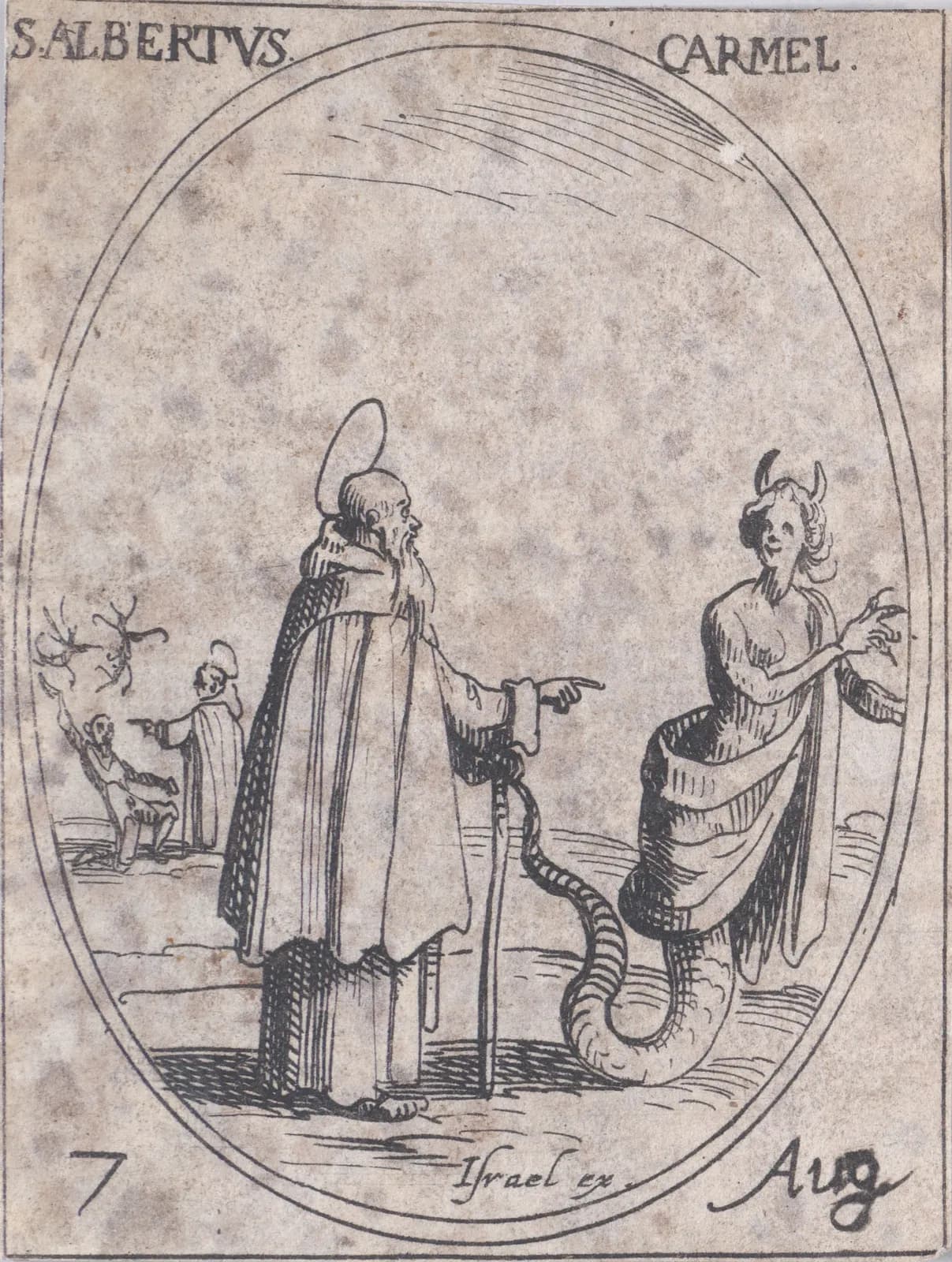
- Born
- At Trapani in Sicily 134, about 1240 according to katolsk.no, which notes that others say 1212 1
- Cult confirmed
- May 31, 1476, by Pope Sixtus IV 1
- Patron of
- Messina, Trapani, Erice, Palermo and Mantua; the Carmelites; coopers; against possession and infertility; in difficult childbirth and fever, according to katolsk.no 1
Saint Albert of Trapani was a Carmelite friar in thirteenth-century Sicily, a preacher who walked the island and was remembered for healing the sick and casting out demons. 13 The Roman Martyrology credits him with converting many Jews by his preaching and with getting food into Messina when the city was under siege. 2 With Saint Angelus he is one of the two oldest saints of his order, and the Carmelites call him a father of the order. 3
A son promised to Carmel
Albert was born at Trapani, on the western tip of Sicily; the 1912 Catholic Encyclopedia lists "the Carmelite St. Alberto degli Abbati" among the city's natives. 4 The Norwegian bishops' saints database (katolsk.no) dates his birth to about 1240, noting that other sources say 1212, and says he came of a distinguished Florentine family. 1 Fr. Giovanni Grosso, a Carmelite historian writing for his order, puts the birth around the middle of the thirteenth century and names his parents as Benedetto degli Abati and Giovanna Polizi. 3
Both sources tell the same story of his birth. His parents had been childless for a long time; Grosso says twenty-six years of marriage, and katolsk.no that they were getting on in years. 13 They promised that a son would be given to Our Lady of Mount Carmel, in her order. 1 Grosso adds that the promise was really his mother's, and that his father wanted him to marry and take over the family fortune. 3 Albert went with his mother's wish and entered the Carmelite house at Trapani, a foundation his own family had endowed. 3
Grosso is frank about how little is firm. "We do not have much information about his life, but we can trace its main lines with reliability," he writes. 3 The oldest biography was written a little after 1385, nearly eighty years after Albert's death, and the later ones depend on it. 3 katolsk.no is blunter: the biography is late and contains many impossible and doubtful details. 1
A preacher on the roads of Sicily
After his ordination Albert was sent to the Carmelite house at Messina. 13 katolsk.no says he worked there with great success for the conversion of the Jews, and became known for his sermons, his preaching journeys and the wonders that happened around him. 1 Grosso describes the kind of preaching it was: popular, plain and aimed at people's needs, the work the new mendicant orders had taken up, and which the Carmelites made their own especially after the Second Council of Lyon in 1274. 3
The documents that do survive are notarial. Albert was back in Trapani by August 1280, when he witnessed the will of Ribaldo Abati, and he was there again on April 4, 1289, to witness the will of Ribaldo's second wife, Perna, and on October 8 of that year for a contract of the knight Palmerio Abati. 3 A deed of May 10, 1296, calls him Carmelite provincial of Sicily. 13 Grosso notes that no record shows what part, if any, he took in the larger events of the order in those years. 3
The traditions about his way of life are scattered across the island. At Corleone his flask for wormwood was kept, the bitter herb he mixed into his food; at Petralia Soprana there is a stone he is said to have used for a pillow. 3 Grosso reads them as the marks of a friar from a well-off family who chose to travel poor, sleeping in barns and caves rather than with friends who would have housed him. 3 Legend also says Albert recited the whole Psalter every day besides the Divine Office, and Grosso, without vouching for it, notes that this was a known practice of medieval hermits. 3
The siege of Messina
The story the Martyrology singles out is the relief of Messina. 2 In 1301 Robert of Calabria, later king of Naples, blockaded the city and its people were starving. 3 Through Albert's intercession, Grosso writes, ships broke the blockade and brought in food; the sources disagree about the number, which runs from one to twelve. 3
Grosso points out that this episode is recorded outside the order as well, in the tenth chapter of the fourteenth-century chronicle known as the Life of Cola di Rienzo. 3 He also gives a plainer side of it: Albert had influential connections, and they let him arrange supplies for the city. 3 What moved him, Grosso says, was "the hunger of the people," and he made himself the spokesman for ordinary citizens with "more pressing concerns than who controlled the Straits of Messina." 3
Healer and exorcist
Most of what is told about Albert is healing. 13 In Palermo a boy whom his sister had blinded in a game got his sight back and later became a Carmelite; another boy, from Lentini, was cured when his mother covered him with a piece of Albert's habit, joined the order out of gratitude, and afterward left it. 3 At Trapani Albert helped a young woman through a childbirth in which both she and the child were in danger. 3 Other women came to him with abscesses of the breast and with fever, Grosso says especially the puerperal fever that killed so many mothers. 3 At Agrigento he is remembered for purifying the water of a well, as Elisha did at Jericho. 3
He was also an exorcist. 13 At Licata a mother brought him her daughter, thought to be possessed; when the girl struck him, he offered her the other cheek, and she was freed. 3 The legend of his own temptation belongs here too. As a novice, it says, he was visited by the devil in the shape of a beautiful young woman, and recognized him by the cloven hooves showing under her skirts. 3 Painters show Albert trampling a devil with a woman's features and a goat's feet, and katolsk.no adds that he is shown with bird's claws poking out from under his cloak, and with a chained devil recalling the exorcism of a girl. 13
Two of the stories involve Jews: Albert saved three Jews from drowning near Agrigento, and at Sciacca he cured a Jewish boy of epilepsy, and in both, the legends say, the healed made a profession of faith and were baptized. 3 Of all these wonders Grosso writes, "The historicity of these events aside, what matters is their meaning." 3
Death and a father of the order
katolsk.no says Albert spent his last years as a hermit near Messina. 1 He died there, by tradition on August 7, 1307; katolsk.no allows 1306. 13 A legend tells of a quarrel at his funeral, the people wanting to honor him as a saint and the clergy preferring an ordinary Requiem, until angels appeared and intoned "Os justi," the opening chant of the Mass for a confessor. 3
His relics were moved in 1309 or, Grosso thinks more likely, in 1317. 3 The provincial Cataldo di Anselmo of Erice took his skull to Trapani, and other relics went to towns across Italy, while his tomb remained at Messina. 13 katolsk.no says he was never formally canonized: Pope Sixtus IV confirmed his cult on May 31, 1476. 1 Among those devoted to him it names Saint Teresa of Avila and Saint Mary Magdalene de' Pazzi. 1
Grosso calls Albert one of the two most ancient saints of the Carmelites. With Saint Angelus he bears the title "Father of the Order," pater ordinis, "for his sanctity and the exemplary quality of his life." 3 A tradition links him with the marble Madonna of Trapani, though Grosso admits it is hard to say what the tradition rests on. 3
What is Saint Albert of Trapani the patron saint of?
katolsk.no names Saint Albert of Trapani patron of the cities of Messina, Trapani, Erice, Palermo and Mantua, of the Carmelites and of coopers, and invokes him against possession and infertility and in difficult childbirth and fever. 1 Those last fit the stories Grosso gathers of the women Albert helped in childbirth and in fever, and of the possessed girl at Licata. 3
Saint Albert of Trapani's feast day
Praying with Saint Albert
Very little about Albert can be proved. Notaries saw him sign as a witness in Trapani, and a deed calls him provincial; nearly everything else was written down generations later. 3 What his order kept is a man who walked the roads of Sicily preaching, and who was remembered for going where he was needed. 13
The people in the stories are mostly those with nowhere else to go: a starving city, a blind boy, a mother in a dangerous labor, a girl who hit him. 3 Grosso's point about the siege is that ordinary citizens had no say in the war that was starving them. 3
Even the legend of his temptation is told without much drama. A novice saw the devil for what he was and sent him away. 3 Grosso says the purity of Albert's life was "primarily a spiritual reality," the whole of a man given over to God. 3
Saint Albert of Trapani, pray for us.
Sources
- 1."Den hellige Albert av Trapani (~1240-1307)," Den katolske kirke (katolsk.no), Catholic Diocese of Oslo (in Norwegian).
- 2.Roman Martyrology, entry for August 7, "Sant'Alberto degli Abbati, sacerdote," as printed in "Santo del giorno," Conferenza Episcopale Italiana (in Italian).
- 3.Giovanni Grosso, O.Carm., "Albert of Trapani: A Saint of Yesterday for Today," trans. P. Chandler, O.Carm., Order of Carmelites (ocarm.org).
- 4.Umberto Benigni, "Trapani," The Catholic Encyclopedia, Vol. 15 (New York: Robert Appleton Company, 1912).
Saints to turn to next
Others in this collection who are turned to for some of the same things.
- Saint Maximilian KolbeJanuary 8, 1894 - August 14, 1941Suffering and illnessPrayerProtection
- Saint Rosalia of Palermoc. 1125 or 1130 - c. 1160PrayerSuffering and illnessProtection
- Saint BlaiseDied c. 316ProtectionSuffering and illness
- Saint ErasmusDied c. 303, or in the late second century by one accountProtectionSuffering and illness