Saint Rosalia of Palermo
c. 1125 or 1130 - c. 1160
- Died
- In a cave on Monte Pellegrino near Palermo, at 30 or 35; Catholic Culture gives the year 1160 123
- Earliest account
- None before about 1590, though churches were dedicated to her in 1237 1
- Relics
- Found in 1624 and brought to the Cathedral of Palermo 1
Saint Rosalia was a twelfth-century hermit who died in a cave on Monte Pellegrino above Palermo, and she is the patroness of that city and of all Sicily. 12 Almost everything told of her life comes from local tradition written down centuries later; the Catholic Encyclopedia says flatly that "there is no account of her before Valerius Rossi (about 1590)." 1 Her remains were found in 1624; carried in procession during a plague, they were credited with many healings, and Palermo still keeps two feasts for her each year. 123 Her feast is September 4. 13
What the record holds
The 1912 Catholic Encyclopedia gives Rosalia a single paragraph, and it carries a warning: nothing was written about her until about 1590. It sets one fact beside that: "churches were dedicated in her honour in 1237." 1 So the veneration is medieval and well attested, and the biography is late.
Her written Life, the encyclopedia goes on, was judged by the Bollandist J. Stilting to have been "compiled from local traditions, paintings, and inscriptions." 1 What it says is brief. She was the daughter of Sinibald, Lord of Quisquina, and of Rosa, a family said to descend from Charlemagne. While still young she left home and hid in a cave near Bivona, and later in another on Monte Pellegrino near Palermo, "in which she died and was buried." 1
The encyclopedia adds what is not known. Whether she belonged to a religious community before she withdrew cannot be said. The Basilian monks claim her in their martyrology, and she is often painted as a Basilian nun holding a Greek cross. 1
The legend
Catholic Culture reprints the fuller story from Omer Englebert's Lives of the Saints, and introduces it with the words "Her legend states." She was born around 1130 at the court of Roger II, King of Sicily. When she was fourteen the Virgin appeared to her and urged her to leave the world, since her beauty was a danger to her soul. She took "her crucifix, her discipline, and a few books" and left her father's castle by night. 2
Two angels, one armed like a knight and one dressed as a pilgrim, led her to a grotto on the mountain Englebert calls Quisquita, hidden among trees and buried in snow. After several months they warned her that her parents were searching for her and brought her to the top of Monte Pellegrino. "There, it is said," Englebert writes, she spent the last sixteen years of her life in penance, "miraculously nourished by the Host." 2
The sources give her slightly different lifetimes. Catholic Culture has her born in 1130 and dead in 1160, at thirty. 2 Vatican News says she "was born to a noble family around the year 1125" and "was only 35 when she died." 3 Either way she died young, alone, about three miles from the city that now carries her through its streets. 2
The body in the cave
More than four and a half centuries passed. Then, the encyclopedia says, "In 1624 her remains were discovered and brought to the Cathedral of Palermo." 1 Englebert's version is that the body, "long sought in vain, was found in the 17th century encased in a sheath of rock crystal." 2
Vatican News says her popularity grew "when, during a plague, her relics were carried in procession around Palermo, resulting in many healings." 3 Englebert is more guarded and gives the following year: she "seems to have delivered her country from the plague in 1625 and, since then, to have brought about innumerable cures." 2 Pope Urban VIII put her name into the Roman Martyrology. 1
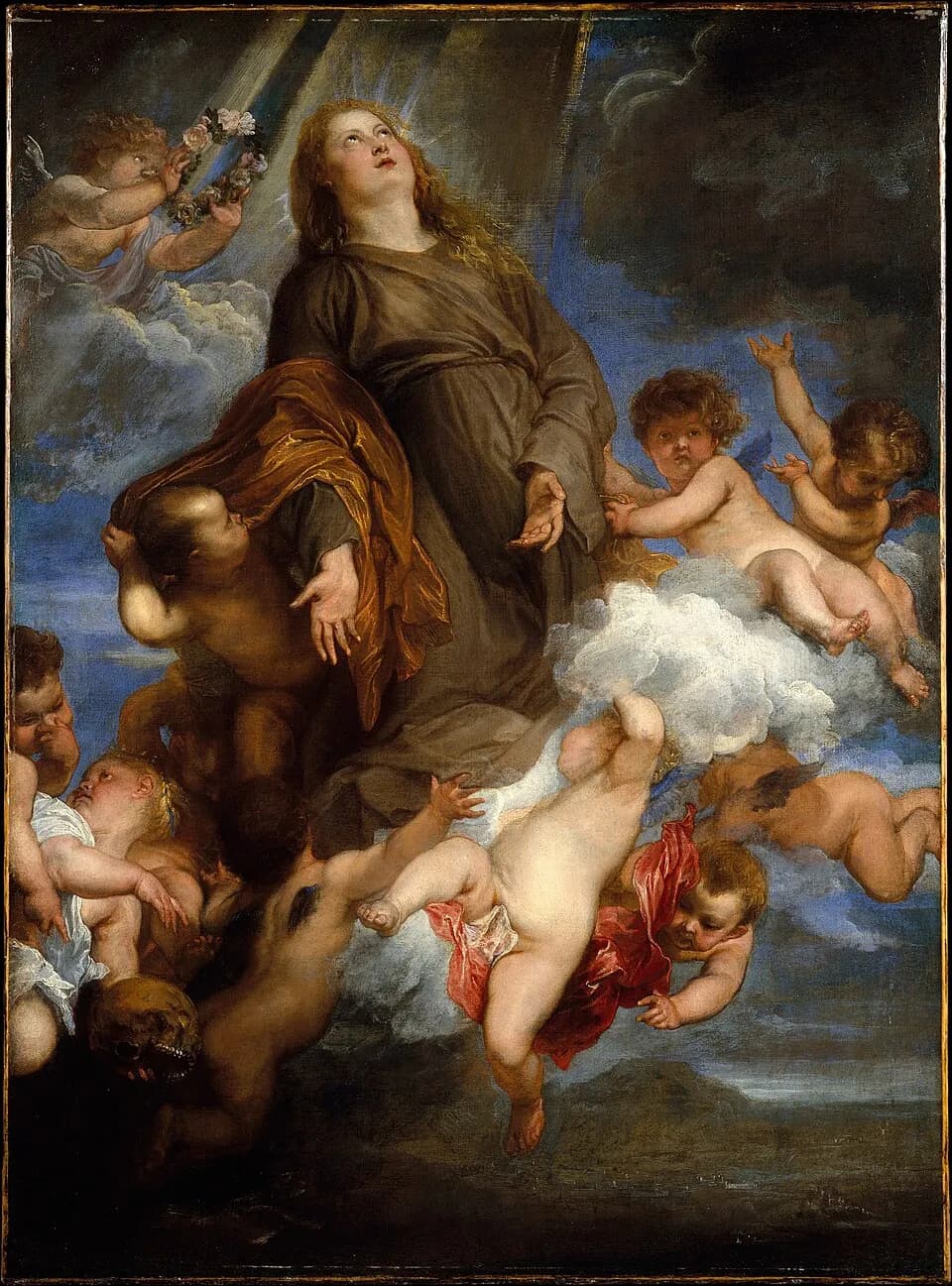
The picture on this page is by Anthony van Dyck, and the Metropolitan Museum of Art, which owns it, dates it to 1624, the year the relics were found. The museum titles it "Saint Rosalie Interceding for the Plague-stricken of Palermo." The wreath of roses and the skull in it are among the emblems Catholic Culture lists for her. 2
Palermo and the Santuzza
The city celebrates two feasts in her honor each year, and one of them, according to Englebert, was raised to a holy day of obligation by Pius XI in 1927. 2 It marks the recovery of her body. Her shrine rides on an enormous carriage full of musicians, level with the rooftops and drawn by forty mules, with cannon fire and fireworks, and the celebration lasts five days. 2
Popes have spoken of her in the same terms as the people of Palermo do. Benedict XVI, preaching in the city on October 3, 2010, called her the saint "whom you venerate and honour and who, from Mount Pellegrino, watches over your City of which she is the Patroness." 5
In 2024 Pope Francis wrote to the Archbishop of Palermo for the fourth centenary of the finding of her body, which the archdiocese kept as a Rosalian Jubilee Year. He used the city's own name for her, the "Santuzza," and quoted the motto he says she adopted, "Per amore Domini mei." 4 He called her a "woman of prayerful silence" and "a sublime figure of a woman and 'apostle', who did not hesitate to accept the trials of loneliness for love of her Lord." 4
What is Saint Rosalia of Palermo the patron saint of?
Saint Rosalia is the patron saint of Palermo and of Sicily. The encyclopedia says she is venerated "in the whole of Sicily" as its patroness, and Catholic Culture lists Palermo, Sicily and a number of Sicilian towns, among them Bivona, near which the encyclopedia places her first cave, and Santo Stefano Quisquina. 12 Vatican News and Englebert both connect her with deliverance from plague, but neither calls her a patron against it. 23
Saint Rosalia of Palermo's feast day
Saint Rosalia's feast is September 4. The encyclopedia gives that date, and both Catholic Culture and Vatican News list her under it; Catholic Culture places her among the day's commemorations in the Roman Martyrology. 123 The encyclopedia adds that "a special feast of the translation of her relics is kept in Sicily 15 July." 1
Praying with Saint Rosalia
There is very little of Rosalia to hold on to. No letters, no sayings, no witness who knew her. The earliest account comes more than four hundred years after the dates given for her death, and the encyclopedia does not pretend otherwise. 12 What the tradition keeps is a single choice: a girl from a great house went up a mountain to be alone with God and stayed there until she died. 12
Pope Francis read that choice through her motto. "Per amore Domini mei," he wrote, is what she adopted "by handing over her own existence and abandoning the wealth of the world." 4 He did not make her solitude sound easy. He spoke of "the trials of loneliness," and of a Christian life "constantly marked by the cross." 4
The other half of her story belongs to the city. A hermit whom nobody had seen for centuries became, after 1624, the saint Palermo turned to in a plague, and the city has not let go of her since. 123 Francis told the people of Palermo to ask her "to dispel fears and overcome the resignations that suffocate the roots of goodness." 4
Saint Rosalia of Palermo, pray for us.
Sources
- 1.Francis Mershman, "St. Rosalia," The Catholic Encyclopedia, vol. 13 (New York: Robert Appleton Company, 1912).
- 2."St. Rosalia, Virgin," Liturgical Year, September 4, Catholic Culture; with an excerpt from Omer Englebert, Lives of the Saints.
- 3."St. Rosalia, Virgin of Palermo," Saint of the Day, 4 September, Vatican News.
- 4.Pope Francis, Message on the occasion of the IV Centenary of the discovery of the relics of Saint Rosalia, June 29, 2024.
- 5.Pope Benedict XVI, Homily at the Eucharistic Celebration, Foro Italico, Palermo, October 3, 2010.
Saints to turn to next
Others in this collection who are turned to for some of the same things.
- Saint Maximilian KolbeJanuary 8, 1894 - August 14, 1941Suffering and illnessPrayerProtection
- Saint Aelred of Rievaulx1109 - January 12, 1166 (or 1167)PrayerSuffering and illness
- Saint Agathac. 230 - c. 251Suffering and illnessProtection
- Saint Alphonsus Rodriguez1532 or 1533 - October 1617PrayerSuffering and illness