Saint Catherine de' Ricci
April 23, 1522 - February 2, 1590
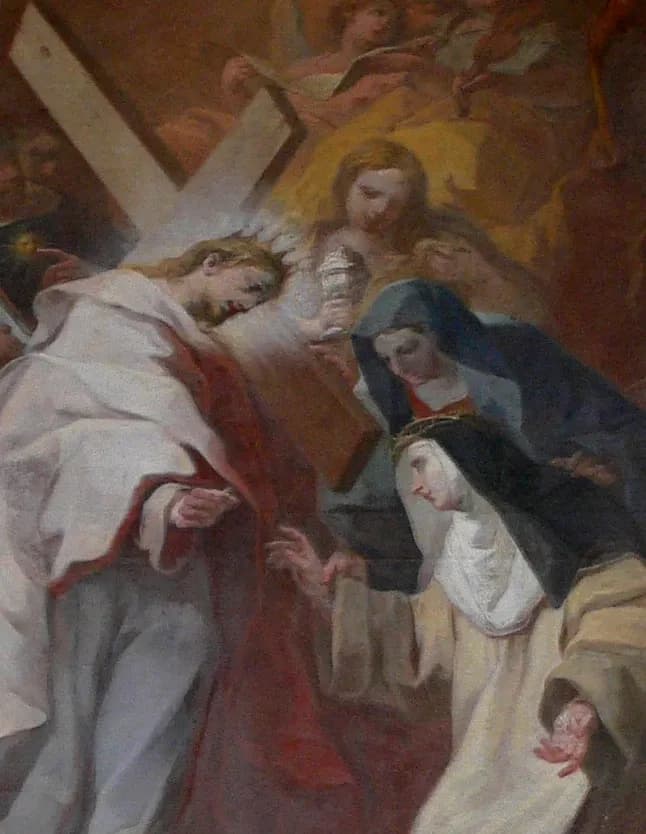
- Born
- Alessandra Lucrezia Romola de' Ricci, April 23, 1522, in Florence 1
- Entered
- The Dominican convent of San Vincenzio at Prato; clothed in 1535, professed in 1536 1
- Canonized
- 1746, by Pope Benedict XIV; beatified by Clement XII in 1732 1
- Patron of
- As Catholic Culture lists it: against illness; sick people; pipe makers; tobacconists; Prato, Italy 3
Saint Catherine de' Ricci was a Dominican nun of Prato, near Florence, who for years passed every week from Thursday noon to Friday afternoon in an ecstasy in which she lived through the Passion of Christ. 1 She was also, for thirty-six years, the prioress of her convent, and is remembered as a capable and kindly one. 23 She died on February 2, 1590, and her order keeps her feast on February 4. 12
Alessandra of Florence
She was born in Florence on April 23, 1522, and baptized Alessandra Lucrezia Romola. 1 Her father, Pier Francesco de' Ricci, belonged to what the 1908 Catholic Encyclopedia calls "an old and respected family of bankers and merchants." Her mother, of the Ricasoli family, died when she was small, and she was raised by a stepmother, Fiammetta da Diacceto, who noticed the child's bent toward solitary prayer and did what she could to encourage it. 1
While still a child Alessandra decided to join a strictly observant religious house, and had trouble finding one. The encyclopedia says that "the state of relaxation just then was so universal that it was long before she could find what she desired." 1 She found it during a stay at Prato, in the Dominican convent of San Vincenzio, which had been founded in 1503 by nine women who were devoted followers of Savonarola. 1
After some difficulties with her father she entered. She was clothed in the habit in 1535, taking the name Catherine, and made her profession in 1536. 1 The Dominican Supplement says she was twelve when she entered; Catholic Culture and the Dominican Friars of the Province of Saint Joseph say thirteen. 234 The sources also describe her status differently. The encyclopedia calls her "a Dominican nun, of the Third Order, though enclosed," and the Dominican Friars speak of "the Second Order Dominicans at the monastery of St. Vincent." 14
Misunderstood, then trusted
The first years were hard. During her novitiate and for four or five years after her profession, the encyclopedia says, "she was subjected to humiliating trials from the community, owing to their misunderstanding of some of the high supernatural favours she received; but her holiness and humility eventually triumphed." 1
She was then appointed to one office after another. 1 Catholic Culture's account has her rise to novice mistress, then subprioress, and at thirty to prioress in perpetuity. 3 The encyclopedia says she remained prioress or subprioress until her death, and the Dominican sources count thirty-six years as prioress. 124
The ecstasy of the Passion
What made her known outside Prato began in February 1542. 1 Every week, from Thursday at noon until four o'clock on Friday afternoon, she was rapt in an ecstasy in which, in the encyclopedia's words, "she went through all the stages of Our Lord's Passion." 1 The life Catholic Culture excerpts counts the hours, twenty-eight of them, and says her body followed the movements of Christ in his agony and that she spoke exhortations to those around her, coming to herself only briefly to receive Communion. 3 The encyclopedia calls the ecstasy "marvellous, but fully and most carefully authenticated." 1
The sources differ on how long this went on. The encyclopedia says it was renewed every week for twelve years, and the Dominican Friars also say twelve. 14 The short life in the Dominican Supplement says that "at the age of twenty" she "began to experience the sacred stigmata and weekly ecstasies of the Passion," and that "These phenomena continued for twenty years." 2
It ended, by the encyclopedia's account, because she and her sisters asked for it to end. So many people "of every rank and calling" were coming to Prato that "the peace and strict observance of the convent were suffering," and the ecstasy "ceased in answer to the prayers of Catherine herself and the community." 1
Two other things are reported of her. She bore the stigmata, according to the Dominican sources and Catholic Culture. 234 And Catholic Culture says that her canonization process gave detailed attention to reports of a ring given her by Christ, with depositions that her finger at times "showed the marks of a mysterious ring made of gold set with a diamond." 3
Prioress, correspondent, reformer
None of this kept her from running a convent. The Dominican Supplement says she "was noted as a kind and considerate superior, particularly gentle with the sick." 2 Catholic Culture's account calls her "an energetic and efficient administrator, a person of sound mental and physical health, and happy in all her activities." 3
She kept up with her family and with a wide circle outside the cloister. The encyclopedia describes her "feeling and showing keen interest in all her relations — especially her brothers — and in numerous friends" whom it calls her "spiritual children." 1 Many of her letters survive. 1 The Dominican Friars single out those "to Pope Pius V and other leaders" as evidence of "her courageous work for church reformation," and the Supplement says that, "Inspired by Girolamo Savonarola she worked constantly to promote the regular life." 24 Catholic Culture says three future popes were among the thousands who came to ask her prayers. 3
She lived, as the encyclopedia remarks, "in an age of great saints," among them Charles Borromeo, Philip Neri and Mary Magdalen de' Pazzi. With the last two "she is said to have held in different ways, miraculous intercourse, never having met them in a natural way." 1 Catholic Culture reports the story that she conversed with Philip Neri in Rome without leaving Prato, and says five witnesses swore to her appearing in more than one place at once. 3 The encyclopedia's "is said" is the right note for all of it.
The Dominicans still sing something of hers. The Irish Dominicans describe her Canticle of the Passion as "a sung collection of biblical verses to do with the suffering of Our Lord," and the Dominican Friars say her devotion is found in it. 45
Death and canonization
She died on February 2, 1590, according to the encyclopedia and the Dominican sources. 12 The life excerpted by Catholic Culture says February 2, 1589, after a long illness, at sixty-seven, though Catholic Culture's own summary gives her years as 1522 to 1590. 3
Clement XII beatified her in 1732 "after many delays in the process," and Benedict XIV canonized her in 1746, the encyclopedia says; the life in Catholic Culture says 1747. 13 Her body remained at Prato, in the convent of San Vincenzio, which came to be called Santa Caterina, and Catholic Culture describes it as incorrupt and kept in the basilica there. 13 The Dominican Friars count her as one of five Dominican women who have been canonized. 4
What is Saint Catherine de' Ricci the patron saint of?
Catholic Culture lists her patronage as "against illness; sick people; pipe makers; tobacconists; Prato, Italy." 3 It does not say where the list comes from, and none of the Dominican sources consulted for this page names a patronage, though the Dominican Supplement does remember her as "particularly gentle with the sick." 23
Saint Catherine de' Ricci's feast day
The Dominican Order keeps her feast on February 4, as both the Dominican nuns and the Irish Dominicans print it. 25 She died on February 2, and Catholic Culture notes that the Roman Martyrology commemorates her on that day, which is also the feast of the Presentation of the Lord. 3 The 1908 encyclopedia gives a third date: "Her feast is kept on the 13th of February." 1
Praying with Saint Catherine de' Ricci
The Irish Dominicans place her in a line. Dominic prayed for hours with his eyes on the crucifix, and Catherine of Siena wrote of Christ's suffering as an act of love that invites love in return; Catherine de' Ricci, they write, "was following her Dominican forebears in her great devotion to the Passion of Christ." 5 What was unusual in her was the form it took. 1
She seems to have treated the ecstasies as something to be borne. Her own community distrusted them for years, and she put up with that. 1 When they drew crowds that disturbed the house, she prayed with her sisters for them to stop, and they stopped. 1 The convent's quiet and its rule mattered more to her than the thing she was famous for.
For most of her life she was a superior with a convent to run, the sick to look after, and brothers and friends to keep up with. 12 The sources that report the visions report this too, and with as much respect: kind, considerate, efficient, happy. 23
Saint Catherine de' Ricci, pray for us.
Sources
- 1.Florence Capes, "St. Catherine de' Ricci," The Catholic Encyclopedia, vol. 3 (New York: Robert Appleton Company, 1908).
- 2.Mary Shaffer, "St. Catherine de' Ricci," Dominican Nuns of the Monastery of Our Lady of Grace, February 4, 2023; with the life from the Dominican Supplement to the Liturgy of the Hours.
- 3."St. Catherine de Ricci," Liturgical Year, February 2, Catholic Culture; with a life excerpted from The Encyclopedia of Catholic Saints and Rosalie Marie Levy, Heavenly Friends: A Saint for Each Day.
- 4."St. Catherine de Ricci," Dominican Friars, Province of Saint Joseph.
- 5."Saint Catherine de' Ricci OP," Dominican Friars Ireland, February 4, 2011.
Saints to turn to next
Others in this collection who are turned to for some of the same things.
- Saint Catherine of Genoa1447 - September 15, 1510Suffering and illnessPrayer
- Saint Charles of Mount ArgusDecember 11, 1821 - January 5, 1893Suffering and illnessPrayer
- Saint FiacreLate sixth century - August 18, c. 670Suffering and illnessPrayer
- Saint Joachima de Vedruna1783 - 1854Suffering and illnessPrayer