Saint Charles of Mount Argus
December 11, 1821 - January 5, 1893
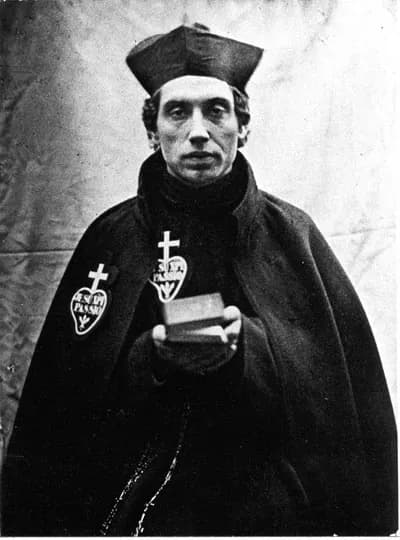
- Born
- John Andrew (Johannes Andreas) Houben, at Munstergeleen in the Netherlands, December 11, 1821, the fourth of eleven children 25
- Ministry
- England from 1852; Mount Argus, Dublin, from 1856 or 1857, with eight years back in England from 1866 235
- Patron of
- The sick, healing ministries and the people of Ireland 4
- Tomb
- Inside the church at Mount Argus, where his remains were moved in 1949 5
Saint Charles of Mount Argus was a Dutch Passionist priest who could never preach well in English and spent most of his life hearing confessions and blessing the sick in a Dublin monastery, where, by Mount Argus parish's count, as many as 300 people a day came to him. 25 The Holy See's biography says the Irish loved him so much that they called this native of Holland "Father Charles of Mount Argus." 2 When he died in 1893 his superior wrote, "The people have already declared him a saint." 12 Benedict XVI canonized him in 2007. 1
A boy from Limburg
He was born John Andrew Houben on December 11, 1821, at Munstergeleen, in the Dutch diocese of Roermond, the fourth of eleven children, and was baptized the same day. 25 He went to school in Sittard and Broeksittard. 2 Archbishop Diarmuid Martin of Dublin, preaching the day after the canonization, was frank about how little those years promised: "He was a happy child raised in a large family; he was an undistinguished student and something of a failure as a soldier." 7
The army interrupted his studies. The Holy See biography puts his entry in 1840; Mount Argus parish says he was enrolled for military service in 1841. 25 It was while he was a soldier that he first heard of the Passionists and was drawn to their way of life. 257
Leaving home was not simple. Martin says the deaths of an uncle, who employed the family, and of his mother made his father reluctant to let him go. 7 He was received into the congregation by Blessed Dominic Barberi and entered the novitiate at Ere, near Tournai in Belgium, on November 5, 1845, taking the name Charles of St. Andrew. 2 The Passionist General Curia dates his first profession to December 10, 1846; the Holy See biography gives December 10, 1850. 23 He was ordained a priest on December 21, 1850, at Tournai. 35 His father had died shortly before, and Martin records that the family's money troubles meant none of them could be there. 7
England, then Dublin
In 1852 he was sent to the Passionists' new English foundation, shortly after Dominic Barberi's death. 3 The Holy See biography says he served as vice-master of novices at Broadway and did parish work at St. Wilfrid's and the surrounding area. 2 Mount Argus parish notes that it was in England that he first met the Irish who were emigrating in the wake of the Famine. 5
He was then moved to the newly founded monastery of Mount Argus, on the edge of Dublin: in 1856, by the Holy See's account, or on July 9, 1857, by the parish's. 25 He lived there for almost all the rest of his life. 2
The Dublin he came to was, in Martin's phrase, "no Garden of Eden." 7 He wrote to his brother of the thousands in and around the city "who neither go to confession nor make their Easter communion." 7
Confessor and blesser of the sick
He never mastered English well enough to preach. The Holy See biography says plainly that because of this "he was never a formal preacher and he never preached missions," and Mount Argus parish calls him "not a good preacher." 25 What he did instead was hear confessions and give spiritual direction. 2 The Passionist General Curia says he "was noted more for his apostolate of blessing and hearing confessions than for his preaching." 3
The crowds came for his blessing. The parish says as many as 300 people a day came to be blessed, and that his gift of healing is what is most clearly remembered. 5 The Holy See biography speaks of "numerous testimonies" to cures through his prayer, so that "even during his lifetime he was known as a miracle worker," with a fame that reached Britain, America and Australia. 2 Benedict XVI said the people "flocked to him to seek out his wise counsel, his compassionate care and his healing touch," and that "in the sick and the suffering he recognized the face of the Crucified Christ, to whom he had a lifelong devotion." 1
Archbishop Martin added one more thing that tends to be left out. Part of the explanation, he said, lay in "his fundraising activities": people asked to give to the Passionists' mission "must obviously have had reason to trust this priest." 7
Eight years away
In 1866 he was moved back to England, where he stayed eight years. 5 The sources give different reasons. The Holy See biography says it was his very fame, and the wish "to afford him some rest," and that in Broadway, Sutton and London he was soon sought out again by Catholics and non-Catholics alike. 2 Martin is blunter: "In his own lifetime, there were those who questioned his authenticity and those who mistrusted his management skills had him distanced from 'his people' for a number of years." 7
He came back to Dublin in 1874 and stayed for the rest of his life. 25 The daily line of sick and troubled visitors started again almost at once. 5
Death, and a crowd
His last years were hard. The parish says his family in Holland were dying and old injuries came back to trouble him, and Martin says the surviving photographs "reveal a very frail and unimposing figure." 57 He said his last Mass on the feast of the Immaculate Conception in 1892 and died at 5:30 in the morning on January 5, 1893. 25
Martin says the funeral drew more people than Parnell's two years before, and that for five days, through snowstorms, thousands filed past the coffin. 7 The Holy See biography quotes a newspaper of the time: "Never before has the memory of any man sparked an explosion of religious sentiment and profound veneration as that which we observed in the presence of the mortal remains of Father Charles." 2 He was buried in the cemetery beside the monastery, the grave quickly became a place of pilgrimage, and in 1949 his remains were moved to a tomb inside the church. 5
His cause was opened on November 13, 1935, and John Paul II beatified him on October 16, 1988. 2 The miracle accepted for his canonization was the cure of Adolf Dormans of Munstergeleen, his own birthplace, from what the Holy See describes as "perforated, gangrenous appendicitis with generalized peritonitis," judged by the medical board to be "not scientifically explainable." 2 Benedict XVI canonized him in St. Peter's Square on June 3, 2007, with George Preca, Simon of Lipnica and Marie Eugénie Milleret. 1
What is Saint Charles of Mount Argus the patron saint of?
The Passionists of Holy Cross Province list his patronage as "the sick, healing ministries and the people of Ireland." 4 Mount Argus parish, without using the word patron, says that "Ireland now has a Saint for the poor, for the sick, for immigrants and for emigrants, a Saint for everyone." 5 His parish still offers a blessing with his relic every day, a monthly healing Mass and an annual Mass for the sick with anointing. 6
Saint Charles of Mount Argus's feast day
Saint Charles of Mount Argus's feast day is January 5, the day he died in 1893. Mount Argus parish, which keeps his tomb, says "The Feast of Saint Charles of Mount Argus is celebrated on January 5," and the Holy Cross Province of the Passionists gives the same date. 456 None of the sources here says how widely the feast is kept beyond the Passionists and his own church in Dublin, and this page does not guess.
Praying with Saint Charles of Mount Argus
By the measures a religious order might have used, he had little to offer. He was a poor student, an unremarkable soldier, and a priest who never learned to preach in the language of the people he served. 27 What he could do was sit in a confessional and lay his hands on the sick, and the sources agree that for decades the people of Dublin came to him for exactly that. 125
His life also had its share of distrust. Martin says some questioned whether he was genuine and that he was moved away from the people who sought him out; the Holy See puts the move down to his need for rest. 27 Either way, he went to England for eight years and went on doing the same work there, and then came back and did it in Dublin until he died. 25
Benedict XVI chose a line of Saint Paul for him: "The love of God has been poured into our hearts by the Holy Spirit," and said that in this Passionist "that love overflowed in a life totally dedicated to the care of souls." 1 The General Curia's prayer to him speaks of him bringing "healing to those who were wounded by sin and suffering." 3
Archbishop Martin thought the crowds came "because they saw in him a friend of God," and quoted a witness from the cause who said that talking to him gave "the impression that you were talking to someone who was an intimate friend of God." 7 Martin traced that to "his own life of prayer, so obviously and unaffectedly witnessed to in his letters." 7
Saint Charles of Mount Argus, pray for us.
Sources
- 1.Benedict XVI, Homily for the Canonization of George Preca, Simon of Lipnica, Charles of St Andrew Houben and Marie Eugenie of Jesus Milleret, St Peter's Square, June 3, 2007.
- 2."Fr. Charles of St. Andrew (1821-1893) - Biography," Office for the Liturgical Celebrations of the Supreme Pontiff, The Holy See, 2007.
- 3."Saint Charles Houben," Curia Generalizia dei Passionisti (Passionist General Curia), Rome.
- 4."St. Charles Houben," Passionist Saints & Blesseds, The Passionists of Holy Cross Province.
- 5."Saint Charles of Mount Argus," Mount Argus Parish, Dublin.
- 6."Devotions to Saint Charles of Mount Argus," Mount Argus Parish, Dublin.
- 7.Archbishop Diarmuid Martin, homily at the Mass of Thanksgiving for the Canonization of Saint Charles of Mount Argus, Basilica of Saints John and Paul, Rome, June 4, 2007, Irish Catholic Bishops' Conference.
Saints to turn to next
Others in this collection who are turned to for some of the same things.
- Saint Catherine de' RicciApril 23, 1522 - February 2, 1590PrayerSuffering and illness
- Saint Catherine of Genoa1447 - September 15, 1510Suffering and illnessPrayer
- Saint FiacreLate sixth century - August 18, c. 670Suffering and illnessPrayer
- Saint Joachima de Vedruna1783 - 1854Suffering and illnessPrayer