Saint Leo III
d. 816
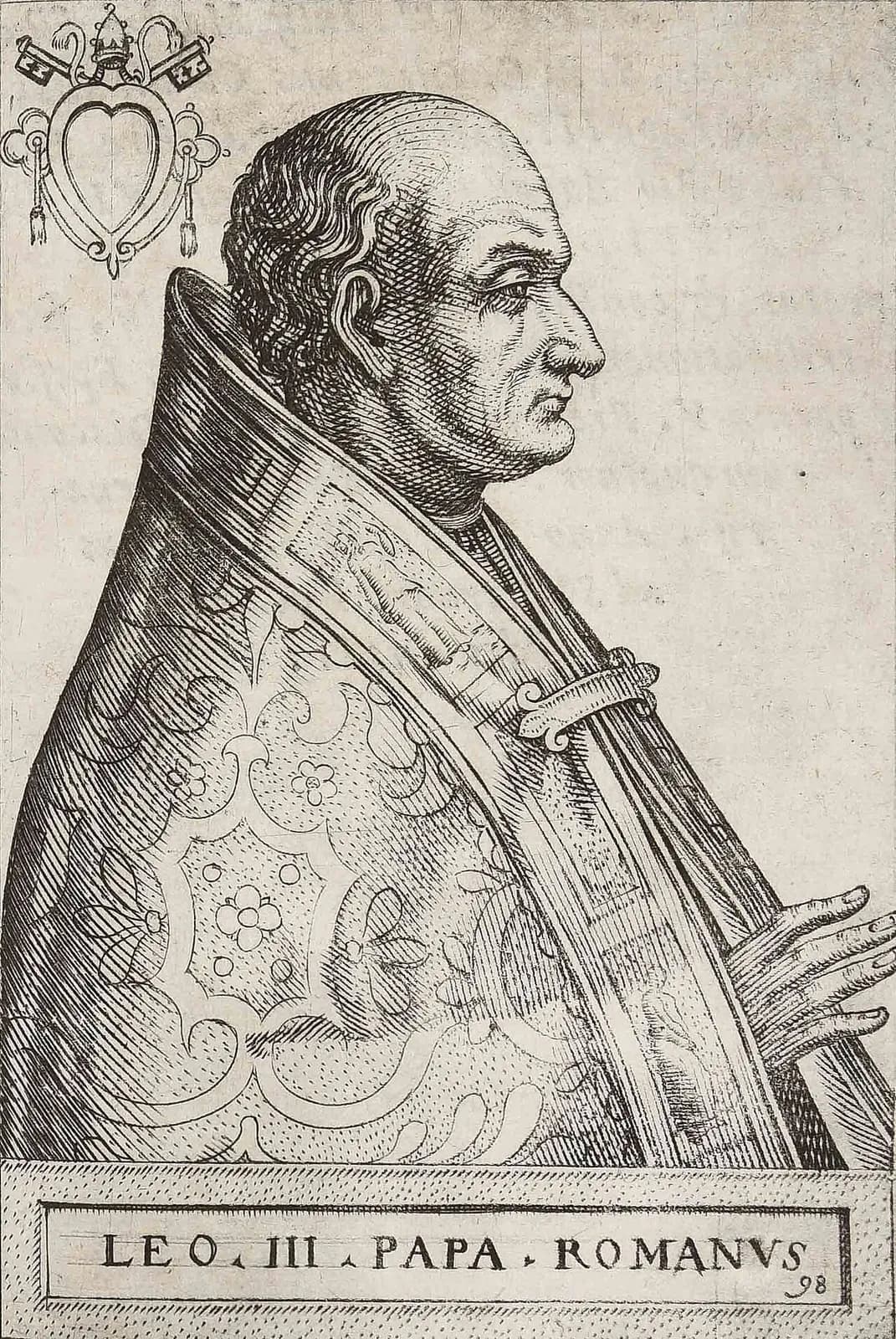
- Pope
- Elected December 26, 795; consecrated the next day 1
- Born
- In Rome, to Atyuppius and Elizabeth; the date is unknown 1
- Before his election
- Cardinal-priest of St. Susanna, and seemingly chief of the papal treasury 1
- Died
- 816; buried in St. Peter's on June 12, 816 1
- Canonized
- 1673, according to the Catholic Encyclopedia 1
Saint Leo III was the pope who placed a crown on Charlemagne's head in St. Peter's on Christmas Day in the year 800 and so revived an empire in the West. 1 A year and a half earlier a gang of armed men had thrown him to the ground in a Roman street and tried to cut out his tongue and his eyes. 1 He survived that, cleared himself of the charges his enemies brought, and governed the Church for twenty years, and the Roman Martyrology remembers him on June 12 as the pope who crowned Charlemagne and defended the true faith in the divinity of the Son of God. 12
A Roman elected in a hurry
Leo was a Roman, the son of Atyuppius and Elizabeth, and the date of his birth is unknown. 1 At the time of his election he was cardinal-priest of the church of St. Susanna and seems also to have been the vestiarius, the official in charge of the papal treasury and wardrobe. 1 He was elected on the very day his predecessor, Adrian I, was buried, December 26, 795, and consecrated the next morning. 1 Horace Mann, who wrote his entry in the Catholic Encyclopedia, suspects the Romans moved quickly so that the Franks would have no chance to interfere. 1
If so, the new pope did not hold the Franks at arm's length for long. With the letter announcing his unanimous election he sent Charlemagne, king of the Franks, the keys of the confession of St. Peter and the standard of the city of Rome, a sign that he looked on the king as protector of the Holy See. 1 Charlemagne answered with congratulations and a large share of the treasure he had taken from the Avars, and Mann says that money is a large part of why Leo could be so generous to the churches and charitable houses of Rome. 1
The attack of 799
Not everyone in Rome wanted him. A group of Adrian I's relatives, moved, Mann writes, by "jealousy or ambition, or by feelings of hatred and revenge," set out to make Leo unfit to hold office. 1 On April 25, 799, during the procession of the Greater Litanies, armed men fell on him as he made his way toward the Flaminian Gate. He was thrown down, and they tried to tear out his tongue and his eyes. 1 They left him bleeding in the street for a time, then carried him off at night to the monastery of St. Erasmus on the Caelian Hill. 1
There, Mann says, "in what seemed quite a miraculous manner," Leo recovered the full use of his eyes and his tongue. 1 He escaped from the monastery and went north with a number of Romans to find Charlemagne, who received him at Paderborn with great honor, although the pope's enemies had already filled the king's ears with accusations. 1 In 1996 John Paul II, after a visit to Paderborn, recalled that historic meeting of 799, at which, he said, the pope and the Frankish king sealed a pact of cooperation that would shape the course of Europe for centuries. 5
After a few months Charlemagne had him escorted back to Rome, where the whole city turned out to welcome him. 1 The conspirators were tried by the king's envoys and, unable to prove either Leo's guilt or their own innocence, were sent as prisoners to the land of the Franks. 1
An oath and a crown
In 800 Charlemagne came to Rome himself, and the pope and his accusers were brought face to face. 1 The assembled bishops said they had no right to judge the pope. Leo then chose, of his own accord, to swear an oath that he was wholly innocent of the charges, in order, he said, to clear away any suspicion in people's minds. 1 At his own request, the death sentence passed on the leading conspirators was changed to exile. 1
A few days later, on Christmas Day, the two men met again in St. Peter's. After the Gospel had been sung, Leo went up to Charlemagne, who was kneeling before the confession of St. Peter, and set a crown on his head. 1 The crowd in the basilica shouted: "To Charles, the most pious Augustus, crowned by God, to our great and pacific emperor life and victory!" 1 With that, Mann writes, the empire in the West was revived, and its emperor's first duty was understood to be the protection of the Roman Church and of Christendom. 1 The Roman Martyrology, summing up Leo's life in a single sentence, puts this first: he conferred on Charlemagne the crown of the Roman Empire. 2
Leo hoped to go further and unite East and West under Charlemagne by a marriage between the emperor and the Byzantine empress Irene, but she was deposed in 801 and the plan came to nothing. 1 In 804 he crossed the Alps again to see the emperor, and two years later he was asked to approve Charlemagne's arrangements for dividing his lands among his sons. 1
The Creed and the Filioque
Pope and emperor did not agree on everything. They acted together against Adoptionism, a heresy that had arisen in Spain, but Charlemagne, Mann says, "went somewhat further than his spiritual guide" in wanting the word Filioque, "and the Son," inserted everywhere into the Nicene Creed. 1 The encyclopedia's article on the Filioque tells what happened when the decrees of the Council of Aachen of 809 came to Rome. Leo approved the doctrine the word expresses, that the Holy Spirit proceeds from the Father and the Son, but advised that the word be left out of the Creed. 4 His advice was not followed, and by the middle of the eleventh century the addition had a firm footing in Rome itself. 4 The Martyrology's summary of his life ends on this note, saying he did everything he could to defend the right faith and the divine dignity of the Son of God. 2
England, Constantinople and Rome
His reach was wide. At his command the synod of Beccanceld, also called Clovesho, in 803 condemned the appointment of laymen as heads of monasteries. 1 At the request of Ethelheard, archbishop of Canterbury, he excommunicated Eadbert Praen for seizing the throne of Kent and restored Canterbury's jurisdiction "just as St. Gregory the Apostle and Master of the nation of the English had arranged it." 1 In the East the monks led by St. Theodore the Studite, who had been imprisoned and exiled for condemning the emperor Constantine VI's second marriage, turned to Leo for help, and he answered with praise, encouragement and rich gifts. 1
At home he kept a fleet to guard the coast against Saracen raiders, on Charlemagne's advice, and handed the defense of Corsica to the emperor. 1 When Charlemagne died on January 28, 814, his enemies tried again. This time Leo learned of the plot before it came to a head, and he had the leaders seized and executed. 1 The man who had begged for his attackers' lives in 800 did not spare these, and Mann reports it without comment. 1
The money Charlemagne sent let Leo help the poor and restore churches in Rome and as far away as Ravenna. 1 He used mosaic to decorate them, above all his old titular church of St. Susanna, where a mosaic portrait of him could still be seen at the end of the sixteenth century. 1
What is Saint Leo III the patron saint of?
Saint Leo III's feast day
Saint Leo III's feast day is June 12. The Roman Martyrology commemorates him on that day, "at Rome, near St. Peter's," and Vatican News lists him among the saints of June 12. 23 It is the date of his burial: Mann records that he was laid to rest in St. Peter's on June 12, 816, where his relics lie with those of three other popes named Leo, the first, the second and the fourth. 1 Mann also says he was canonized in 1673. 1
Praying with Saint Leo III
Leo's life turns on a morning in April when men he knew tried to blind him and silence him in the street. 1 Whatever happened in the monastery afterward, he got up, went to find help, and came back to the city where it had happened. 1
Then, given the chance to see his enemies die, he asked for exile instead. 1 Before that he took an oath nobody could make him take, so that no one would be left wondering. 1 Mercy and a clear conscience were both, in that moment, a choice. The later executions sit beside them in Mann's account, and they belong in the picture too. 1
On the Filioque he held two things together that others wanted pulled apart: what he believed, and the words a whole Church had received. 4 He approved the teaching and left the Creed as it was. 4 The Church's summary of him remembers the defense of the faith in the divinity of the Son as the work of his life. 2
Saint Leo III, pray for us.
Sources
- 1.Horace Mann, "Pope St. Leo III," The Catholic Encyclopedia, Vol. 9 (New York: Robert Appleton Company, 1910).
- 2.Roman Martyrology, entry for June 12, "San Leone III, papa," as printed in "Santo del giorno," Conferenza Episcopale Italiana (in Italian).
- 3."12 June," Saint of the Day, Vatican News.
- 4.Anthony Maas, "Filioque," The Catholic Encyclopedia, Vol. 6 (New York: Robert Appleton Company, 1909).
- 5.John Paul II, General Audience, June 26, 1996, on his apostolic journey to Germany (in Spanish).
Saints to turn to next
Others in this collection who are turned to for some of the same things.