Saint Leo II
Died 683
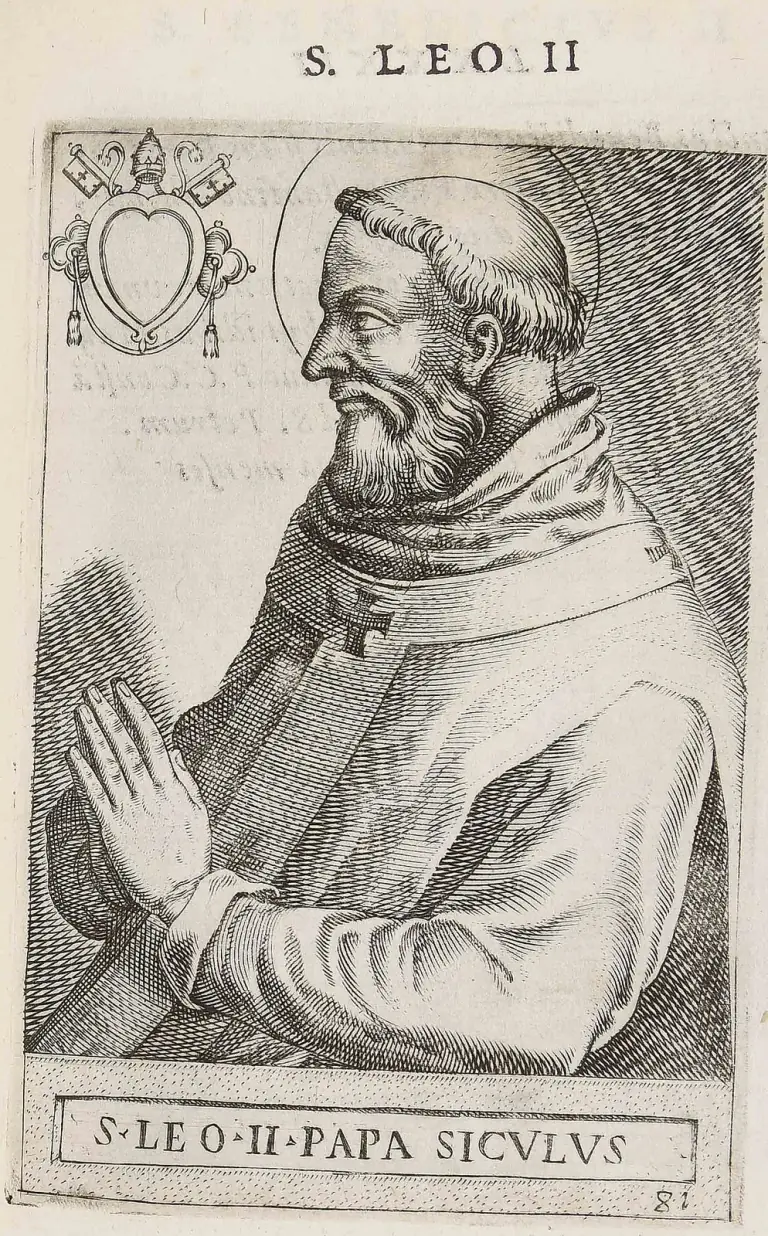
Saint Leo II was a Sicilian, learned in Greek and Latin and a lover of the poor, who was elected pope early in 681 and not consecrated until August 682, because the emperor in Constantinople held back his consent. 136 In his ten months as pope he confirmed the council that had condemned the Monothelite heresy, and with it the condemnation of his predecessor Honorius I. 15 The Roman Martyrology keeps him on July 3. 3
A Sicilian scholar
Leo was a Sicilian, the son of a man named Paul. 16 katolsk.no, the Norwegian bishops' saints database, says he was born at Messina and educated in the papal school in Rome. 2 The Liber Pontificalis, the ancient lives of the popes, gives him one of its warmest portraits. Horace Mann, translating it in his history of the popes, calls him a man of learning and great eloquence, well read in the Scriptures, "well versed in Greek and Latin," skilled in chant and psalmody, and "a lover of poverty and the poor." 6 The Roman Martyrology still remembers him in nearly the same words. 3
Mann notes that the praise for his Greek tells its own story: knowledge of the language was becoming rare in Rome, and earlier popes had complained how hard it was to find anyone to translate Greek documents. 6
A year and a half of waiting
Pope Agatho died on January 10, 681. 12 Leo was elected a few days later, but he was not consecrated until August 17, 682, after a vacancy Mann counts at 584 days. 16 In those centuries a pope-elect could not be consecrated until the emperor confirmed him. 12
The sources explain the delay differently. Mann, in the Catholic Encyclopedia, thinks it was probably the long correspondence between Rome and the Emperor Constantine IV over the tax the popes paid the imperial treasury at every consecration, which the emperor had promised to abolish or reduce. 1 katolsk.no gives a harder reason. A council was then meeting at Constantinople against the Monothelites, who held that Christ had only one will, and the emperor, it says, held back his approval until the council had condemned Pope Honorius I along with the other leaders of that teaching, and until Rome had accepted the sentence. 2 The papal legates did not come home until July 682, bringing with them both the council's decrees and the emperor's consent. 26
Confirming the council
The council, which the Church counts as the sixth ecumenical council and the Martyrology calls the Third Council of Constantinople, had been presided over by Agatho's legates. 13 Leo's most important act as pope was to confirm it. 1 katolsk.no says he had its decrees translated from Greek into Latin and sent them to the Church leaders and rulers of the West. 2 Four of his letters to Spain survive, to the Spanish bishops, to a Bishop Quiricus, to King Ervig and to a Count Simplicius, explaining what the council had done and asking the bishops to subscribe. 16 In 684 a council at Toledo accepted it. 16
Monothelitism had never had much following in the West, katolsk.no observes, and the bishops had little difficulty accepting the decrees. 2 The hard part was Honorius.
Leo II and Pope Honorius
Half a century earlier, Pope Honorius I had answered a letter from the patriarch of Constantinople in words that seemed to allow only one will in Christ. 5 The council anathematized him with the heretics. Leo, confirming it, did the same, and his letter of confirmation, in the Greek that John Chapman quotes in the Catholic Encyclopedia, says Honorius "did not attempt to sanctify this Apostolic Church with the teaching of Apostolic tradition, but by profane treachery permitted its purity to be polluted." 5 katolsk.no notes that the Latin original was harsher, and that the Greek softened it. 2
To the Spanish bishops he put it differently. Honorius was condemned, he wrote, because he "did not, as became the Apostolic authority, extinguish the flame of heretical teaching in its first beginning, but fostered it by his negligence." 56
What Leo meant by this is still argued. Mann, in his encyclopedia article on Leo, says Leo was at pains to make clear that he condemned Honorius "not because he taught heresy, but because he was not active enough in opposing it." 1 Chapman, in the article on Honorius in the same encyclopedia, disagrees: the distinction between the pope's view and the council's "is not justified by close examination of the facts." 5 Chapman adds that the condemnation was read in the Breviary lessons for Leo's feast until the eighteenth century. 5
Peace with Constantinople, and the churches of Rome
The emperor was satisfied. katolsk.no says he invited the pope to keep a permanent envoy at court and lightened the taxes and grain levies on the papal estates in Sicily and Calabria. 2 He also revoked the decree of his father Constans II that had made the archbishops of Ravenna independent of Rome. 12 Leo was generous in return: he abolished the fee the archbishops of Ravenna paid for the pallium, and while he insisted that they come to Rome to be consecrated, he let them go home after eight days and send a delegate each year instead of coming in person. 1
When Macarius, the patriarch of Antioch whom the council had deposed, arrived in Rome with other unrepentant Monothelites, the emperor left their fate to the pope. Two renounced the heresy and were admitted to communion; katolsk.no says Leo sent the rest to various monasteries. 2
In Rome he moved many martyrs' relics from the catacombs into a church he built to receive them, perhaps, Mann suggests, for fear the Lombards would rob the cemeteries again. 1 He dedicated a church to Saint Paul beside Santa Bibiana on February 22, 683, and built near the Velabrum the church of Saints Sebastian and George, today San Giorgio in Velabro, which Mann notes was the titular church of Cardinal Newman. 6 katolsk.no says he loved church music and celebrated the liturgy with great solemnity. 2
What is Saint Leo II the patron saint of?
Saint Leo II's feast day
Saint Leo II's feast day is July 3 in the current Roman Martyrology, which enters him at Saint Peter's on that day: a man versed in Greek and Latin, a lover of poverty and the poor, who received the decisions of the Third Council of Constantinople. 3 Vatican News lists him on July 3 and says he is buried beneath Saint Peter's. 4
The older date was June 28. Mann's 1910 article says he died on June 28, 683, and is commemorated in the Roman Martyrology on that day. 1 katolsk.no gives his death as July 3, 683, and says the older feast of June 28 has given way to July 3. 2 Mann's 1902 history explains the two dates differently: Leo was buried in Saint Peter's on July 3, 683, and June 28 is the day in 688 when his body was moved into the basilica proper. 6
Praying with Saint Leo II
Leo spent longer waiting to be pope than he spent as pope. 12 The work that fell to him in those ten months was to put his name to a judgment on a predecessor, and to explain it to the West in a way that was honest about what Honorius had done and had failed to do. 15
He did not soften it into nothing. Honorius, he wrote, had let the flame of a heresy grow when he should have put it out. 5 It is a hard thing for a pope to say of another pope, and Leo said it in letters that survive. 56
His biographer remembered something else as well: that he loved poverty and the poor, and that he was a man of chant and psalmody. 6 He also brought the martyrs in from the cemeteries and built small churches for them, one of which still stands. 16
Saint Leo II, pray for us.
Sources
- 1.Horace Mann, "Pope St. Leo II," The Catholic Encyclopedia, vol. 9 (New York: Robert Appleton Company, 1910).
- 2."Den hellige pave Leo II," compiled by Per Einar Odden, Helgener, salige og andre, katolsk.no, the Catholic Church in Norway (in Norwegian).
- 3.Roman Martyrology, entry for July 3, "San Leone II, papa," Santo del giorno, Conferenza Episcopale Italiana (in Italian).
- 4."St. Leo II, Pope," Saints of the day, July 3, Vatican News.
- 5.John Chapman, "Pope Honorius I," The Catholic Encyclopedia, vol. 7 (New York: Robert Appleton Company, 1910).
- 6.Horace K. Mann, The Lives of the Popes in the Early Middle Ages, vol. 1, part 2 (London: Kegan Paul, Trench, Trübner, 1902), "St. Leo II," as digitized on the Internet Archive.
Saints to turn to next
Others in this collection who are turned to for some of the same things.
- Saint Alexander Sauli1533 or 1534 - October 11, 1592Poverty and simplicityStudy and teaching
- Saint Antoninus of FlorenceMarch 1, 1389 - May 2, 1459Poverty and simplicityStudy and teaching
- Saint Brigid of Kildare451 or 452 - February 1, 525Study and teachingPoverty and simplicity
- Saint Caesarius of Arlesc. 470 - August 27, 542 or 543Study and teachingPoverty and simplicity