Saint Leander of Seville
c. 534 - c. 600
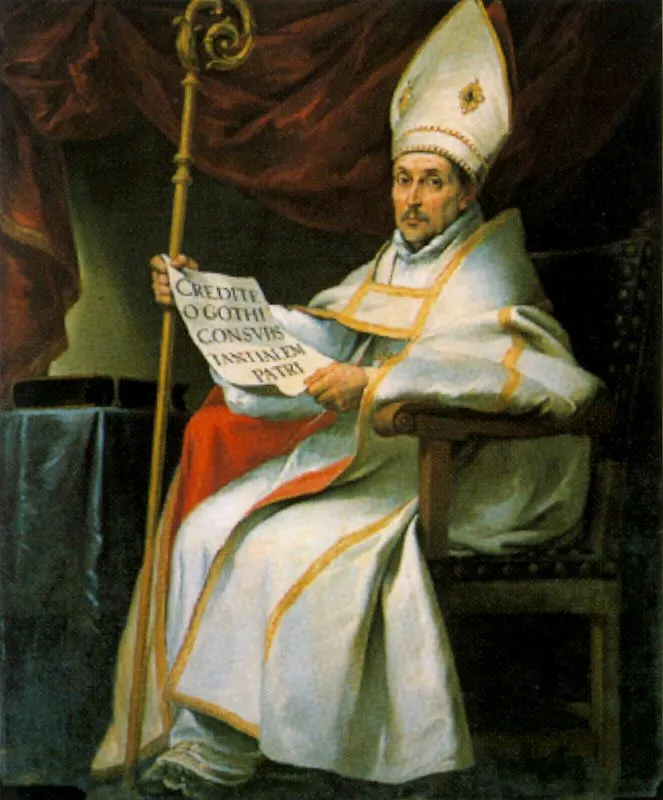
- Born
- About 534, at Carthage by the encyclopedia's text, at Cartagena in Spain by Butler and Seville 167
- Family
- Brother of Saints Isidore, Fulgentius and Florentina 1
Saint Leander of Seville was the bishop who did most to bring the Visigothic kingdom of Spain from Arianism to the Catholic faith, and he preached the closing sermon at the Third Council of Toledo, where the change was made public. 1 He raised and taught his younger brother Isidore, and he was the close friend of Pope Gregory the Great, who wrote his commentary on Job for him. 23 The Roman Martyrology keeps him on March 13. 6
A family of saints
Leander was born about 534 into a Roman family. 1 The Catholic Encyclopedia prints his birthplace as Carthage; Butler's Lives and the Archdiocese of Seville both say Cartagena, on the Spanish coast, and the encyclopedia's own article has his brother Fulgentius as bishop of "Carthagena." 167 Some historians made his father, Severian, duke or governor of the city, but the encyclopedia notes that Isidore "simply states that he was a citizen." 1 The family left about 554 and settled in Seville; the archdiocese ties the move to the arrival of the Byzantines on that coast. 17
Four of the children are honored as saints. Leander and Isidore both became bishops of Seville, Fulgentius was a bishop too, and their sister Florentina became a nun who, the encyclopedia says, directed forty convents and a thousand nuns. 1 Butler counts differently and calls Leander "the eldest of five brothers." 6
Benedict XVI, speaking about Isidore in 2008, began with the older brother. Isidore "owed much to Leander, an exacting, studious and austere person," who surrounded him with the discipline of a monk and the pace of serious study. 2 Their home had "a library richly endowed with classical, pagan and Christian works," and Isidore learned to read both kinds under Leander's eye. 2 The Archdiocese of Seville adds that their father had died and that Leander took charge of the boy's education. 7
Monk, bishop and exile
Leander was a monk first, a Benedictine by the encyclopedia's account, and then bishop of Seville, in 579 according to the encyclopedia and 578 according to the archdiocese. 17 He founded a school in the city that the encyclopedia calls "a centre of learning and orthodoxy," and Seville remembers him as the founder of its theological school, concerned with teaching, with writing and with the training of clergy. 17
The kings of Spain at the time were Visigoths and Arians. Butler says the heresy had held the country for a hundred years when Leander became bishop, and calls it "his great affliction." 6 The break came inside the royal family. Leander helped the Frankish princess Ingunthis bring her husband Hermenegild, the eldest son of King Leovigild, into the Catholic Church, and he stood by the prince when his father turned on him. 1
It cost him his see for a time, though the sources tell it two ways. The encyclopedia says Leovigild exiled him and that he withdrew to Byzantium from 579 to 582, possibly to seek the emperor's help against the Arian king, which it calls "possible, but not proved." 1 The Archdiocese of Seville says it was Hermenegild who sent him to Constantinople, for three years, and that the king's persecution and some years of exile came after he returned. 7 Either way he used the time. He wrote against Arianism, and he met the papal legate at the imperial court, a Roman named Gregory, then the legate of Pope Pelagius II. 1
Leovigild put Hermenegild to death in 585. 1 Butler adds a story the encyclopedia does not tell: that the king, sick and remorseful, recalled the bishop and commended his other son, Reccared, to him. 6 The encyclopedia says only that it is not known exactly when Leander came home. 1
The Third Council of Toledo
Reccared succeeded his father and became a Catholic. The encyclopedia says Leander "had a share" in that conversion and never stopped exercising "a deep and beneficial influence" on the king. 1 In 589 the Third Council of Toledo met, and there Reccared, the bishops and the nobles renounced Arianism and professed the faith of Nicaea. 5 Leander delivered the closing sermon, which survives as a homily on the triumph of the Church at the conversion of the Goths. 1 The calendar note at CatholicCulture.org goes further and has him presiding over the council, and credits him with introducing the Nicene Creed into the Mass. 6
Back in Seville he called a synod of his own province and went on consolidating what the council had done. 1 Isidore, who succeeded him and carried the work on, wrote of his brother that "by his faith and zeal the Gothic people have been converted from Arianism to the Catholic faith." 1
Little of his writing is left. The encyclopedia, which rates him "superior to his brother Isidore" as a writer, lists just two works: the council homily and a rule of life for nuns, written for his sister Florentina. 1
Gregory's letters
The friendship made in Constantinople lasted for life, and the encyclopedia counts Gregory's letters to him among Leander's "greatest titles to honour." 1 Gregory became pope in the years after, and wrote to Seville the way a tired man writes to someone he trusts. He describes himself steering "the old and rotten ship" of the Church through a storm and asks his friend to "stretch out to me in the midst of these billows the hand of your prayer." 3
The same letter carries his joy at the news that "our common son, the most glorious King Rechared, has been converted with most entire devotion to the Catholic faith," and his advice to keep careful watch over the king so that he finishes what he has begun. 3 Leander had asked whether baptism should be given with three immersions or one. Gregory answered: "where there is one faith, a diversity of usage does no harm to holy Church." 3 He also promises the commentary on Job that Leander had asked for, "especially as I have written this same work for your Reverence," and closes, "I carry the image of your countenance stamped within the bowels of my heart." 3
A later letter came with the pallium, "to be used only in celebration of Mass." 4 The encyclopedia dates it to August 599. 1 By then both men were ill. "Your Holiness writes of being afflicted with the pains of gout," Gregory says, "by continual suffering from which I too am grievously worn down." 4 To Leander's praise of him he answers, "I am not today the man you knew." 4
Leander died soon afterward. The encyclopedia gives March 13 of 600 or 601; Butler says about 596, on February 27, "as Mabillon proves from his epitaph"; and Benedict XVI has Isidore succeeding him in 599. 126
What is Saint Leander of Seville the patron saint of?
The only patronage any of these sources gives him is a place. CatholicCulture.org lists "Seville, Spain." 6 The Archdiocese of Seville keeps his day as a feast, though the title of its principal patron belongs to his brother Isidore. 7 Neither the encyclopedia nor Benedict XVI names him patron of any cause or trade, and this page does not add one. 12
Saint Leander of Seville's feast day
His feast is March 13. CatholicCulture.org marks that day as his commemoration in the Roman Martyrology, and Vatican News lists "St. Leander, Bishop of Seville" in its calendar for the same date. 68 It is the day the encyclopedia gives for his death. 1
Two other dates are attached to him. His own Archdiocese of Seville celebrates him as a feast on November 13. 7 Butler, following Mabillon's reading of the epitaph, put his death on February 27. 6
Praying with Saint Leander of Seville
Most of what Leander did has to be read through other people. His books against Arianism are lost, and what speaks for him now is a brother's tribute, a friend's letters and the record of a council. 1 The work itself was slow. The exile, a prince dead, the turn of a king, the council of 589 and the synod after it filled about ten years of his time as bishop. 15
Benedict XVI's picture of him is domestic: an austere older brother with a good library, setting a hard pace for a clever boy. 2 The boy became a Doctor of the Church. Leander's own surviving work on the religious life is a rule he wrote for his sister. 1
Gregory's letters show a different side. Two bishops with gout, each convinced the other is the better man, ask one another for prayers across the length of the Mediterranean. 34 Gregory could admit to Leander that the papacy had worn him down and that he missed the quiet of his monastery. 4 It is a friendship between saints in which neither one is performing.
His brother's sentence about him gives equal weight to two things: he "shone as brightly by his virtues as by his doctrine." 1 The answer Gregory sent him about baptism has the same balance, firm on the one faith and easy about a difference of custom. 3
Saint Leander of Seville, pray for us.
Sources
- 1.Pierre Suau, "St. Leander of Seville," The Catholic Encyclopedia, vol. 9 (New York: Robert Appleton Company, 1910).
- 2.Benedict XVI, General Audience, June 18, 2008: Saint Isidore of Seville.
- 3.Gregory the Great, Register of Letters, Book I, Letter 43, to Leander, Bishop of Seville, trans. James Barmby, Nicene and Post-Nicene Fathers, Second Series, vol. 12 (1895).
- 4.Gregory the Great, Register of Letters, Book IX, Letter 121, to Leander, Bishop of Seville, trans. James Barmby, Nicene and Post-Nicene Fathers, Second Series, vol. 13 (1898).
- 5.Conde de Cedillo, "Toledo," The Catholic Encyclopedia, vol. 14 (New York: Robert Appleton Company, 1912).
- 6."St. Leander of Seville," excerpted from Alban Butler, Lives of the Saints (Benziger Bros., 1894), with calendar notes, CatholicCulture.org, Liturgical Year, March 13, 2026.
- 7."Santoral sevillano," Archidiócesis de Sevilla (in Spanish).
- 8."St. Leander, Bishop of Seville," Saint of the Day, 13 March, Vatican News.
Saints to turn to next
Others in this collection who are turned to for some of the same things.
- Saint Edmund CampionJanuary 25, 1540 - December 1, 1581CourageStudy and teachingConversion
- Saint Gregory Thaumaturgusc. 213 - between 270 and 275ConversionStudy and teachingCourage
- Saint Hilary of Poitiersc. 315 - 368Study and teachingCourageConversion
- Saint Hippolytus of RomeDied about 235 or 236ConversionStudy and teachingCourage