Saint Hippolytus of Rome
Died about 235 or 236
- Described as
- "Martyr, presbyter and antipope" 1
- Lived
- Rome, in the first decades of the third century 1
- In schism
- From the election of Pope Callistus I, which the encyclopedia dates 217-218, until about 235 1
- Chief surviving work
- The Refutation of All Heresies, or Philosophumena, most of which was first published in 1851 1
Saint Hippolytus of Rome was the most important theologian of the Roman church in the early third century, and for most of two decades he led a small rival church against three popes in turn. 1 In 235 he was banished to Sardinia together with the last of them, Pope Pontian. He made his peace with the Church, both men died in exile, and their bodies came home to Rome on the same day. 12 They are kept together on August 13. 34
One Hippolytus or several?
The ancient writers do not agree about who he was. J.P. Kirsch opens his article in the 1910 Catholic Encyclopedia by listing them. Eusebius says he was bishop of a church somewhere. Saint Jerome calls him bishop of an unknown see. The Chronography of 354 names him as a presbyter banished to Sardinia with Bishop Pontianus in 235. The inscription Pope Damasus composed for his grave says he followed the schism of Novatian and, before he died, urged his followers to be reconciled. Later Greek writers make him bishop of Rome or of Porto, and others place his see at Bostra. 1
Then there are the legends. The poet Prudentius has a martyr Hippolytus torn to pieces by wild horses at Ostia or Porto, which Kirsch calls "evidently a reminiscence of the ancient Hippolytus, son of Theseus." The legend of Saint Lawrence makes Hippolytus the officer set to guard the deacon, who was converted with his household and killed in the same way. 1
Until 1851, Kirsch says, "it was impossible to obtain any definite authentic facts" from all this. In that year the greater part of a lost work against heresies, the Philosophumena, was published, and its author turned out to describe his own quarrel with the bishops of Rome. 1 Kirsch builds his account of Hippolytus on that book, and he is open about the footing: "We proceed on the assumption that Hippolytus was really the author of the aforesaid work, an hypothesis almost universally accepted by investigators today." 1 What follows on this page is that reading, in which the writer, the antipope and the martyr buried on the Via Tiburtina are one man.
The quarrel with the popes
On that reading Hippolytus was a presbyter of the Church of Rome at the beginning of the third century. Kirsch thinks it possible that he had been a disciple of Saint Irenaeus, and that Origen heard him preach when he visited Rome about the year 212. 1
Under Pope Zephyrinus (198-217) he came into conflict with the pope and with most of the Roman church over how to speak of Christ. He had fought the teachers who stressed the unity of God so far that Father and Son became mere modes of one divine nature. His own position ran to the other side. Kirsch says he distinguished the Son from the Father in a way that left the Son "almost completely separate from God" and "altogether subordinate to the Father." 1 When Zephyrinus declined to rule on the question, Hippolytus censured him as incompetent and as the tool of his deacon Callistus. 1
Callistus was elected pope when Zephyrinus died, and Hippolytus, in Kirsch's words, "immediately left the communion of the Roman Church and had himself elected antipope by his small band of followers." He called his own group the Catholic Church and the great majority of Roman Christians "the School of Callistus." 1 He accused Callistus of heresy and of relaxing the discipline of penance out of greed. Kirsch's verdict is short: "These reproaches were altogether unjustified. Hippolytus himself advocated an excessive rigorism." 1
John Chapman, writing on Callistus in the same encyclopedia, is harder still. He notes that nearly everything known of that pope comes from "his bitter enemies," and that the point at issue was a decree by which Callistus granted Communion, after due penance, to those who had committed adultery and fornication. 6 Chapman speaks of "the vindictive spirit exhibited by Hippolytus and his defective theology" and concludes that "the Catholic church sides with Callistus against the schismatic Hippolytus and the heretic Tertullian." 6
Sardinia
The schism outlasted Callistus. Hippolytus stayed in opposition through the reigns of the next two popes, Urban and Pontian, and Kirsch thinks he wrote the Philosophumena during Pontian's. 1 Then, in 235, the emperor Maximinus the Thracian began a persecution "directed chiefly against the heads of the Church," and one of its first victims was Pontian, "who with Hippolytus was banished to the unhealthy island of Sardinia." 2 The excerpt from J.V. Bartlett on Catholic Culture agrees and calls the place the "Island of Death." Catholic Culture's own summary names the persecution of Alexander Severus instead. 3
Pontian resigned on September 28, 235, so that Rome could elect a new bishop. 2 Bartlett calls him "the first pope known to have abdicated." 3 Hippolytus, for his part, was reconciled with the lawful bishop. Kirsch can only say that it happened "shortly before this, or soon afterward"; Bartlett places it in the mines, where Hippolytus "reconciled his differences with Pontian and even ordered his followers to bring themselves back to the Church." 13
Both men died on the island. Kirsch puts Hippolytus's death about 236, and Catholic Culture in 235. 13 Pope Fabian later had the two bodies brought back, and they were buried in Rome on the same day, August 13: Pontian in the papal vault of the catacomb of Callistus, Hippolytus on the Via Tiburtina. 12 The Roman Martyrology still describes them that way, as deported together, bearing one sentence, and crowned, as it seems, with a single crown. 4
For Kirsch that shared honor settles the question of how Hippolytus ended. "Both were equally revered as martyrs by the Roman Church: certain proof that Hippolytus had made his peace with that Church before his death." 1 It also explains the muddle in the old writers. A schismatic bishop of Rome who was afterward honored as a martyr and theologian did not appear on the list of Roman bishops, so that by the fourth century nobody knew what his see had been. 1
The writer
Kirsch calls him "the most important theologian and the most prolific religious writer of the Roman Church in the pre-Constantinian era." 1 He wrote in Greek, and that was his misfortune, since "when that language was no longer understood in Rome, the Romans lost interest in his writings." Most of his books are lost or survive in fragments, some only in old translations into Eastern and Slavic languages. 1
What remains includes a commentary on the Song of Songs, a commentary on Daniel in four books, a treatise on Christ and Antichrist that survives entire in Greek, and the Refutation of All Heresies, which Kirsch ranks as "one of the most important sources for the history of the heresies which disturbed the early Church." He also drew up a cycle for calculating Easter and a chronicle of the world. 1
On his liturgical writings the sources read differently. Kirsch reports that three treatises on church law were handed down under his name and judges that two are "spurious beyond doubt" and the third belongs "in all probability to the fifth or sixth century." 1 The summary of Mike Aquilina's podcast on Catholic Culture says of him: "The Church revived his Mass prayers in the last century, and they're still in use today." 7 Neither source says which prayers are meant.
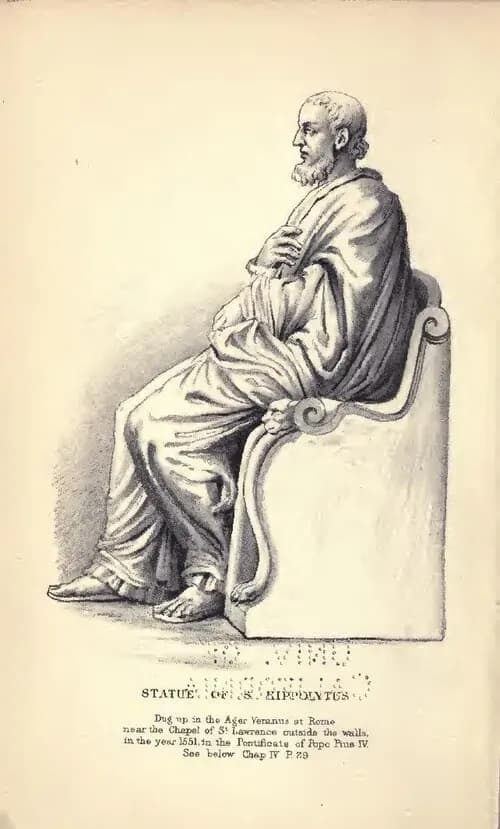
One monument of him survives from his own century. A large fragment of a marble statue was found in 1551 and restored with a new head and upper body. It shows a figure seated on a chair, and on the sides of the chair are carved his table for reckoning Easter and a list of his works. 1 The engraving on this page was made from it, so the head it shows is the restorer's.
What is Saint Hippolytus of Rome the patron saint of?
None of the encyclopedia articles names a patronage for Hippolytus of Rome. 126 Catholic Culture's list gives "Horses; prison guards; prison officers; prison workers," and as his symbols armor, a bunch of keys and the tails of wild horses. 3 Those belong to the legendary Hippolytus, the jailer of Saint Lawrence who was dragged to death by horses, and Kirsch treats that story as one of the later legends attached to the name. 1 This page claims no patronage for him.
Saint Hippolytus of Rome's feast day
Saint Hippolytus of Rome is kept on August 13, together with Pope Saint Pontian. Catholic Culture lists the day as the optional memorial of "Saints Pontian, Pope; Hippolytus, Priest, Martyrs," and Vatican News and the Roman Martyrology give the same two names on the same date. 345
The date is old. Kirsch notes that the Roman calendar in the Chronography of 354 already records, under August 13, the feast of Hippolytus on the Via Tiburtina and of Pontianus in the catacomb of Callistus. 1 He also says that the feast "is kept on 13 August, a date assigned in accordance with the legend of St. Laurence," and that a separate Hippolytus of Porto was celebrated on August 22. 1 When he wrote, Pontian had his own day in the Roman Martyrology, November 19. 2
Praying with Saint Hippolytus of Rome
The summary of Mike Aquilina's podcast episode on him puts the whole life in a sentence: "He started as a papal critic, became history's first antipope, and today is honored—with the pope he rejected—as a saint whose feast day is universal." 7 The Church did not arrive at that by forgetting what he had done. The encyclopedia that calls him Rome's most important early theologian also calls his charges against Callistus unjustified and his rigor excessive. 1
His fault was a learned man's fault. He was right that the teachers he opposed were wrong, and he could not bear that the bishop of Rome would not say so in his words and on his schedule. 1 When Callistus opened a way back for people who had sinned gravely, Hippolytus saw only laxity. 16 He spent some eighteen years outside the church he had served.
Nobody recorded what was said in the mines. The sources know only that the antipope and the pope were sentenced together, that Hippolytus told his followers to go back, and that Rome buried the two on the same day and honored both as martyrs. 134 A reconciliation that late could have been left out of the calendar. It was written into it, with the two names side by side.
Saint Hippolytus of Rome, pray for us.
Sources
- 1.Johann Peter Kirsch, "St. Hippolytus of Rome," The Catholic Encyclopedia, vol. 7 (New York: Robert Appleton Company, 1910).
- 2.Johann Peter Kirsch, "Pope St. Pontian," The Catholic Encyclopedia, vol. 12 (New York: Robert Appleton Company, 1911).
- 3."Optional Memorial of Saints Pontian, Pope; Hippolytus, Priest, Martyrs," Liturgical Year, August 13, 2025, Catholic Culture (Trinity Communications); with an excerpt from J.V. Bartlett, The Popes: A Papal History.
- 4.Santo del giorno, 13 agosto, from the Roman Martyrology, Conferenza Episcopale Italiana (in Italian).
- 5."Sts. Pontian, Pope and Hippolytus priest, Martyrs," Saint of the Day, 13 August, Vatican News (Dicastery for Communication).
- 6.John Chapman, "Pope Callistus I," The Catholic Encyclopedia, vol. 3 (New York: Robert Appleton Company, 1908).
- 7.Mike Aquilina, "Ep. 17: The Long, Strange Trip of Hippolytus of Rome," Way of the Fathers podcast, episode summary, June 10, 2020, Catholic Culture (Trinity Communications).
Saints to turn to next
Others in this collection who are turned to for some of the same things.
- Saint Edmund CampionJanuary 25, 1540 - December 1, 1581CourageStudy and teachingConversion
- Saint Gregory Thaumaturgusc. 213 - between 270 and 275ConversionStudy and teachingCourage
- Saint Hilary of Poitiersc. 315 - 368Study and teachingCourageConversion
- Saint Justin Martyrc. 100 - c. 165Study and teachingConversionCourage