Saint Justina of Padua
d. 304
- Historical record
- A church in her honor by the sixth century; the twelfth-century account of her life is a forgery 13
Saint Justina of Padua is the first martyr of the Church of Padua, put to death for her faith in the persecution of the early fourth century and buried in a Christian cemetery outside the Roman town. 124 A church rose over her grave within two centuries, and a Benedictine abbey still keeps her body there today. 13 Much of the story told about her is late, and one source calls part of it a forgery, but the grave, the church and the devotion are old and real. 13
The martyr of Padua
Padua gave several martyrs to the early Church, and the 1911 Catholic Encyclopedia names Justina first among them. 7 Roman Patavium was then a prosperous town, and the ground where her basilica now stands held one or more burial grounds of the pagan aristocracy and a Christian cemetery. According to the Benedictine monks who keep her shrine, her body was laid there on October 7, 304, after she was put to death as a Christian by sentence of the emperor Maximian, who was passing through. 3 The Norwegian bishops' saints database is more careful: she died a martyr at Padua, possibly in Diocletian's persecution, and tradition says she was beheaded on October 7, 304. 1
The Roman Martyrology, as the Italian bishops print it, gives her one line: at Padua, Saint Justina, virgin and martyr. 6 The Diocese of Padua calls her its protomartyr, its first martyr, and its co-patron, and describes her as a woman at the origin of the faith and the Christian history of the diocese. 45
What her Passio says
The abbey tells her story from her Passio, which it dates to the sixth century. In it Justina is of noble birth and a Christian. Maximian sets up a tribunal on the Campo Marzio at Padua to kill the servants of God, and Justina, hurrying to visit them, is caught by soldiers near Pontecorvo and taken before him. 2 He questions her with contempt and threatens her, and invites her to sacrifice to Mars. When she will not move, he pronounces sentence: since she says she remains bound to the Christian religion and will not obey, she is to be killed by the sword. 2
In the abbey's quotation she answers with a prayer. She thanks Jesus Christ for deigning to write his martyr in his book, and asks him, enthroned, to take his handmaid to himself, calling him her light and the precious pearl she has always loved. 2 She kneels, the executioner drives the sword into her side, and she makes the sign of the cross and dies. The Christians, seeing her faith, lay her body in the cemetery just outside Padua, where the abbey now stands. 2
There is a second, later account, and katolsk.no is blunt about it. A twelfth-century document claims that Justina was baptized by Saint Prosdocimus, "a disciple of the apostle Peter" and supposedly the first bishop of Padua, and that she died under Nero. katolsk.no calls the document a forgery. 1 The encyclopedia agrees on the chronology from the other side: Prosdocimus "cannot have governed the diocese earlier than the beginning of the third century." 7
A church over her grave
Shortly after 520 Opilio, a praetorian prefect and patrician, built the first basilica over the cemetery, with an adjoining oratory, decorated with fine marble and mosaics. 3 Venantius Fortunatus, the poet who later became bishop of Poitiers, described it in 565 in his life of Saint Martin. 3 He had also seen her in the mosaics of Sant'Apollinare Nuovo in Ravenna, ranked her among the great saints of her time, and told travelers to Padua to kneel in her church and kiss her tomb. In making Padua famous, katolsk.no observes, she did for her city what Euphemia had done for Chalcedon and Eulalia for Mérida. 1
By the sixth century, the abbey says, the basilica was already a place of pilgrimage, since her cult had spread along the Adriatic coast. 3 In the same century her name entered the canon of the Ambrosian Mass. Rimini chose her as a protector of the city beside Saint Andrew, and in 617 a church was dedicated to her at Como. 1
The monks of Santa Giustina
The abbey dates the secure presence of Benedictine monks to 971, when Bishop Gauslinus of Padua re-established a monastery under the Rule of Saint Benedict and endowed it with land and churches. 3 katolsk.no describes the monastery as richly endowed in the tenth century and reformed under the Rule in the eleventh. 1 The monks drained the marshes and cleared the woods of the Paduan countryside. 3
The two sources tell her recovery differently. In katolsk.no the basilica was destroyed by an earthquake early in the twelfth century, relics believed to be hers were found afterward, and they were translated in 1117. 1 The abbey puts the earthquake itself in 1117, says it threw down Opilio's basilica but spared the adjoining chapel, and says her body came to light in 1174. 3
In the fifteenth century Ludovico Barbo reformed the monastery, beginning in 1408, and his congregation of Santa Giustina, "De Unitate," spread across Europe and became the Cassinese Congregation of the Benedictines. 13 Justina was its patron, which did more than anything to spread her cult. 1 The monks rebuilt her church on a grand scale; the encyclopedia says it was "rebuilt in 1502" and is "crowned by eight cupolas," while katolsk.no dates the rebuilding and enlargement from 1521 to 1587. 17 Her relics were enshrined under the high altar in 1627. 1 Venice adopted her as a patron after the victory over the Turks at Lepanto, which was won on her feast day. 1
Under the Cisalpine Republic the monastery's goods were seized in 1797; the state sold its property in 1806 and turned the buildings into a barracks and military hospital; katolsk.no says the monastery was closed in 1810. 13 On June 22, 1917, Benedict XV restored the abbey with all its ancient rights. 3 A community of its own was formed in 1942, and in January 1943 it elected its first abbot in 123 years. 3 katolsk.no gives the reopening as 1919 and says her cult, which had nearly disappeared, revived with it. 1
What is Saint Justina the patron saint of?
Saint Justina is co-patron of the Diocese of Padua, beside its first bishop, Saint Prosdocimus, who is buried in the same basilica and is the principal patron. 45 katolsk.no lists her as a patron of the city of Padua, and Venice took her as a patron after Lepanto. 1 About ten parishes of the diocese are dedicated to her. 4
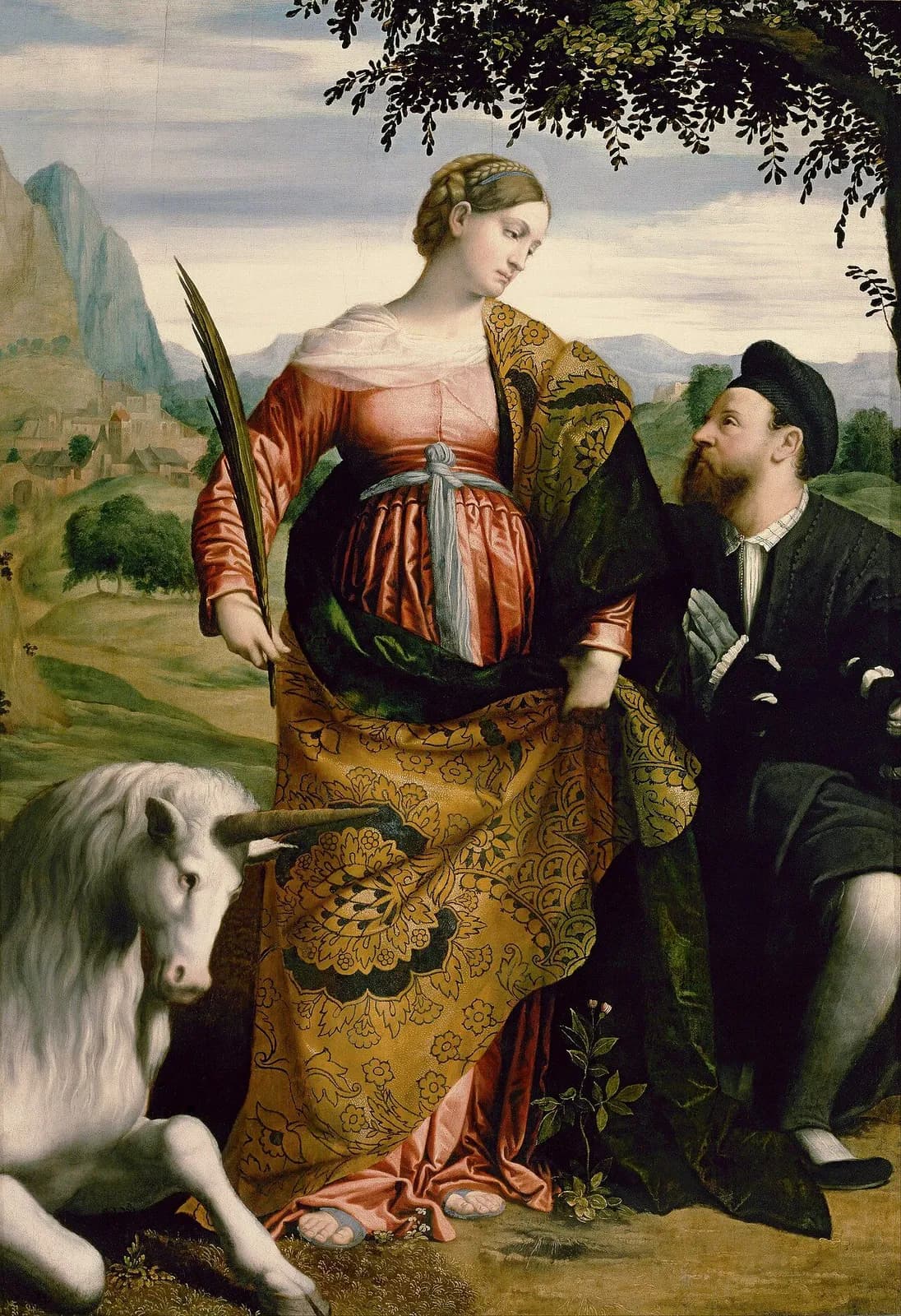
She is painted with a crown, a palm and a sword, sometimes with a sword through her breast, and in some pictures with a unicorn, a symbol of virginity, as in the panel at the top of this page. 1 Because she gave her name to the great Cassinese congregation, she is often shown beside Saint Scholastica, although she was never a nun. 1
Saint Justina's feast day
Saint Justina's feast day is October 7, the day the abbey gives for her death, and the day the Roman Martyrology enters her. 126 In Padua it is kept as a diocesan feast in her basilica. First Vespers are sung with the monks on the evening before, and the bishop presides at a solemn Mass on the day itself. 5 In recent years the diocese has chosen her feast for the consecration of women to the Ordo Virginum, the order of consecrated virgins, and a choir of some eighty women from across the diocese sings for it. 45
Praying with Saint Justina
Almost everything about Justina's life is out of reach. What is left is a name, a date in early October, a grave just outside a Roman town, and a church built over it by people who remembered. 123 For Padua that has been enough for seventeen centuries.
The Passio is late, but it puts a prayer in her mouth that the abbey still quotes: thanks that she has been written in God's book, and a plea to be received by the one she has always loved. 2 It is the prayer of somebody who saw the sentence as an answer rather than an ending.
Her day has become one on which women in Padua consecrate their lives to God as virgins living in the world, and on which a diocese gathers to sing in her church. 45 It is hard to think of a better use for the feast of a young woman whose story nobody can verify and whose choice nobody doubts.
Saint Justina of Padua, pray for us.
Sources
- 1."Den hellige Justina av Padova (d. ~304)," Den katolske kirke (katolsk.no), Catholic Diocese of Oslo (in Norwegian).
- 2."Santa Giustina, vergine e martire," Abbazia di Santa Giustina, Padua (Benedictine abbey), quoting the Passio S. Justinae Virginis et Martiris (in Italian).
- 3."Basilica," history of the basilica and monastery, Abbazia di Santa Giustina, Padua (in Italian).
- 4."Festa di Santa Giustina," press release 115/2023, Ufficio Stampa, Diocesi di Padova, October 3, 2023 (in Italian).
- 5."Festa di Santa Giustina," press release 130/2025, Ufficio Stampa, Diocesi di Padova, October 5, 2025 (in Italian).
- 6.Roman Martyrology, entry for October 7, "Santa Giustina, vergine e martire," as printed in "Santo del giorno," Conferenza Episcopale Italiana (in Italian).
- 7.Umberto Benigni, "Padua," The Catholic Encyclopedia, Vol. 11 (New York: Robert Appleton Company, 1911).
Saints to turn to next
Others in this collection who are turned to for some of the same things.