Saint Julius I
Died April 12, 352
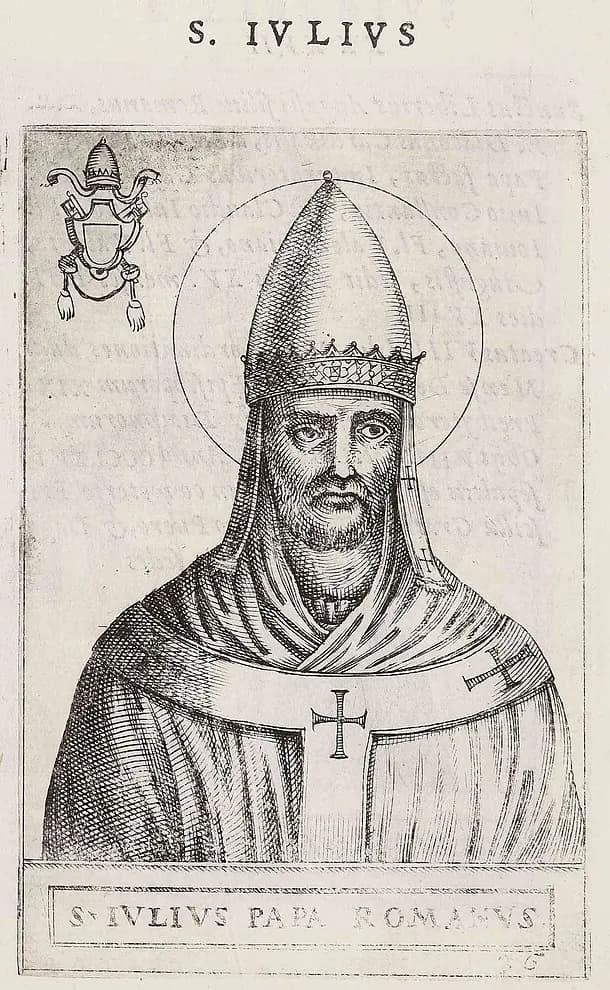
- Known for
- Receiving the exiled Saint Athanasius in Rome and clearing him at a synod; his letter to the Eastern bishops; the Council of Sardica 126
- Built
- Two basilicas in Rome, one of them now Santa Maria in Trastevere, and three cemetery churches 1
Saint Julius I was bishop of Rome from 337 to 352, the years when bishops who held to the Council of Nicaea were being driven from their sees across the East. 16 He took in the greatest of them, Saint Athanasius of Alexandria, heard his case at a synod in Rome, and told the bishops who had deposed him that they should have written to Rome first. 12 His feast is April 12. 1
A Roman elected after a long vacancy
Almost nothing is recorded of Julius before he was pope. He was a native of Rome. 18 Johann Peter Kirsch, in the Catholic Encyclopedia, notes that Saint Sylvester's successor had ruled for less than nine months in 336, and that after his death the see stood empty for four months. "What occasioned this comparatively long vacancy is unknown." 1 Julius was elected on February 6, 337. 18
Constantine the Great died that May. 1 It is for what Julius did in the years that followed that he is remembered. Kirsch says his pontificate "is chiefly celebrated for his judicious and firm intervention in the Arian controversies." 1 The chief witness is Athanasius himself, who copied two of the pope's letters into his own defense. 2
Athanasius comes to Rome
Athanasius had been deposed by a council at Tyre in 335 and exiled. After Constantine's death he was allowed home to Alexandria. 1 His opponents, the party of Eusebius of Nicomedia, set up a rival bishop there named Pistus and sent envoys to Rome, asking Julius to enter into communion with Pistus. 1 Athanasius sent envoys too, carrying a letter from the bishops of Egypt in his defense. 12
When the two delegations met in Rome, the head of the Eusebian envoys left the city. The two who stayed asked the pope to call a synod and hear both sides. 1 Athanasius remembered the request with some dryness: his accusers, "thinking to frighten me, requested him to call a council, and to be himself the judge, if he so pleased." 2
Julius took them at their word. He sent two priests east with letters of invitation; Athanasius names them as Elpidius and Philoxenus. 12 Meanwhile the Eusebians, meeting at Antioch, chose a new bishop for Alexandria and installed him by force. 1 Athanasius fled to Rome. Other deposed Eastern bishops arrived as well, among them Marcellus of Ancyra. 1
The Eastern bishops refused to come, "in a letter couched in haughty terms." 1 Julius waited. Then he held the synod without them, in the autumn of 340 or 341 by Kirsch's reckoning, in the church of a Roman priest named Vitus. 1 More than fifty bishops attended, according to Athanasius. 2 They examined the documents and restored Athanasius and Marcellus to their rights as bishops. 1
The letter to Antioch
The synod asked Julius to write to the bishops who had stayed away, and he did. 2 Kirsch calls the result "a very notable and able letter." 1
It opens with a complaint about tone. He had written to them in charity and received contention in return, and "what was written in a charitable spirit ought likewise to be answered in a spirit of charity and not of contention." 2 Athanasius, by contrast, had come and waited: "he continued here a year and six months," expecting his accusers. 2 Cornelius Clifford, in the encyclopedia's article on Athanasius, puts his whole stay in Rome at three years. 4
Then the pope turns to what had been done in the East. Bishops had been forced from their churches and others brought in from elsewhere to replace them. "O beloved, the decisions of the Church are no longer according to the Gospel, but tend only to banishment and death." 2 Even if the accused had been at fault, he writes, the matter should have been handled by the rule of the Church. Then the question for which the letter is remembered: "Are you ignorant that the custom has been for word to be written first to us, and then for a just decision to be passed from this place?" 2
He does not present this as his own opinion. "For what we have received from the blessed Apostle Peter, that I signify to you." 2
The Council of Sardica
The letter settled nothing in the East. Julius and other Western bishops then asked the emperor Constans to press his brother Constantius, emperor in the East, on behalf of the deposed bishops. 1 The two emperors agreed to a general council at Sardica, the modern Sofia. Patrick Healy, in the encyclopedia's article on the council, says it was convoked by the emperors "at the urgent entreaty of Pope Julius"; the Roman Martyrology simply credits him with convoking it. 36 Kirsch dates it to 342 or 343, Healy "most probably in 343." 13
Julius did not go. He sent two priests, Archidamus and Philoxenus, and a deacon named Leo, and Hosius of Cordova presided. 13 The Eastern bishops of the Eusebian party would not sit with Athanasius, withdrew, and held their own meeting. 13 The bishops who remained cleared Athanasius again and passed canons on how a bishop who had been condemned could appeal. In Kirsch's words, "the manner of the papal intervention in the condemnation of bishops was definitely established." 1
On whether the council succeeded, the two encyclopedia writers part company. Kirsch says "the synod nevertheless accomplished its task." 1 Healy says flatly, "The council failed entirely to accomplish its purpose. The pacification of the Church was not secured." 3 Vatican News takes Healy's side: Julius tried more than once to bring the Arian party back, at Rome and then at Sardica, and did not manage it. 7
Athanasius goes home
Athanasius was not allowed back to Alexandria until 346, after his rival there had died. 1 On his way he went up to Rome to say goodbye, and Julius gave him a letter to carry to his people. 2 It is a warm one. "I congratulate you, beloved brethren, that you now behold the fruit of your faith before your eyes." 2 Their bishop, he tells them, "returns to you now more illustrious than when he went away from you." 2
One more vindication followed. Two bishops deposed at Sardica for Arianism, Ursacius and Valens, came to Rome and recanted. Julius received a signed confession from them and restored them to their sees. 1 Athanasius kept a copy of what they wrote to "the most blessed lord, pope Julius": that everything they had alleged against Athanasius was "falsehoods and fabrications." 2
The churches he built
About the ordinary life of the Roman Church under Julius, Kirsch admits, "we have no exact information." 1 What is known is that the Christian population of the city was growing fast, and that he built for it: two new basilicas inside the walls, the church that bore his name and is now Santa Maria in Trastevere, and the Basilica Julia, now the Church of the Twelve Apostles. 1 Outside the walls he built three churches over cemeteries, one of them on the Via Flaminia at the tomb of the martyr Saint Valentine. 1
Julius died on April 12, 352, and was buried in the cemetery of Calepodius on the Via Aurelia. 16 His body was later moved to Santa Maria in Trastevere, the church he had built. 1
Did Pope Julius set the date of Christmas?
It is often said that Julius I fixed the birth of Christ on December 25. The story comes from letters in which Saint Cyril of Jerusalem asks Julius to establish the true date from census records at Rome, and Julius answers with December 25. 5 Cyril Martindale, in the encyclopedia's article on Christmas, calls this a "so-called correspondence" and speaks of "the Cyriline forgeries." His reasoning is simple: "Julius died in 352, and by 385 Cyril had made no change." 5
What is Saint Julius I the patron saint of?
Saint Julius I's feast day
Saint Julius I's feast day is April 12. Kirsch states it directly: "His feast is celebrated on 12 April." 1 The Roman Martyrology, in the text published by the Italian bishops, has his entry on that date: at Rome, in the cemetery of Calepodius at the third mile of the Via Aurelia, the burial of Saint Julius I, pope, who held firmly to the Nicene faith during the Arian persecution, defended Athanasius against his accusers and sheltered him in exile. 6 Vatican News lists him on April 12 as well. 7
April 12 is also the day he died. 18 Kirsch adds that he "very soon after his death, was honoured as a saint." 1
Praying with Saint Julius I
Julius left no treatise and no rule. What survives of his own voice is two letters, and both were written for someone else's sake. 2
The long letter is patient before it is firm. He asks the Eastern bishops to come. He waits more than a year for them. He keeps their insulting reply to himself so that it will not grieve the people around him. 2 Only when nobody arrives does he hear the case and say what he thinks, and even then he asks them to bear with him, because "what I write is for the common good." 2
His concern throughout is that people be judged fairly, with the accused present and both sides heard. 12 He applied the same fairness in the other direction. When Ursacius and Valens, who had slandered Athanasius, came to Rome and admitted it, he pardoned them and gave them back their sees. 12
By one encyclopedia writer's account his great council failed, and the quarrel he tried to end outlived him by decades. 3 Athanasius would be exiled again after Julius was dead. 4 What Julius could do, he did: he opened his door to a hunted bishop and did not shut it when the bishops who had deposed him answered with scorn.
Saint Julius I, pray for us.
Sources
- 1.Johann Peter Kirsch, "Pope St. Julius I," The Catholic Encyclopedia, vol. 8 (New York: Robert Appleton Company, 1910).
- 2.Saint Athanasius, Apologia Contra Arianos (Defense against the Arians), Part I, containing the letters of Julius; translated by M. Atkinson and Archibald Robertson, Nicene and Post-Nicene Fathers, Second Series, vol. 4 (Buffalo: Christian Literature Publishing Co., 1892), as hosted by New Advent.
- 3.Patrick Healy, "Council of Sardica," The Catholic Encyclopedia, vol. 13 (New York: Robert Appleton Company, 1912).
- 4.Cornelius Clifford, "St. Athanasius," The Catholic Encyclopedia, vol. 2 (New York: Robert Appleton Company, 1907).
- 5.Cyril Charles Martindale, "Christmas," The Catholic Encyclopedia, vol. 3 (New York: Robert Appleton Company, 1908).
- 6.Roman Martyrology, entry for April 12, "San Giulio I, papa," Santo del giorno, Conferenza Episcopale Italiana (in Italian).
- 7."San Giulio I, papa," Santo del giorno, 12 aprile, Vatican News (in Italian).
- 8."Julius I," The Supreme Pontiffs, The Holy See.
Saints to turn to next
Others in this collection who are turned to for some of the same things.