Saint Juliana of Nicomedia
d. about 305
- Also called
- Juliana of Cumae 2
- Died
- In the persecution of Diocletian and Maximian 12; 305, says katolsk.no 2, February 16, 308, says the Archdiocese of Madrid 5
- Place of martyrdom
- Nicomedia, by her legend 14; Campania, in the current Roman Martyrology 3; near Naples more likely, says katolsk.no 2
- Earliest record
- The Martyrologium Hieronymianum, at Cumae, under February 16 1
- Patron saint of
- Childbirth; protection from infectious disease 2
Saint Juliana is a virgin martyr of the Diocletian persecution, venerated on February 16 since the oldest Latin martyrology, which places her at Cumae near Naples. 13 Her famous story belongs to another city: a girl of Nicomedia who refused the marriage her father arranged, was tortured by the man she refused, and led the devil through the streets on a chain. 12 The 1910 Catholic Encyclopedia calls that story "purely legendary," and thinks the Juliana of Nicomedia and the Juliana of Cumae were two women. 1
What is certain
The oldest notice of her is a single line in the Martyrologium Hieronymianum for February 16, which J.P. Kirsch, writing in the Catholic Encyclopedia, gives as "In Campania Cumbas, natale Julianae": the birthday into heaven of Juliana at Cumae in Campania. 1 It survives in only one of the chief manuscripts, but Kirsch holds it authentic because of a letter of Gregory the Great. 1
In that letter a devout woman named Januaria has built a church on one of her estates near Naples and wants relics of Saint Severinus and Saint Juliana for its consecration, and Gregory tells Bishop Fortunatus of Naples to give them to her. 1 The relics meant here were cloths that had touched the graves. 1 katolsk.no, the Norwegian bishops' saints database, tells the same story of an oratory built in her honor, and concludes that nothing certain is known about her. 2
That is the whole of the history: a woman martyr honored at Cumae, and a cult strong enough around Naples that a pope was asked for her relics. 12 The current Roman Martyrology keeps exactly that much. Its entry for February 16 reads, in the Italian bishops' edition, only: in Campania, Saint Juliana, virgin and martyr. 3
The legend of Nicomedia
Everything else comes from her Acts, which Bede used in his martyrology. 1 They set her in Nicomedia in Asia Minor, now Izmit in Turkey. 12 katolsk.no, which calls the legend unreliable, tells it at length. 2
Juliana was born to a distinguished family. Her father, Africanus, was a pagan and an enemy of the Christians, and her mother had no faith at all. 12 As a child she was drawn to Christianity, went secretly to the Christians' assemblies, and after her baptism soon said openly what she was. 2 When she was nine her father promised her to a young nobleman, Eleusius in the encyclopedia, Evilasius in katolsk.no and Eluzo in the Madrid archdiocese's retelling. 125 At eighteen she was to be married, and she refused unless he was baptized. 2
Her father tried flattery first and then the whip. 2 In the Madrid version she had already set a first condition, that the young man become judge and prefect of the city, and he had managed it; the second, that he become a Christian, he would not meet. 5 Her suitor, now the governor at Nicomedia, had her brought before him, and when she refused him again he had her tortured and thrown into prison. 2
In prison, says the legend, the devil came to her in the form of a shining angel and urged her to sacrifice and marry. 2 After a long argument she seized him, bound him and threw him to the ground, and he confessed who he was. 2 The next day her wounds had healed, and she was led out dragging the devil behind her on a chain, so that the crowd could mock him. 2 Many of those watching became Christians. 2
The torments went on. katolsk.no has her partly burned and then thrown into a cauldron of boiling oil; the Madrid account has molten tin and fire. 25 In the end she was beheaded, at eighteen, says the Madrid archdiocese, on February 16, 308. 25 katolsk.no gives the year as 305. 2
What the historians make of it
Neither of the older English-language Catholic authorities takes the Acts seriously. Kirsch calls them "purely legendary." 1 Alban Butler is shorter: "Her acts in Bollandus deserve no notice." 4 What Butler does accept is the bare record, that "after many torments, she was beheaded at Nicomedia, under Galerius Maximianus." 4
Kirsch explains how a martyr of Nicomedia came to be honored at Cumae. The legend says that soon after her death a noble lady named Sephonia passed through Nicomedia, took the body with her to Italy, and buried it in Campania. 1 "Evidently it was this alleged translation," he writes, "that caused the martyred Juliana, honoured in Nicomedia, to be identified with St. Juliana of Cumae, although they are quite distinct persons." 1
katolsk.no is less sure there were two. It notes that the Martyrology before 1970 put her death at Nicomedia, and judges it more likely that she died near Naples, perhaps at Cumae itself. 2 The current Martyrology has dropped Nicomedia altogether. 3
From Cumae to Naples and the Low Countries
The relics have their own story, and the sources tell it differently. The Archdiocese of Madrid says that when the peace of Constantine came, a matron named Sophronia took the body to carry it to Rome, but a storm drove her ashore at Pozzuoli, where she built a church that the Lombards later destroyed, and the relics were moved to Naples for safety. 5 katolsk.no dates their arrival at Cumae to 568 and their move to Naples to 1207. 2 Kirsch puts the move to Naples at the beginning of the thirteenth century, and notes that a contemporary account of it survives. 1 Butler, for his part, says Gregory the Great mentions her bones being taken to Rome. 4
Her cult traveled north. Kirsch says it "became very widespread, especially in the Netherlands," and Butler, that she is "much honored in the Low Countries," with part of her relics in the church of Our Lady of the Sablon in Brussels. 14
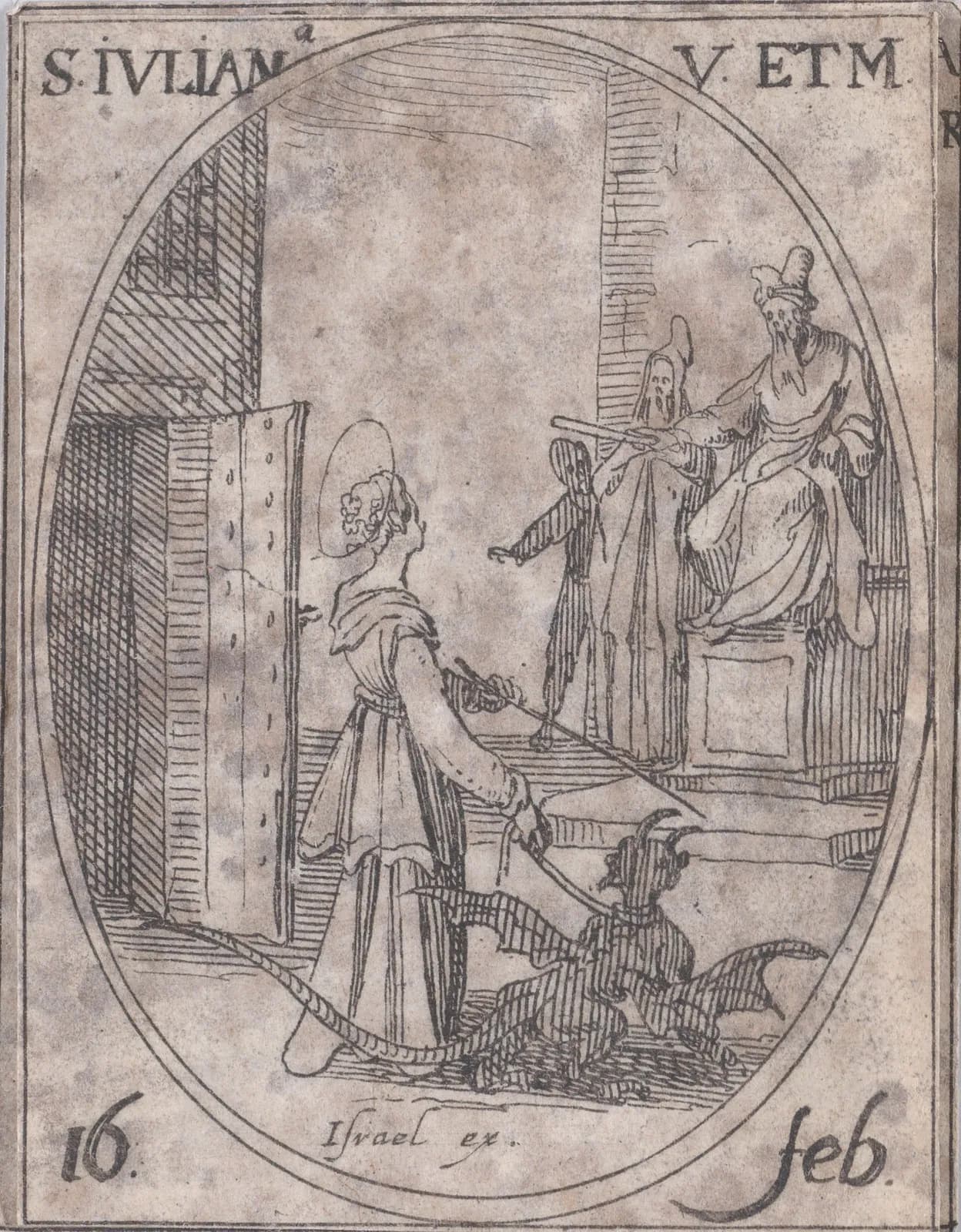
Painters gave her the scene from the prison. Kirsch says she is shown "with a winged devil whom she leads by a chain." 1 katolsk.no lists the variants: standing or sitting on a winged devil or dragon, binding it with a chain, or chaining and whipping it, and also with the martyr's crown, palm and sword. 2 Jacques Callot's 1636 etching above shows the chained devil at her feet as she faces her judge.
What is Saint Juliana the patron saint of?
Saint Juliana's feast day
Saint Juliana's feast day is February 16. 1234 It is the day the Martyrologium Hieronymianum gives her, and Butler adds that Bede and the martyrologies under Saint Jerome's name call it the day of her martyrdom. 14 The current Roman Martyrology keeps her on February 16, as a virgin and martyr of Campania. 3 The Greek Church keeps her on December 21. 1
Praying with Saint Juliana
The certain part of Juliana's life is very small. A woman died for Christ, Christians near Naples remembered her, and long afterward a landowner wanted something from her grave for the altar of a new church. 1 Januaria's request reached a pope, and he granted it. 1
The legend that grew around her is about a daughter who would not be married to a man outside the faith, and a father who chose the whip over losing the argument. 2 Families in conflict over a child's choices are not a story only from late antiquity. In the legend her refusal costs her everything, and nothing in it softens that.
The image the painters kept is a young woman holding the devil on a chain. 12 It is a picture of evil named, bound and made ridiculous, by someone who by every outward measure had no power at all.
Saint Juliana of Nicomedia, pray for us.
Sources
- 1.J.P. Kirsch, "St. Juliana," The Catholic Encyclopedia, Vol. 8 (New York: Robert Appleton Company, 1910).
- 2."Den hellige Juliana av Cumae (av Nikomedia) (-305)," Den katolske kirke (katolsk.no), Catholic Diocese of Oslo (in Norwegian).
- 3.Roman Martyrology, entry for February 16, "Santa Giuliana, vergine e martire," as printed in "Santo del giorno," Conferenza Episcopale Italiana (in Italian).
- 4.Alban Butler, "St. Juliana, Virgin and Martyr," February 16, The Lives of the Fathers, Martyrs, and Other Principal Saints, Vol. II.
- 5."Juliana, virgen y mártir († s. III)," Santoral, Oración y Liturgia, Archdiocese of Madrid, February 16, 2026 (in Spanish).
Saints to turn to next
Others in this collection who are turned to for some of the same things.