Saint Juliana of Liège
c. 1192 - April 5, 1258
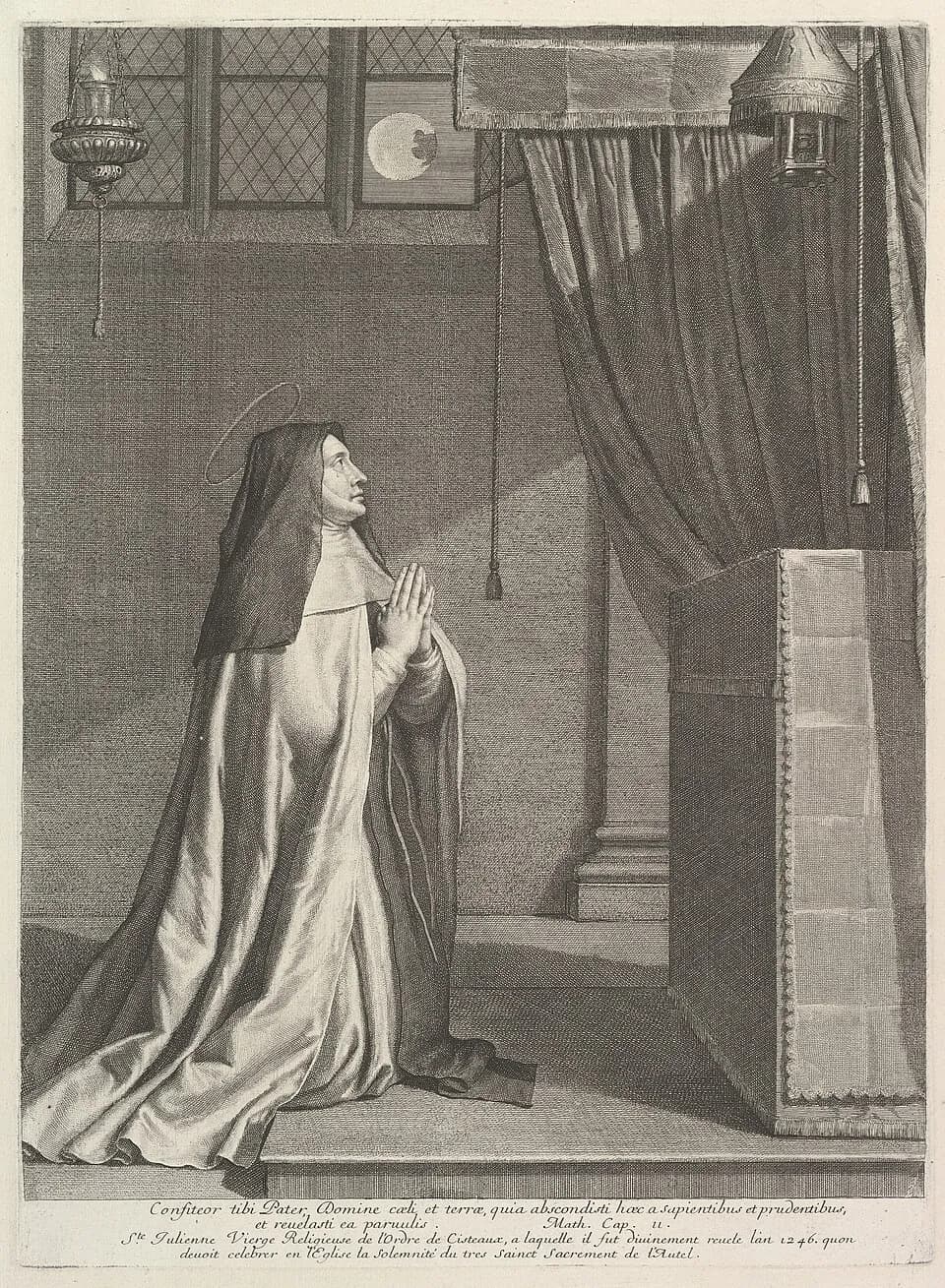
- Veneration approved
- 1869, by Pope Pius IX, with an office and Mass 2
Saint Juliana of Liège, also called Juliana of Cornillon, was an Augustinian nun in a leper hospital outside Liège whose visions, and whose persistence, gave the Church the feast of Corpus Christi. 13 She saw the feast decreed for her own diocese in 1246 and was then driven from her convent; she died in 1258, six years before Pope Urban IV extended it to the whole Church. 13 "She is little known," Benedict XVI said of her in 2010, "but the Church is deeply indebted to her." 1
An orphan at Mont-Cornillon
She was born at Retinne, a village near Liège in what is now Belgium. The Catholic Encyclopedia gives the year as 1193; Benedict XVI says between 1191 and 1192, and CathoBel 1192. 124 Her parents died when she was five, and she and her sister Agnes were given into the care of the Augustinian nuns of Mont-Cornillon, a convent that was also a leprosarium. 14
A sister whom Benedict XVI calls "Sapienza" took charge of her formation. 1 Juliana learned Latin well enough to read the Fathers of the Church, Saint Augustine and Saint Bernard above all, and the encyclopedia remarks on her rapid progress. 12 The encyclopedia has her taking the veil in 1206 and working among the sick in the hospital the convent ran. 2
Liège was a good place for a girl with her leanings. Benedict XVI describes a diocese where eminent theologians had written on the Eucharist and where groups of women, guided by priests, lived together in prayer, charitable work and frequent communion. 1 Juliana returned again and again to one line of the Gospel, "And lo, I am with you always, to the close of the age." 1
The moon with a dark stripe
At sixteen she had a vision, and it came back many times while she prayed before the Eucharist. In Benedict XVI's words it showed "the moon in its full splendour, crossed diametrically by a dark stripe." 1 She came to understand it this way: "The moon symbolized the life of the Church on earth, the opaque line, on the other hand, represented the absence of a liturgical feast," one in which believers could adore the Eucharist, grow in faith and make reparation for offenses against the Blessed Sacrament. 1 The encyclopedia tells it more cautiously. Her desire for such a feast, it says, "is said to have been increased by a vision of the Church under the appearance of the full moon having one dark spot." 3
She told no one for about twenty years. 1 By then she was prioress, elected by the unanimous vote of the community in 1230 according to the encyclopedia, or already in 1222 according to CathoBel. 24 She finally confided in two women: Eve, who lived as a recluse in Liège, and Isabella, who had joined her at Cornillon. 1 Benedict XVI calls what the three formed a "spiritual alliance" for the glory of the Blessed Sacrament. 1
They then brought in a priest, John of Lausanne, a canon of the church of Saint Martin in Liège, and asked him to put the idea to theologians and clergy. The answers were encouraging. 1 The encyclopedia names others who heard of it from Juliana: the Dominican Hugh, later a cardinal and papal legate, and the archdeacon of Liège, Jacques Pantaléon. 3 The Pope drew a general rule from her method: "To have confirmation that an inspiration comes from God it is always necessary to be immersed in prayer to wait patiently, to seek friendship and exchanges with other good souls and to submit all things to the judgement of the Pastors of the Church." 1
The first feast, at Liège
The bishop of Liège, Robert of Thourotte, hesitated at first and then accepted. 1 In 1246 he called a synod and ordered the feast to be kept in his diocese from the following year, on the Thursday after Trinity Sunday. 34 He died on October 16, 1246, before he could see it, and the first celebration was held by the canons of Saint Martin. 3
The sources differ on the texts used. The encyclopedia says the bishop directed a monk named John to write the office. 3 CathoBel, following Bishop Delville of Liège, says Juliana herself set about composing an office in honor of Christ's presence in the Eucharist. 4 After Robert's death the papal legate Hugh of Saint-Cher made the feast obligatory throughout his own jurisdiction. 4
Driven out
Her convent answered to a general superior, and in 1233 that post went to a man named Roger, who obtained it, the encyclopedia says, by intrigue and bribery and was "a man of vicious and scandalous habits." 2 He resented her reproaches and stirred up the townspeople against her. 2 CathoBel gives the accusation: she was suspected of diverting the hospital's money to promote her feast, and her house was ransacked. 4
She took refuge in Eve's cell and then in a house lent by Canon John. 2 Bishop Robert investigated, the courts cleared her, Roger was removed, and she returned as prioress. 24 The reprieve ended with the bishop's life. His successor, Henry of Guelders, was more occupied with making war than with the leper hospital, and by 1247 Roger was back in power and she was forced out again. 24
Benedict XVI tells this part with a different emphasis. He speaks of "the harsh opposition of certain members of the clergy and even of the superior on whom her monastery depended," and then says that she left Mont-Cornillon with several companions "Of her own free will." 1 For ten years, from 1248 to 1258, she was a guest in one house of Cistercian nuns after another. 1 The encyclopedia names Namur and then Fosses. 2 Of those years the Pope says, "She edified all with her humility, she had no words of criticism or reproach for her adversaries and continued zealously to spread Eucharistic worship." 1
She died at Fosses on April 5, 1258. 23 The Blessed Sacrament was exposed in the cell where she lay, and her biographer says she died looking at it. 1 At her own request she was buried at the Cistercian abbey of Villers. 24
Corpus Christi after Juliana
The archdeacon who had listened to her became Pope Urban IV in 1261. 3 Eve pressed Bishop Henry to ask him to extend the feast to the whole Church. 3 In 1264 Urban issued the bull Transiturus, which the encyclopedia dates to September 8 and Benedict XVI to August 11, ordering Corpus Christi to be kept every year on the Thursday after Trinity Sunday; the text of the audience says "the Thursday after Pentecost." 13 He sent a copy of the bull to Eve. 4
Benedict XVI notes that the bull alludes discreetly to Juliana's experiences, and he quotes it: "Although the Eucharist is celebrated solemnly every day, we deem it fitting that at least once a year it be celebrated with greater honour and a solemn commemoration." 1 Urban kept the feast himself at Orvieto and asked Saint Thomas Aquinas to compose its office. 13 The Pope died that October and the observance faltered, until the Council of Vienne in 1311 and Pope John XXII, in 1317, restored it for the universal Church. 13
What is Saint Juliana of Liège the patron saint of?
None of the sources consulted for this page names Saint Juliana of Liège as the patron saint of anything. 124 She is remembered for one thing, the feast of the Body and Blood of Christ, and the Church has not attached a trade, a place or a need to her name in any source used here. The page does not supply one.
Saint Juliana of Liège's feast day
Saint Juliana of Liège's feast day is April 5 according to CathoBel, which adds that her own diocese of Liège keeps her more solemnly on August 7. 4 April 5 is the day she died, by the Catholic Encyclopedia's date, but the encyclopedia itself, in 1910, prints the feast a day later: "Her feast is on 6 April." 2 Her veneration was confirmed in 1869, when Pope Pius IX ratified it and permitted an office and Mass in her honor. 2
At Cornillon the sanctuary is still in use. A community of Poor Clares keeps perpetual adoration there and runs a workshop that bakes altar breads, and CathoBel reports that Liège has now held its 780th celebration of the feast she asked for. 4
Praying with Saint Juliana of Liège
Juliana waited twenty years before she said a word about what she had seen. 1 Then she did not announce it. She told two friends, the friends told a priest, the priest asked the theologians, and only after that did the matter reach a bishop. 1 Benedict XVI holds this up as the ordinary way an inspiration is tested, and it is striking how little of it depended on her being believed on her own word. 1
Being right did her no good in her lifetime. The feast was approved in 1246, and within two years she had left her convent for good. 13 She had been accused of spending the hospital's money on her cause. 4 She spent her final decade as a guest in other people's houses and died before any pope had acted. 12
What the sources agree on is how she carried it. The encyclopedia records no appeal or protest from her last years, only seclusion; Benedict XVI says she had no word of reproach for her adversaries and went on doing the one thing she had been asked to do. 12 The work was finished by others: by Eve, who would not let the bishop forget, and by an archdeacon who remembered a prioress after he became pope. 3
Her whole devotion rested on the promise she kept returning to as a girl, that Christ is with his Church always. 1 The Pope closed his catechesis on her by asking people to do something small in her spirit, and to "pay frequent visits to the Lord present in the Tabernacle." 1
Saint Juliana of Liège, pray for us.
Sources
- 1.Benedict XVI, General Audience, "Saint Juliana of Cornillon," November 17, 2010.
- 2.Francis Mershman, "St. Juliana of Liège," The Catholic Encyclopedia, vol. 8 (New York: Robert Appleton Company, 1910).
- 3.Francis Mershman, "Feast of Corpus Christi," The Catholic Encyclopedia, vol. 4 (New York: Robert Appleton Company, 1908).
- 4."« Elle dut subir la dure opposition de membres du clergé »: découvrez l'histoire de sainte Julienne de Cornillon," CathoBel, August 2025, republished August 7, 2026 (in French; biography credited to a lecture by Bishop Jean-Pierre Delville of Liège, March 14, 2023).
Saints to turn to next
Others in this collection who are turned to for some of the same things.