Saint Juan Diego
1474 - May 30, 1548
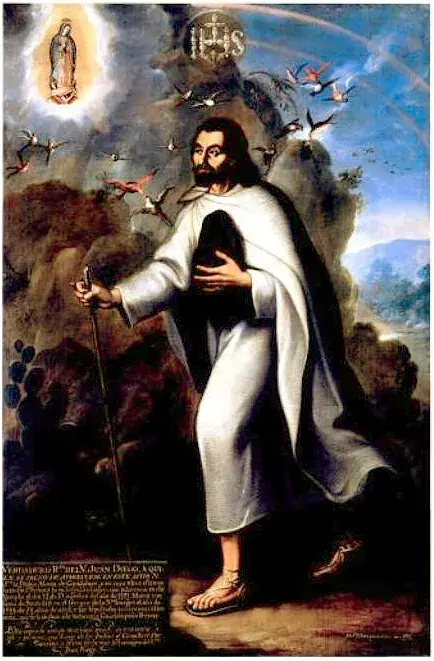
- Feast day
- December 9, the date of the first apparition at Tepeyac in 1531 2
- Not the same day as
- Our Lady of Guadalupe, kept on December 12 2
- Born
- 1474; first called Cuauhtlatohuac, "the eagle who speaks" 2
- Died
- May 30, 1548 2
- First
- "The first indigenous Saint of the American Continent" 1
Saint Juan Diego was a poor Indian layman in newly conquered Mexico to whom, in December 1531, the Mother of God appeared at Tepeyac hill and gave a sign for his bishop. 2 John Paul II canonized him in 2002 as "the first indigenous Saint of the American Continent," and used the occasion to say something the Church had not always said clearly: that Juan Diego accepted the Christian message "without forgoing his indigenous identity." 1
The eagle who speaks
He was born in 1474 and was first called Cuauhtlatohuac, which Franciscan Media translates as "the eagle who speaks." 2 Everything else that is commonly known about him is bound up with what happened at Tepeyac on 9 December 1531, and with the image on his tilma. 2
John Paul II describes the accounts of Guadalupe as "sensitively written and steeped in tenderness," and gives the shape of them in one sentence: "the Virgin Mary, the handmaid who glorified the Lord, reveals herself to Juan Diego as the Mother of the true God. As a sign, she gives him precious roses, and as he shows them to the Bishop, he discovers the blessed image of Our Lady imprinted on his tilma." 1
Franciscan Media is candid that this is where the record thins out. The famous part of the story belongs to the feast of Our Lady of Guadalupe on 12 December, and "after the roses gathered in his tilma were transformed into the miraculous image of Our Lady, however, little more is said about Juan." 2
What he did for the rest of his life
He lived near the shrine that was built at Tepeyac, and Franciscan Media records what he was remembered as: "a holy, unselfish, and compassionate catechist, who taught by word and especially by example." 2 He died on 30 May 1548, seventeen years after the apparitions. 2
That is a short paragraph because the sources are short. He was a layman who spent the second half of his life next to a shrine, explaining the faith to people in their own language, and there is no account of him founding, governing or writing anything.
Franciscan Media draws out what that means rather than apologizing for it: "God counted on Juan Diego to play a humble, yet huge role in bringing the Good News to the peoples of Mexico... Juan Diego cooperated with God's grace in showing his people that the Good News of Jesus is for everyone." 2 And it records that John Paul II used the beatification in 1990 to press Mexican lay people to take up their own responsibility for passing the faith on - which is the same point made about the living rather than the dead. 2
Why the canonization mattered
John Paul II beatified him during a pastoral visit to Mexico in 1990, confirming a long-standing cult, and canonized him twelve years later. 2 On 31 July 2002 he came, as he put it, "on pilgrimage to this Basilica of Our Lady of Guadalupe, the Marian heart of Mexico and of America, to proclaim the holiness of Juan Diego Cuauhtlatoatzin, the simple, humble Indian who contemplated the sweet and serene face of Our Lady of Tepeyac." 1
He built the homily on two texts: from Sirach, that God alone "is mighty; he is glorified by the humble"; and from Paul, that "God chose what is low and despised in the world... so that no human being might boast in the presence of God." 1 The point is not decoration. Juan Diego was chosen, and the pope wants the reason understood as a pattern rather than an accident.
Among the thousands in the basilica were members of Mexico's sixty-four indigenous groups, and John Paul II addressed them directly: "The Pope expresses his closeness to them, his deep respect and admiration, and receives them fraternally in the Lord's name." 12
Without giving up who he was
The sentence that carries the homily is this one: "In accepting the Christian message without forgoing his indigenous identity, Juan Diego discovered the profound truth of the new humanity, in which all are called to be children of God." 1
John Paul II quotes the Mexican bishops on what the events at Tepeyac did: "The Guadalupe Event meant the beginning of evangelization with a vitality that surpassed all expectations. Christ's message, through his Mother, took up the central elements of the indigenous culture, purified them and gave them the definitive sense of salvation." Guadalupe and Juan Diego are therefore, he says, "a model of perfectly inculturated evangelization." 1
John Paul II presses the consequence for Mexico itself. Juan Diego "facilitated the fruitful meeting of two worlds and became the catalyst for the new Mexican identity, closely united to Our Lady of Guadalupe, whose mestizo face expresses her spiritual motherhood which embraces all Mexicans." The witness of his life, he says, "must continue to be the inspiration for the building up of the Mexican nation... ever helping to reconcile Mexico with its origins, values and traditions." 1
He does not leave it in the sixteenth century. "It is necessary today to support the indigenous peoples in their legitimate aspirations, respecting and defending the authentic values of each ethnic group. Mexico needs its indigenous peoples and these peoples need Mexico!" 1 A canonization homily is an odd place for that sentence, which is presumably why he put it there. He had already told the psalm on the same theme: "The Lord looks down from heaven, he sees all the sons of men" - a God, as he glosses it, "who makes no distinctions of race or culture." 1
What is Saint Juan Diego the patron saint of?
Neither source cited here states a patronage. 12 Franciscan Media's entry carries no "Patron Saint of" list and the canonization homily names none, so the question is left open rather than answered from the lists that circulate.
What he is for is plain enough from the homily: indigenous Catholics, lay catechists, and anybody who has been asked to carry a message to someone who outranks them.
Saint Juan Diego's feast day
The feast of Saint Juan Diego is December 9, the date the Virgin first appeared to him at Tepeyac in 1531. 2
It sits three days before the feast of Our Lady of Guadalupe on 12 December, which is the day the fuller story is told and the far better known of the two. 2 They are separate feasts and this page keeps them apart.
Praying with Saint Juan Diego
He was sent to a bishop with a message and was not believed the first time. That is the part of the Guadalupe story most people remember about him, and Franciscan Media names it as what he had to overcome: "his own fear and the doubts of Bishop Juan de Zumarraga." 2 The roses were needed because his word was not enough.
John Paul II built an entire canonization homily on two verses about God choosing the low and the despised. 1 In 1531 that was not a figure of speech in Mexico; it described the legal and social position of the man kneeling in the basilica's founding story.
The line worth carrying away is about not having to become someone else. He accepted the faith "without forgoing his indigenous identity," and the pope calls the result "the profound truth of the new humanity." 1 Conversion in his case did not require the erasure of what he already was, which has not always been the message people in his position received.
The pope opened his homily with a question rather than a claim: "What was Juan Diego like? Why did God look upon him?" 1 He answers it out of Sirach and Paul rather than out of anything Juan Diego did, which is the honest answer and also the uncomfortable one. There is no achievement in the record to point at. He was looked upon, and that is the whole account.
And then seventeen years of being a catechist near a shrine, teaching "by word and especially by example," with nothing else recorded. 2 The vision took a few days. The rest of it was the ordinary work of explaining God to his neighbors, and that is the part that lasted longest.
Saint Juan Diego, pray for us.
Sources
Saints to turn to next
Others in this collection who are turned to for some of the same things.