Saint Józef Sebastian Pelczar
January 17, 1842 - March 28, 1924
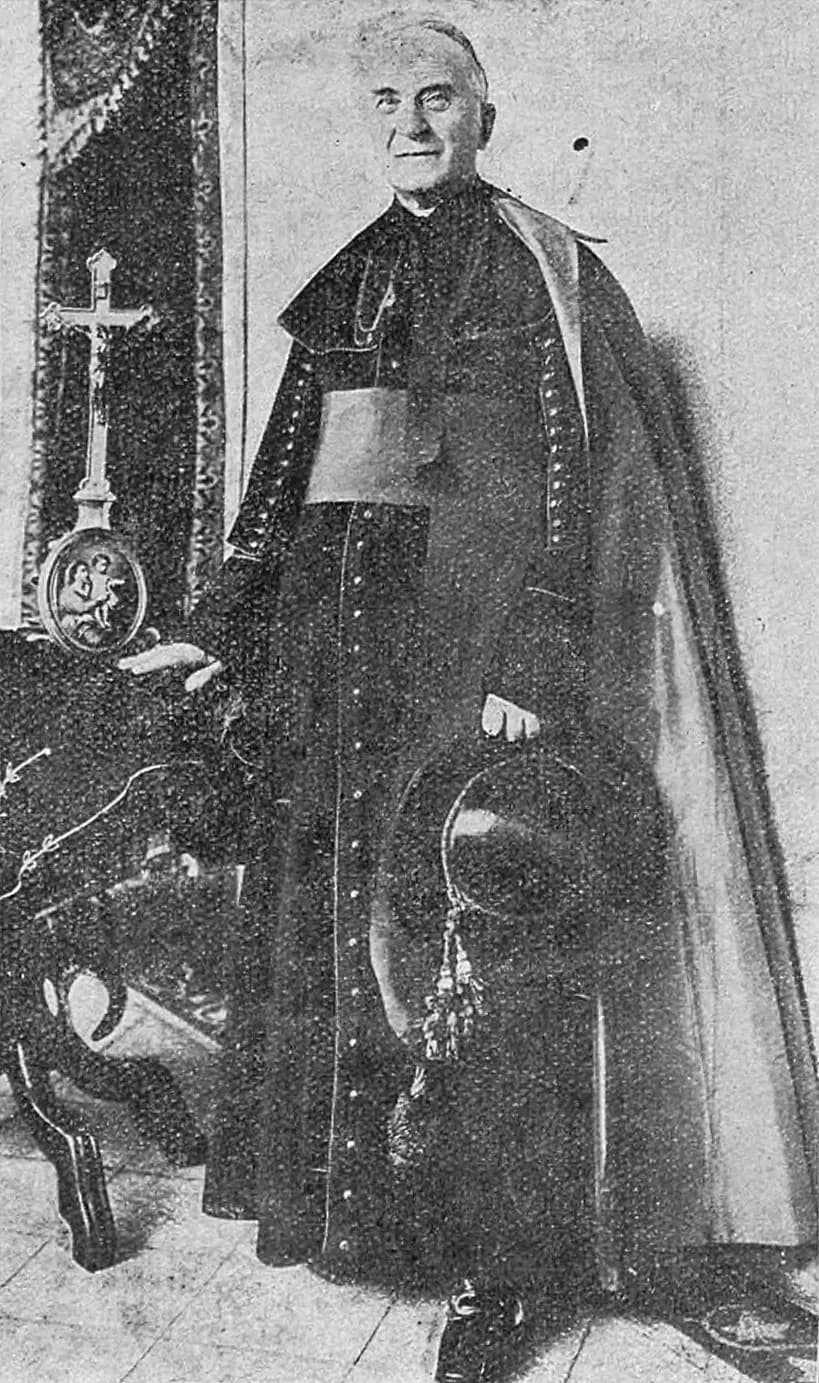
- Baptized
- January 19, 1842, in the parish church at Korczyna 4
- Founded
- The Congregation of the Sister Servants of the Most Sacred Heart of Jesus, Krakow, April 15, 1894 14
- Invoked as
- "The saint of difficult decision making," in Poland, according to Catholic Exchange 5
Saint Józef Sebastian Pelczar was a Polish priest who taught theology for three decades, served a year as rector of the Jagiellonian University in Krakow, founded a congregation of sisters in 1894 and spent the last twenty-five years of his life as Bishop of Przemyśl. 1 John Paul II, canonizing him in 2003, said he "lived out this conviction as priest, teacher and Bishop," the conviction being that holiness is open to everyone. 2 His own words, as the Pope quoted them: "No condition, no age is an obstacle to a perfect life." 2
Korczyna and Rzeszów
He was born on January 17, 1842, in Korczyna, a small town in Poland, and grew up there, the Holy See biography says, "in an atmosphere of traditional Polish piety." 1 His congregation's chronology names his parents as Wojciech and Marianna Pelczar, née Miesowicz, and records that he was baptized in the parish church on January 19, the vigil of Saint Sebastian. 4 It adds that in September 1841, before he was born, his mother made a pilgrimage to the Marian shrine at Lezajsk and offered him to Our Lady there. 4
After two years at the local primary school, his parents saw that he was unusually able and sent him on to school in Rzeszów. 1 The chronology dates his move there to September 1850. 4 He decided while still a student to give himself to God, and the Holy See biography quotes his diary: "Earthly ideals are fading away. I see the ideal of life in sacrifice, and the ideal of sacrifice in priesthood." 1
The decision did not come all at once. Catholic Exchange, in an article by one of the sisters of his congregation, says he struggled early on between becoming a professor of history and becoming a priest, and after that between the diocesan priesthood and the Jesuits. 5 He entered the minor seminary after the sixth grade at the Rzeszów academy, and in 1860 began theology at the major seminary of Przemyśl. 1
Rome, and a professor's career
He was ordained a priest on July 17, 1864, and spent a year and a half as a curate at Sambor. 14 In 1866 he was sent to Rome, where he studied at the Collegium Romanum, now the Gregorian University, and at the Institute of Saint Apollinaris, now the Lateran. 1 He came home with doctorates in theology and canon law. 1
Back in Poland he served briefly as a curate at Wojutycze and again at Sambor, and then taught at the major seminary of Przemyśl. 1 The Holy See biography gives his professorship there as 1869 to 1877; the congregation's chronology has him prefect of the seminary from October 1869 and professor from September 1870. 14 In 1877 he was appointed to the Jagiellonian University in Krakow, where he taught until 1899. 1
He became dean of the theology faculty, and the university made him its rector for 1882-83. 1 The Holy See biography says he had the reputation of "a wise and scholarly man, a competent organizer and a friend to young people." 1 The chronology also records a pilgrimage to the Holy Land in the spring of 1872, and his profession as a Franciscan tertiary at Assisi on April 18, 1893. 45
Libraries, servants and the poor
He did not keep to the lecture hall. He worked with the Saint Vincent de Paul Society, and for sixteen years he was president of the Society for the Education of the People. 1 In that time, the Holy See biography says, it set up hundreds of libraries, gave a great many free lectures, published and distributed more than a thousand books, and opened a school for servants. 1
In 1891 he founded the Fraternity of Our Lady, Queen of the Polish Crown, which besides its religious purpose cared for the poor, orphans, apprentices and servants, especially the sick and unemployed. 14 Catholic Exchange describes what came next: seeing that many young women coming in from the country to work as domestic help in Krakow were in moral danger, he set up kitchens and dormitories to receive them. 5
On April 15, 1894, he founded in Krakow the Congregation of the Sister Servants of the Most Sacred Heart of Jesus. 14 Catholic Exchange and the congregation name Blessed Klara Szczesna as its co-foundress. 35 He wanted the sisters, the Holy See biography says, to be signs and instruments of the love of the Heart of Jesus "for girls, for the sick and all people in need." 1 Catholic Exchange quotes what he wrote about taking it on: "May the Lord forgive my boldness, because until now the founders of religious orders have been saints, but I can be somewhat justified, because in the strange course of events, I saw God's will." 5
Bishop of Przemyśl
He was named auxiliary bishop of Przemyśl in 1899, and when Bishop Łukasz Solecki died in 1900 he succeeded him. 14 The chronology dates his appointment to February 27, 1899, his consecration by Solecki to March 19, and his appointment as diocesan bishop to December 17, 1900. 4 In August 1901, on a pilgrimage to Paray-le-Monial and Lourdes, he dedicated the diocese to the Sacred Heart of Jesus. 4
His health was poor, the Holy See biography says, and he worked anyway. 1 He visited his parishes regularly, paid particular attention to the moral and intellectual formation of his clergy, and saw the number of churches and chapels grow. 1 Despite "the unfavorable political circumstances of the times," he held three diocesan synods, which the chronology dates to 1902, 1908 and 1914. 14 He opened nurseries, soup kitchens, homeless shelters and schools for poor country girls, and helped poor seminarians with their tuition. 1 He sympathized with workers who were treated unjustly and with those forced to emigrate for want of work, and he pressed for the social teaching of Leo XIII to be put into practice. 1
He also wrote a great deal: theology, history, canon law, pastoral letters, sermons, prayer books and textbooks. 1 The sisters' congregation received papal approval on December 17, 1909, and final approval of its constitutions on January 30, 1923. 4
His motto and his death
The sources give his motto two ways. John Paul II quoted it as "All for the Most Sacred Heart of Jesus through the immaculate hands of the Most Blessed Virgin Mary"; Catholic Exchange gives it as "All for God alone." 25 The Pope dwelt on his love of the Eucharist, quoting him: "It was His love that invented this miracle of miracles, instituting the Most Holy Sacrament." 2
On March 19, 1924, he marked the twenty-fifth anniversary of his consecration as a bishop. 4 Catholic Exchange says he caught pneumonia during those celebrations, and he died on March 28. 145 At his funeral, the Holy See biography records, his former student and successor in the theology department, Father Antoni Bystrzonowski, spoke of "his tireless pastoral zeal" and "a truly youthful enthusiasm." 1
His cause was opened on June 28, 1954. 4 John Paul II beatified him at Rzeszów on June 2, 1991, and canonized him in Rome on May 18, 2003, together with Ursula Ledóchowska, Maria De Mattias and Virginia Centurione Bracelli. 124 His relics rest in the cathedral at Przemyśl. 1
What is Saint Józef Sebastian Pelczar the patron saint of?
None of the sources consulted names a formal patronage for him, so this page does not claim one. 123 Catholic Exchange says that in Poland he is hailed as "the saint of difficult decision making" and invoked as such, because of his own long discernment between scholarship, the diocesan priesthood and the Jesuits. 5 His congregation's litany likewise addresses him as "Patron of right decisions of life." 3 Those are devotional titles from his own religious family, and they are reported here as that.
In the canonization homily John Paul II commended him to three groups in particular: the Sister Servants of the Most Sacred Heart of Jesus, the Church of Przemyśl, and "all believers in Poland and throughout the world." 2
Saint Józef Sebastian Pelczar's feast day
His feast is January 19. The Holy See biography published for his canonization says so, and so do his congregation and Catholic Exchange. 135 The congregation's chronology gives January 19, 1842 as the day he was baptized. 4
He died on March 28, 1924. 14 No source consulted here prints March 28 as a feast, so this page gives it only as the day he died.
Praying with Saint Józef Sebastian Pelczar
The Holy See biography quotes a resolution he wrote in his diary as a schoolboy, and Catholic Exchange says that was not the end of his deciding: he still had to choose between a diocese and the Jesuits. 15 That is the basis on which Poles turn to him over hard decisions. 5 The sources do not say how he chose, only that he did, and that it took time.
Most of his life was spent in work that does not look like a saint's story: lectures, a dean's office, libraries for villages, synods and parish visits. 1 John Paul II's reading of it was that "in his service Christ himself was the Master," and that he believed what he wrote, that "no condition, no age is an obstacle to a perfect life." 2
His concern ran to particular people: girls arriving in Krakow to work as servants, poor seminarians who needed help with their tuition, workers treated unjustly, people forced to emigrate for want of work. 15 The sisters he founded were meant for girls, the sick and "all people in need," and the Holy See biography says he did this in spite of poor health. 1
Underneath it, John Paul II pointed to the Eucharist and to Mary. He quoted Pelczar saying that every person "must be struck with amazement" that Christ chose to live on earth with men, and said that this wonder led him to Mary, whom he loved with "the love he had learned in his family." 2
Saint Józef Sebastian Pelczar, pray for us.
Sources
- 1."Joseph Sebastian Pelczar (1842-1924), Bishop of Przemysl, Founder of the Sister Servants of the Most Sacred Heart of Jesus," biography published by the Holy See for the canonization of May 18, 2003.
- 2.John Paul II, Homily for the Canonization of Four New Saints (Joseph Sebastian Pelczar, Ursula Ledóchowska, Maria De Mattias and Virginia Centurione Bracelli), May 18, 2003.
- 3."St. Joseph Sebastian Pelczar," Sister Servants of the Most Sacred Heart of Jesus (American province), with the Office of Readings and litany for January 19.
- 4."Chronology of the Life of St. Joseph Sebastian Pelczar," Sister Servants of the Most Sacred Heart of Jesus (American province).
- 5.Sr. Mary Joseph Calore, SSCJ, "Burning With Love: St. Joseph Sebastian Pelczar," Catholic Exchange.
Saints to turn to next
Others in this collection who are turned to for some of the same things.
- Saint Bonaventure1217 or 1221 - July 15, 1274Study and teachingPrayerDiscernment
- Saint Brunoc. 1030 - October 6, 1101PrayerDiscernmentStudy and teaching
- Saint Gertrude the GreatJanuary 6, 1256 - November 17, 1302PrayerStudy and teachingDiscernment
- Saint Jadwiga of Poland1373 - July 17, 1399Study and teachingDiscernmentPrayer